Wayground logo

Free Printable Worksheets

Font size

S
M
L
XL
Worksheets

Functions & Transformations

Total questions: 65

Worksheet time: 1hrs 12mins

Name
Class
Date
1.
Which transformation maps the graph of
f(x) = x2 to the graph of g(x) = (x + 4)2?
a)
a translation shifting f(x) 4 units up
b)
a translation shifting f(x) 4 units down
c)
a translation shifting f(x) 4 units to the left
d)
a translation shifting f(x) 4 units to the right
2.
Which transformation will occur if f(x) = x2 is replaced with 2⋅f(x)?
a)
Vertical Compression by a factor of 2
b)
Vertical Stretch by a factor of 2
c)
Vertical translation up by 2 units.
d)
Reflection across the x-axis.
3.
Which transformation will occur if f(x) = x2 is replaced with 1/2⋅f(x)?
a)
Vertical Compression by a factor of 1/2
b)
Vertical Stretch by a factor of 1/2
c)
Vertical translation up by 2 units.
d)
Reflection across the x-axis.
4.
Which transformation will occur if f(x) = x2 is replaced with f(x) + 2?
a)
Translation left 2 units
b)
Narrower
c)
Vertical translation up by 2 units.
d)
Reflection across the x-axis.
5.
Describe the transformation of y = f(x) for the new function
 y = f(x) - 5
a)
The graph of y = f(x) was shifted to the right 5 units. 
b)
The graph of y = f(x) was shifted to the left 5 units. 
c)
The graph of y = f(x) was shifted up 5 units. 
d)
The graph of y = f(x) was shifted down 5 units.
6.
Describe the transformation of y = f(x) for the new function
 y = 5f(x)
a)
The graph of y = f(x) compressed horizontally by a factor of 1/5
b)
The graph of y = f(x) was stretched horizontally by a factor of 5
c)
The graph of y = f(x) was compressed vertically by a factor of 1/5
d)
The graph of y = f(x) was stretched vertically by a factor of 5
7.
Describe the transformation of y = f(x) for the new function
 y = - f(x)
a)
The graph of y = f(x) was flipped vertically across the x axis. 
b)
The graph of y = f(x) was flipped horizontally across the y axis.
c)
The graph of y = f(x) was shifted down.
d)
The graph of y = f(x) was shifted up
8.
Describe the transformation of y = f(x) for the new function
 y = f(- x)
a)
The graph of y = f(x) was flipped vertically across the x axis. 
b)
The graph of y = f(x) was flipped horizontally across the y axis.
c)
The graph of y = f(x) was shifted down.
d)
The graph of y = f(x) was shifted up
9.
Describe the transformation of y = g(x) for the function
y = 3g(x - 3) + 5
a)
Shifted up 5 units
Shifted right 3 units
Stretched vertically by a factor of 3
b)
Shifted up 5 units
Shifted left 3 units
Stretched vertically by a factor of 3
c)
Shifted down 5 units
Shifted left 3 units
Stretched vertically by a factor of 3
d)
Shifted down 5 units
Shifted left 3 units
Stretched vertically by a factor of 1/3
10.
Which equation describes the transformation of shifting f(x)=x3 seven units up?
a)
x3+7
b)
x3-7
c)
(x-7)3
d)
(x+7)3
11.
Which equation describes the transformation of shifting f(x)=x3 four units down?
a)
x3+ 4
b)
x3- 4
c)
(x - 4)3
d)
(x + 4)3
12.
. 
If the blue is f(x)=x2, then the red must be
a)
g(x)=x2-5
b)
g(x)=x2+5
c)
g(x)=(x-5)2
d)
g(x)=(x+5)2
13.
. 
If the blue is f(x)=x2, the red must be
a)
g(x)=(x+3)2
b)
g(x)=(x-3)2
c)
g(x)=x2+3
d)
g(x)=x2-2
14.
What are the following transformations?
- f(x+2)
a)
reflection over the y axis and 2 units to the right
b)
reflection over the x axis and 2 units right
c)
reflection over the y axis and 2 units left
d)
reflection over the x axis and 2 units left
15.
What are the following transformations:
f(-x) - 4
a)
reflection over the x axis and 4 units right
b)
reflection over the x axis and 4 units down
c)
reflection over the y axis and 4 units right
d)
reflection over the y axis and 4 units down
16.
Which of the following transformations are present?
-2f(x - 1) + 2
a)
Shift 1 unit down
b)
Shift 1 unit up
c)
Shift 1 unit left
d)
Shift 1 unit right
17.
What is the equation of this graph?
a)
f(x) = (x + 2)2 - 3
b)
f(x) = (x - 2)2 - 3
c)
f(x) = |x + 2| - 3
d)
f(x) = |x - 2| - 3
18.
What is the equation of the graph?
a)
y = √(x - 3)
b)
y = √(x) + 3
c)
y = √(x - 5) + 4
d)
y = √(x + 5) + 4
19.
Which equation represents this graph.
a)
f(x)=(x - 4)2 - 3
b)
f(x)=-(x - 4)2 + 3
c)
f(x)=(x - 4)2 + 3
d)
f(x)=-(x + 4)2 + 3
20.

Match the equation to its description.

a)

Right 2 and up 2

b)

Left 2 and up 2

c)

Right 2 and down 2

d)

Left 2 and down 2

21.

Which transformation will occur when  g(x)=2f(x)g\left(x\right)=2f\left(x\right)  ?

a)

Vertical stretch by a factor of 2

b)

Vertical compression by a factor of 1/2

c)

Horizontal stretch by a factor of 2

d)

Horizontal compression by a factor of 1/2

22.

What does the transformation g(x) = f(x+1)g\left(x\right)\ =\ f\left(x+1\right) do to the graph of  f(x)f\left(x\right) ?

a)

translates it left one unit 

b)

translates it right one unit 

c)

translates it up one unit 

d)

translates it down one unit

23.

If the graph of  f(x)=xf\left(x\right)=x  is translated 7 units up and is horizontally compressed by a factor of  13\frac{1}{3} , what is the function  g(x)g\left(x\right) ?

a)

 g(x)=13x+7g\left(x\right)=\frac{1}{3}x+7  

b)

 g(x)=3x+7g\left(x\right)=3x+7  

c)

 g(x)=3x+21g\left(x\right)=3x+21  

d)

 g(x)=13x+73g\left(x\right)=\frac{1}{3}x+\frac{7}{3}  

24.

Perform the following sequence of transformations on  f(x)=2x+9f\left(x\right)=2x+9 to get  g(x)g\left(x\right)  .


translate left 3, reflect in the x-axis, horizontally stretch by a factor of 4, translate up 5, vertically compress by 1/2

a)

 g(x)=−14x+1g\left(x\right)=-\frac{1}{4}x+1  

b)

 g(x)=−14x+10g\left(x\right)=-\frac{1}{4}x+10  

c)

 g(x)=−4x−5g\left(x\right)=-4x-5  

d)

 g(x)=−14x−5g\left(x\right)=-\frac{1}{4}x-5  

25.
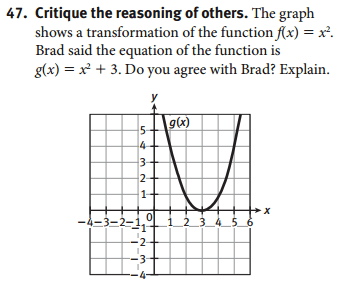
a)
Yes, "+3" on the end of the function moves the function to the right 3 units
b)
No, "+3" on the end of the function moves the function to the left 3 units
c)
No, "+3" on the end of the function moves the function to the down 3 units
d)
No, "+3" on the end of the function moves the function to the up 3 units
26.
Describe the transformation
a)
left 2 up 5
b)
right 2 up 5
c)
left 2 down 5
d)
right 2 down 5
27.
Which equation is an absolute value graph shifted right 5 units?
a)
y = |x - 5|
b)
y = |x + 5|
c)
y = |x| + 5
d)
y = -5|x|
28.
a)
y = Ix + 2I - 1
b)
y = -Ix + 2I - 1
c)
y = -Ix - 2I - 1
d)
y = -Ix + 1I - 2
29.
Tell how the function transformed from y =|x|
y = -2|x|
a)
Translated left 2 units
b)
Reflected over x-axis
c)
Stretched vertically and reflected over x-axis
d)
Compressed vertically and reflected over the x-axis
30.

Describe the transformation from the parent graph

a)

Reflect over x, right 3, down 4

b)

Reflect over y, right 3, down 4

c)

Reflect over x, right 3, up 4

d)

Reflect over y, left 3, down 4

31.
What shifts have occurred?
a)
left 1, up 5
b)
left 1, down 5
c)
right 1, down 5
d)
right 1, up 5
32.
Describe the parent graph transformation
a)
stretch by 1/2, left 1, down 3
b)
stretch by 1/2, right 1, down 3
c)
compression by 1/2, left 1, down 3
d)
compression by 1/2, right 1, down 3
33.
What type of function is shown?
a)
cube root
b)
square root
c)
logarithm
d)
exponential
34.
What type of function is shown?
a)
linear
b)
quadratic
c)
square root
d)
absolute value
35.
What is the equation of the PARENT  function?
a)
f(x) = 2x
b)
f(x) = x3
c)
f(x) = |x|
d)
f(x) = x
36.
Which parent function matches the graph?
a)
y = |x|
b)
y = x
c)
y = x2
d)
y = 2x
37.
What type of function is shown?
a)
absolute value
b)
quadratic
c)
linear
d)
exponential
38.
What type of function is shown?
a)
linear
b)
quadratic
c)
square root
d)
absolute value
39.
Name the parent function.
a)
linear
b)
quadratic
c)
cube root
d)
cubic
40.
Name the parent function. 
a)
constant
b)
square root
c)
linear
d)
absolute value
41.
Which equation below is a quadratic function translated up 5 units?
a)
y = x2 + 5
b)
y = (x + 5)2
c)
y = 5x2
d)
y = -x2 - 5
42.
What type of function is shown?
a)
cube root
b)
square root
c)
logarithm
d)
exponential
43.

Which transformations are involved in the equation  y=12x+1−1y=\frac{1}{2}\sqrt{x+1}-1  ?

a)

Horizontal translation left

b)

Vertical shrink

c)

Vertical translation down

d)

Horizontal translation right

e)

Vertical stretch

44.

If  f(x)=a(x−h)2+kf\left(x\right)=a\left(x-h\right)^2+k  has a horiz. shift of -2, a vert. shift of 3 and a vert. stretch of 4, what is the equation for  f(x)f\left(x\right)  ?

a)

 f(x)=4(x+2)2+3f\left(x\right)=4\left(x+2\right)^2+3  

b)

 f(x)=4(x−2)2+3f\left(x\right)=4\left(x-2\right)^2+3  

c)

 f(x)=3(x+2)2+4f\left(x\right)=3\left(x+2\right)^2+4  

d)

 f(x)=2(x−4)2+3f\left(x\right)=2\left(x-4\right)^2+3  

45.

What does the transformation f(x) → f(x+1)−9f\left(x\right)\ \rightarrow\ f\left(x+1\right)-9 do to the graph of  f(x)f\left(x\right)  ?

a)

translates it left one unit and down 9 units

b)

translates it right one unit and down 9 units

c)

translates it up one unit and right 9 units

d)

translates it down one unit and left 9 units

46.

What does the transformation f(x) → 13f(x)+4f\left(x\right)\ \rightarrow\ \frac{1}{3}f\left(x\right)+4 do to the graph of  f(x)f\left(x\right)  ?

a)

Shrinks the graph vertically by a factor of 1/3 and translates up 4 units.

b)

Stretches the graph by a factor of 3 and translates up 4 units.

c)

Translates the graph left 1/3 of a unit and up 4 units.

d)

Translates the graph right 3 unites and down 4 units.

47.

What family does the pictured graph belong to?

a)

Square root

b)

Linear

c)

Quadratic

d)

Absolute value

48.

Which of the following graphs is the Parent Function in the Quadratic Family?

a)
b)
c)
d)
49.

Which of the following graphs shows a "Reflection about the x-axis" from it's Parent Function?

a)
b)
c)
d)
50.

Which of the following graphs has the greatest Vertical Stretch?

a)
b)
c)
d)
51.

Based on the graph, determine the function in the blue. (Hint: it includes all 4 kinds of translation)

a)

y = -.5( x - 2 )2 - 1

b)

y = -2( x + 2 )2 - 1

c)

y = -2( x - 2 )2 + 1

d)

y = -2( x - 2 )2 - 1

52.
a)
horizontal shift to the right 4 and vertical shift down 2
b)
horizontal shift to the left 4 and vertical shift up 2
c)
horizontal shift to the right 4 and vertical shift up 2
d)
horizontal shift to the left 4 and vertical shift down 2
53.
a)
horizontal shift to the right 2 and vertical shift up 4
b)
horizontal shift to the right 2 and vertical shift down 4
c)
horizontal shift to the left 2 and vertical shift up 2
d)
horizontal shift to the left 2 and vertical shift down 2
54.
a)
horizontal shift to the left 2 and vertical stretch by a factor of 3
b)
horizontal shift to the right 2 and vertical stretch by a factor of 3
c)
horizontal shift to the right 2 and vertical compression by a factor of 3
d)
horizontal shift to the left 2 and vertical compression by a factor of 3
55.
If x=2 What is y?
a)
y= -3
b)
y= -6
c)
y=1
d)
y= 2
56.
If x is -8, what is y?
a)
y = -21
b)
y = 1
c)
y = 10
d)
y = 9
57.

f(x) = 2x-1 + 3 (Select ALL that apply!)

a)

Horizontal translation left

b)

Horizontal translation right

c)

Vertical translation up

d)

Vertical translation down

e)

Vertical stretch

58.

Find the equation of the transformed graph

a)

y=x2+3y=x^2+3

b)

y=(x+3)2y=\left(x+3\right)^2

c)

y= x2−3y=\ x^2-3

d)

y=(x−3)2y=\left(x-3\right)^2

59.

Find the equation of the transformed graph

a)

y=x2+3y=x^2+3

b)

y=(x+3)2y=\left(x+3\right)^2

c)

y= x2−3y=\ x^2-3

d)

y=(x−3)2y=\left(x-3\right)^2

60.

a)

y= ∣x∣ + 3y=\ \left|x\right|\ +\ 3

b)

y= ∣x∣− 3y=\ \left|x\right|-\ 3

c)

y= ∣x+3∣ y=\ \left|x+3\right|\

d)

y= ∣x−3∣y=\ \left|x-3\right|

61.

a)

y= ∣x∣ + 3y=\ \left|x\right|\ +\ 3

b)

y= ∣x∣− 3y=\ \left|x\right|-\ 3

c)

y= ∣x+3∣ y=\ \left|x+3\right|\

d)

y= ∣x−3∣y=\ \left|x-3\right|

62.

 y=x−2y=\sqrt{x-2}  

Which graph represents this transformed function

a)
b)
c)
d)
63.

 y=x−2y=\sqrt{x}-2  

Which graph represents this transformed function

a)
b)
c)
d)
64.

 y=3∣x∣y=3\left|x\right|  

Which graph represents this transformed function

a)
b)
c)
d)
65.

 y=−2∣x∣y=-2\left|x\right|  

Which graph represents this transformed function

a)
b)
c)
d)