Wayground logo

Free Printable Worksheets

Font size

S
M
L
XL
Worksheets

WILD Biologist Competition Quiz

Total questions: 40

Worksheet time: 20mins

Name
Class
Date
1.
What does every food chain start with? (Even if it's not drawn or written there!)
a)
producers
b)
sun
c)
consumer
d)
decomposers
2.
Consumer that eats plants
a)
heterotroph
b)
herbivore
c)
producer
d)
community
3.

Where an organism lives

a)

habitat

b)

niche

c)

biosphere

4.
As you move upward, from level to level, in an energy pyramid, energy _____.
a)
increases
b)
decreases
c)
stays the same
d)
increases exponentially
5.
 plants that convert energy from the sun
a)
decomposer
b)
primary consumer
c)
secondary consumer
d)
producer
6.

symbiotic relationship in which both organisms benefit

a)

competition

b)

mutualism

c)

predation

d)

commensalism

7.
An organism that gets energy from breaking down dead organisms, non-living material or waste
a)
producer
b)
consumer
c)
decomposer
d)
autotroph
8.

The job or role of a plant or an animal in the ecosystem.

a)

carnivore

b)

niche

c)

consumer

d)

habitat

9.
A relationship where one organism benefits and one organism is unaffected is called __________.
a)
mutualism
b)
commensalism
c)
parasitism
10.

What is the process of combining nitrogen gas with other elements to make nitrogen into usable compounds?

a)

nitrogen composition

b)

nitrogen fixation

c)

ammonia

d)

denitrification

11.

What is occurring at arrow #1?

a)

Evaporation

b)

Condensation

c)

Precipitation

d)

Runoff

12.

What are fossil fuels made from?

a)

Plants and animals that are buried underground for millions of years.

b)

They absorb it from the atmosphere.

c)

Water

d)

Wind

13.
TRUE or FALSE?
All of the carbon in existence is continually recycled in the carbon cycle.
a)
True
b)
False
14.

Why does too much carbon dioxide in the atmosphere cause climate change?

a)

It cools our planet.

b)

Blocks out UV rays.

c)

Lets light escape.

d)

Traps heat and warms the planet.

15.

Which of the following organisms DO NOT compete for the same food source?

a)

grasshoppers and rabbits

b)

hawks and blue jays

c)

owls and hawks

16.

What would happen if the snake population increased?

a)

the hawk population would increase

b)

the mouse population would increase

c)

the rabbit population would increase

d)

the hawk population would decrease

17.

What relationship best describes the relationship between the hare and the lynx?

a)

competition

b)

predator-prey

c)

parasitism

d)

mutualism

18.

Evolutionary history of a species or a group of related species:

a)

Phylogeny

b)

Taxonomy

19.

Phylogenetic trees are...

a)

Ancient trees found only in Africa

b)

Models that show evolutionary relationships

c)

Diagrams that map population distribution

d)

Models that represent an ecosystem

20.
New features that do not appear in fossils of ancestors.
a)
Derived traits
b)
Extinct
c)
Genetic Variation
d)
Species
21.

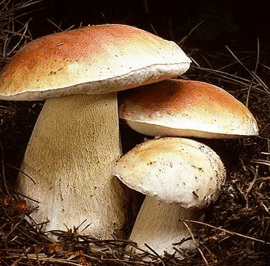
Which letter represents the most recent common ancestor of sponges and mushrooms?

a)

A

b)

B

c)

C

d)

D

e)

E

22.

Which organism goes in the A position?

a)
b)
c)
d)
23.
Most recently evolved trait?
a)
Amniotic egg
b)
Walking legs
c)
Jaws
d)
Hair
24.

Growth strategy that is stable, near carrying capacity

a)

K-selected

b)

r-selected

25.
What growth pattern describes a population whose growth rate slows or stops following a period of exponential growth?
a)
logistic growth
b)
population growth
c)
exponential growth
d)
predator-prey cycle
26.
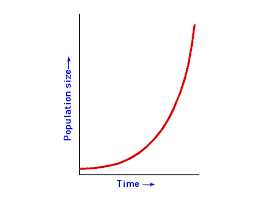
What type of growth is shown in the diagram?
a)
exponential growth
b)
logistic growth 
c)
predator-prey cycle
d)
boom-bust curve
27.
Largest number of individuals of a population that the environment can support...  
a)
carrying capacity
b)
population crash
c)
lag phase
d)
mutualism
28.

Which of the following would INCREASE the carrying capacity of an ecosystem?

a)

increase in predators

b)

disease

c)

increase in available food

d)

drought

29.

Where the better adapted organisms survive to pass traits along to offspring.

a)

Extinction

b)

Natural Selection

c)

Artifical Selection

30.

Why are advantageous traits more likely to be passed onto offspring?

a)

Because organisms with them are more likely to survive and reproduce.

b)

Because they come from dominant genes.

c)

Because the trait is an acquired trait.

31.

What word describes a trait that helps an organism survive in its environment?

a)

natural selection

b)

mutation

c)

fitness

d)

adaptation

32.
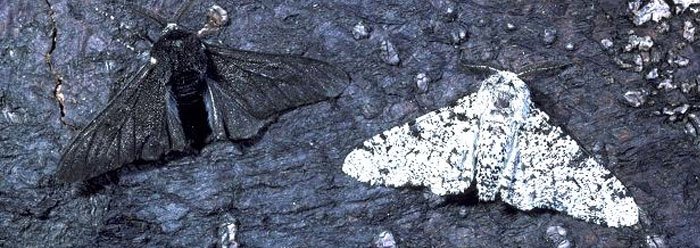
The trees these moths used to live on were white, but have been covered in soot from coal factories. Which moth will be more successful in this environment?
a)
Dark moth
b)
Light moth
c)
Both will be equally successful
d)
Neither will be successful
33.

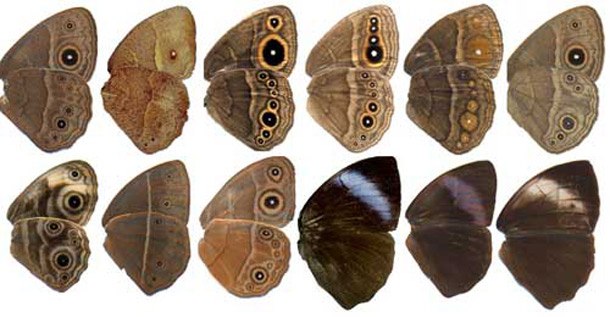
These moths are all the same species. The differences between their wings is an example of ________________

a)

Artificial selection

b)

Variation

c)

Homeostasis

d)

Extinction

34.
In recent years "SuperBugs" (bacteria that aren't effected by antibiotics) are becoming more and more common. How could natural selection explain this?
a)
Superbugs survive antibiotics and reproduce
b)
Antibiotics cause bacteria to become superbugs
c)
We have always had the same amount of superbugs; modern media just discusses them more.
d)
There is no reliable data on the origin of super bugs.
35.
Do organisms "decide" to evolve and change?
a)
Yes, they know they need to change to survive 
b)
No, they change because of natural selection
36.
Which of the following is a term for a group of similar organisms that can reproduce fertile offspring?
a)
individual
b)
population
c)
species
d)
fossil
37.
The term for the formation of new and distinct species over the course of evolution is...
a)
speciation
b)
biological species concept
c)
reproductive barrier
d)
natural selection
38.

The emergence of new rivers or streams is a type of ____________ isolation.

a)

Temporal

b)

Mechanical

c)

Behavioral

d)

Geographic

39.
An organism's ability to survive and reproduce in its environment refers to its
a)
Fitness
b)
Variation
c)
Selection
d)
Mutation
40.

What does the image represent?

a)

Gene flow

b)

Population drift

c)

Mutation

d)

Adaptation