wayground logo

Free Printable Worksheets

NEW

Font size

S
M
L
XL
Worksheets

Fossils & Rocks

Total questions: 29

Worksheet time: 26mins

Name
Class
Date
1.

Which Layer is the youngest?

a)

Layer X

b)

Layer Z

c)

Layer W

d)

Layer Y

2.

What can we learn from fossils?

a)

The effect of earthquakes

b)

How living things change over time.

c)

What animals will look like in the future

3.
Why might a seashell fossil be found in the middle of a desert?
a)
The fossil was moved there by an animal.
b)
The fossil was moved there by a human.
c)
The landscape changed over time.
d)
It was formed in the desert.
4.
Which layer or layers prove that this area was once covered by water?
a)
1
b)
2
c)
3
d)
2 and 3
5.
Which type of rock forms from extreme heat and pressure?
a)
Igneous
b)
Sedimentary
c)
Organic
d)
Metamorphic
6.
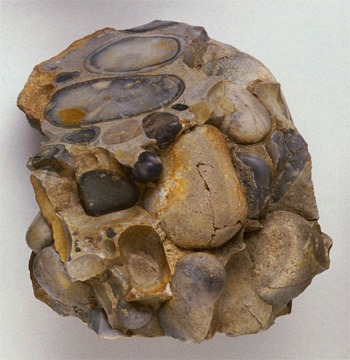
This rock was formed by smaller pieces of rock that settled at the bottom of a lake millions of years ago. What type of rock is this?
a)
Sedimentary
b)
Igneous
c)
Metamorphic
7.
Each rock type can follow only one pathway of the rock cycle.
a)
True
b)
False
8.
In what kind of rock can fossils be found?
a)
Sedimentary Rocks
b)
Igneous Rocks
c)
Metamorphic Rocks
d)
Granite
9.
States that younger rocks lie above older rocks if the layers have not been disturbed
a)
Law of crosscutting
b)
Law of superposition
c)
Relative Dating
d)
Unconformity
10.
Produced when sediments fill in a cavity made when an object decayed 
a)
cast
b)
mold
c)
original remains
11.
Cavity in a rock made when an organism decayed
a)
cast
b)
mold 
c)
original remains
12.
Remains, imprints or traces of once-living organisms
a)
water
b)
superposition
c)
fossils 
13.
People who study fossils are called ____.
a)
meterologists
b)
fossilologists
c)
paleontologists
d)
fossil hunters
14.
Which is not true about fossils?
a)
fossils are only animals remains
b)
fossils show the history of Earth
c)
Fossils can be found in sedimentary rock layers
d)
fossils can be traces of organisms footprints and body structure
15.

How are fossils created?

a)

Traces of organisms get turned into stone.

b)

Dead organisms are buried quickly and remsin undisturbed for millions of years.

c)

Animals get trapped in resin, tar, or ice.

d)

All of the above

16.

What happens when a species become extinct?

a)

All of its members have died.

b)

Only a few of its members are still living.

c)

The animals can no longer lay eggs.

d)

All of its members move to another place.

17.

Which type of fossil can tell you about the BEHAVIOR of ancient organisms? (ex. how they hunted, what kind of home they created, etc.)

a)

mold

b)

cast

c)

trace fossil

d)

preserved remains

18.
Which of the following is true about fossils?
a)
Fossils found in lower layers of  rock  are older than fossils found in upper layers of  rock.
b)
Fossils found in upper layers of  rock are older than fossils found in lower layers.
c)
The relative age of fossils cannot be determined from their position in rock layers
d)
Fossil found in lower layers are as old as fossil in the upper layers
19.
Dr Thakkar was studying a fossil from a dig in a desert when he noticed  that the organism had evidence of fins. What would the most likely tell Dr Thakkar?
a)
Sea animals used to live in deserts
b)
Nothing; every fossilized organism has fins
c)
the desert was once covered by water
d)
the organism grew legs when it wanted to leave the ocean
20.
Which of the following parts of an organism is most likely to become fossilized?
a)
lung
b)
heart
c)
skin
d)
tooth
21.

What does petrified mean?

a)

turned to stone

b)

turned to fire

c)

decompose

d)

turned to ashes

22.

What happens to insects when they become trapped in amber?

a)

they form molds

b)

they are preserved (they stay the same)

c)

they decay

d)

they form casts

23.

What type of fossil is this?

a)

Mold fossil

b)

Cast fossil

c)

True Form fossil

d)

Trace Fossil

24.

What kind of fossil is this?

a)

Mold Fossil

b)

Cast Fossil

c)

True Form Fossil

d)

Trace Fossil

25.

What kind of fossils are these?

a)

Mold fossils

b)

Cast fossils

c)

True Form fossils

d)

Trace fossils

26.

What kind of fossil is this?

a)

Mold fossil

b)

Cast fossil

c)

True Form fossil

d)

Trace fossil

27.

This kind of fossil leaves behind evidence of an animal's behavior or activity.

a)

Mold fossil

b)

Cast fossil

c)

Trace fossil

d)

True Form fossil

28.

According to the Law of Superposition, which layer formed first?

a)

Rock Layer W

b)

Rock Layer X

c)

Rock Layer Y

d)

Rock Layer Z

29.

What is rock strata?

a)

stacked up layers of sedimentary rock

b)

stacked up layers of metamorphic rock

c)

stacked up layers of igneous rock

d)

stacked up layers of meteorites