
NEW
Font size
 Worksheets
Earth's History
Total questions: 25
Worksheet time: 13mins
Index fossils are from widespread species that lived:
only recently
only in water
for a short time
only on land
Fossils provide good evidence for all of the following EXCEPT:
changes in Earth's surface
how Earth originally formed
how environments on Earth have changed over time
How groups of organisms have changed over time
Index fossils are useful because they tell the __________ of the rock layers in which they occur.
absolute age
apparent age
relative age
temporary age
Lava that hardens on Earth's surface is called a(n) ______________________.
unconformity
extrusion
intrusion
superposition
Fossils may form when dead organisms are _________.
buried slowly
exposed to microorganisms
made of hard parts, such as bones, shells, and teeth
composed of soft parts, such as muscles and tissues
A fault can be used to find the __________________of a group of rocks.
absolute age
radiometric age
indexed age
relative age

The footprints in the image is an example of what type of fossil?
original remains
petrified remains
trace fossil
mold / cast
carbon film

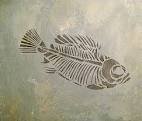
What type of fossil is in the image below? (Hint: this is an IMPRINT in the stone.)
original remains
petrified remains
trace fossil
mold / cast
carbon film

The item in the image used to be a part of a tree, but has been replaced by minerals. What type of fossil is in the image?
original remains
petrified remains
trace fossil
mold / cast
carbon film

A thin layer of an element was left behind by the organism in the fossil. What type of fossil is in the image?
original remains
petrified remains
trace fossil
mold / cast
carbon film

The insect has been trapped in amber. What type of fossil is in the image?
original remains
petrified remains
trace fossil
mold / cast
carbon film
What role do faults play in the Law of Superposition?
Faults create new types of rock.
Faults are younger than the layers they cut through.
Faults are the same age as the layers they cut through.
Faults are older than the layers they cut through.

The type of Earth material most likely to contain fossils is:
igneous rock
metamorphic rock
sedimentary rock
native material
Scientists find dinosaur fossils in the bottom rock layers of a cliff and mammal fossils in the middle rock layer of the cliff. Which could best be concluded from this evidence?
Dinosaurs ate plants.
Dinosaurs were eaten by the mammals.
Dinosaurs lived on Earth before the mammals.
Dinosaurs and mammals lived at the same time.

When two fish die, Fish A sinks to the bottom of a lake and Fish B washes up on the rocky lake shore.
Why is a fossil more likely to form from the body of Fish A than from the body of Fish B?
Soft parts of the fish will decay more quickly in the water.
Sediments in the water will quickly cover the fish
Scavengers in the water will eat the remains of the fish.
Currents in the water will move the fish.
What are strata?
inconsistencies in the fossil record
rock layers
well-known and widespread fossils
units of time

This trilobite fossil is 289 million years old. This is an example of
absolute age
relative age
temporary age
uniform age

Use the image to determine which material is older.
tan sandstone
brown sandstone
Use the image to determine which material is older.
snail fossil
dinosaur bone
Use the image to determine which material is older.
granite intrusion
gray shale
Use the image to determine which material is older.
tan limestone
tan sandstone
Use the image to determine which material is older.
dinosaur bone
red sandstone

