wayground logo

Free Printable Worksheets

NEW

Font size

S
M
L
XL
Worksheets

revision 1

Total questions: 33

Worksheet time: 33mins
Name
Class
Date
1.
How do we characterize an air mass that forms over the ocean?
a)
Dry
b)
Wet
c)
Cold
d)
Warm
2.
How do we characterize an air mass that forms near the poles?
a)
Dry
b)
Wet
c)
Warm
d)
Cold
3.
How do we characterize an air mass that forms over near the equator?
a)
Dry
b)
Wet
c)
Cold
d)
Warm
4.
How do we characterize an air mass that forms over land?
a)
Dry
b)
Wet
c)
Cold
d)
Warm
5.
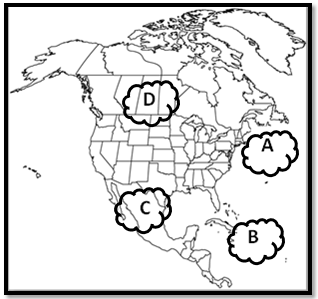
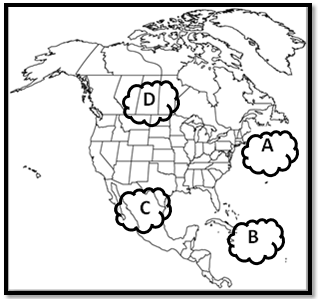
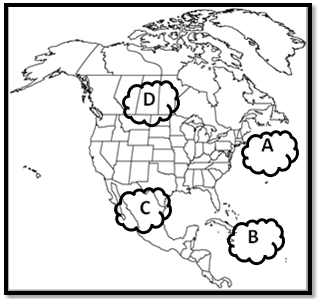
Which type of air would you find at air mass A?
a)
cold, dry
b)
warm, humid
c)
warm, dry
d)
cold, humid
6.
Which type of air would you find at air mass B?
a)
cold, dry
b)
warm, humid
c)
warm, dry
d)
cold, humid
7.
Which type of air would you find at air mass D?
a)
cold, dry
b)
warm, humid
c)
warm, dry
d)
cold, humid
8.
Air travels
a)
from high pressure to low pressure
b)
from low pressure to high pressue
9.
What types of air masses would be warmer?
a)
Maritime
b)
Continental
c)
Polar
d)
Tropical
10.
What types of air masses would be colder?
a)
Maritime
b)
Continental
c)
Polar
d)
Tropical
11.
What types of air masses form over land?
a)
Maritime
b)
Continental
c)
Polar
d)
Tropical
12.
What types of air masses form over oceans?
a)
Maritime
b)
Continental
c)
Polar
d)
Tropical
13.
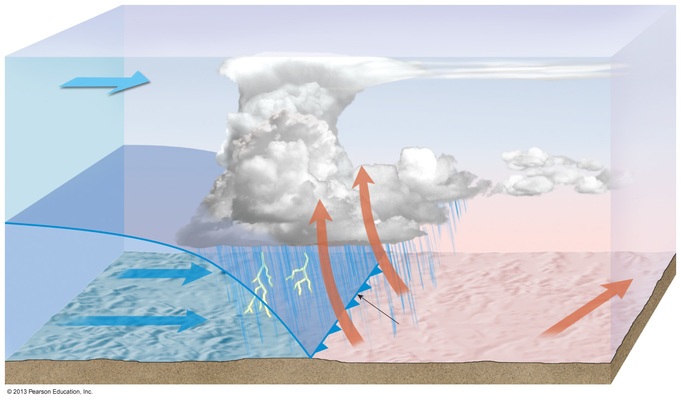
Rapidly moving cold air mass runs into a warm air mass the cold air slides under the warm air. This is called a  .....
a)
cold front
b)
warm front
c)
stationary front
14.
When a warm air mass gently slides on top of a cold air mass, and you have drizzly rain and then warmer weather, what type of front is it?
a)
warm front
b)
cold front
c)
occluded front
d)
stationary front
15.
What type of storm front is this? 
a)
warm front
b)
cold front
c)
stationary front
d)
occluded front
16.

The symbol on a weather map for a cold front is what?

a)

a blue line with triangles on it

b)

a blue line with semi-circles on it

c)

a red line with triangles on it

d)

a red line with circles on it

17.
This is the symbol for a(n) _______________
a)
warm front
b)
cold front
c)
stationary front
d)
occluded front
18.

The symbol on a weather map for a warm front is what?

a)

a blue line with triangles on it

b)

a blue line with circles on it

c)

a red line with semi-circles on it

d)

a red line with circles on it

19.
A front is
a)
where warm air is cooling at earth's surface
b)
a line where hot and cold air are separating
c)
a line where two different air masses meet
d)
where cold air is rising and forming rain clouds
20.
A cold front usually brings what kind of weather?
a)
snow  
b)
sunny and fair
c)
rain and/or thunderstorms 
d)
 cool and dry 
21.
When a cold front or a warm front stays in place for several days without invading another front, it is called a ______. 
a)
stationary front 
b)
 cold front 
c)
occluded front
d)
warm front 
22.
6. Air masses develop because the Earth is heated unevenly.
a)
True
b)
False
23.
What type of weather does a high pressure system bring?
a)
Stormy weather
b)
Clear skies, little rain
24.
4. An air mass is...
a)
A body of air with the same temperature and moisture throughout.
b)
a body of air that produces rain
c)
A body  of evaporated water
d)
the weight of air
25.

What type of front is shown?

a)

Warm Front

b)

Cold Front

c)

Occluded Front

d)

Stationary Front

26.

What type of front is shown?

a)

Warm Front

b)

Cold Front

c)

Occluded Front

d)

Stationary Front

27.

What type of front is shown?

a)

Warm Front

b)

Cold Front

c)

Occluded Front

d)

Stationary Front

28.

What type of front is shown?

a)

Warm Front

b)

Cold Front

c)

Occluded Front

d)

Stationary Front

29.

How does the air in this type of front move?

a)

Warm air slowly moves over cold air

b)

Warm air rapidly moves up when meeting cold air

c)

Warm air is trapped between two colder air masses

d)

Warm air meets cold air and cannot move

30.

How does the air in this type of front move?

a)

Warm air slowly moves over cold air

b)

Warm air rapidly moves up when meeting cold air

c)

Warm air is trapped between two colder air masses

d)

Warm air meets cold air and cannot move

31.

How does the air in this type of front move?

a)

Warm air slowly moves over cold air

b)

Warm air rapidly moves up when meeting cold air

c)

Warm air is trapped between two colder air masses

d)

Warm air meets cold air and cannot move

32.

How does the air in this type of front move?

a)

Warm air slowly moves over cold air

b)

Warm air rapidly moves up when meeting cold air

c)

Warm air is trapped between two colder air masses

d)

Warm air meets cold air and cannot move

33.

What type of weather does this front bring?

a)

Cloudiness and light precipitation; warm and mild weather follows

b)

Thunderstorms can occur; cool, fair weather follows

c)

Many days of clouds and precipitation

d)

Temperature drops; strong winds and heavy precipitation