wayground logo

Free Printable Worksheets

NEW

Font size

S
M
L
XL
Worksheets

Redox & Voltaic Cells

Total questions: 26

Worksheet time: 26mins

Name
Class
Date
1.
Another name for a "oxidation-reduction" reaction is
a)
chemical reaction
b)
neutralization reaction
c)
redox reaction
d)
nuclear reaction
2.
If an atom loses electrons during a chemical reaction, the atom was:
a)
Oxidized
b)
Reduced
c)
Neutralized
d)
Precipitated
3.

Reduction is the ___________ of electrons.

a)

loss

b)

gain

c)

sharing

d)

transfer

4.
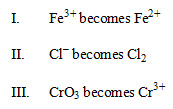
Which are examples of reduction?
a)
I and II
b)
I and III
c)
II and III
d)
I, II and III
5.

Which half-reaction correctly represents reduction?

a)

Ag --> Ag+ + e-

b)

F2 --> 2 F- + 2e-

c)

Au3+ + 3e- --> Au

d)

Fe2+ + e- --> Fe3+

6.

Which energy conversion shown below takes place in a voltaic cell?

a)

Electrical to chemical

b)

Mechanical to chemical

c)

Mechanical to electrical

d)

Chemical to electrical

7.
Reactions in voltaic cells are
a)
spontaneous, redox reactions
b)
non-spontaneous, redox reactions
c)
spontaneous, non-redox reactions
d)
non-spontaneous, non-redox reactions
8.
Reduction happens at the 
a)
anode
b)
cathode
c)
salt bridge
d)
voltmeter
9.
Oxidation happens at the
a)
anode
b)
cathode
c)
salt bridge
d)
voltmeter
10.
This electrode in a voltaic cell gains mass
a)
anode
b)
cathode
11.
This electrode loses mass 
a)
anode
b)
cathode
12.
In a voltaic cell, the salt bridge is necessary for
a)
the movement of electrons to create a current
b)
the movement of ions to create a current
c)
the movement of electrons to maintain the neutrality of solution
d)
the movement of ions to maintain the neutrality of solution
13.
Which statement is correct when the cell produces electricity?
a)
Magnesium atoms lose electrons
b)
Mass of the iron electrode decreases.
c)
Electrons flow from the iron half-cell to the magnesium half-cell.
d)
Negative ion flow from magnesium half-cell to iron half-cell
14.
Metal A is more reactive than metal B. Which statement is correct?
a)
Electrons flow in the external circuit from A to B
b)
Positive ions flow through salt bridge from A to B
c)
Positive ions flow in external circuit from B to A.
d)
Electrons flow through salt bridge from B to A
15.
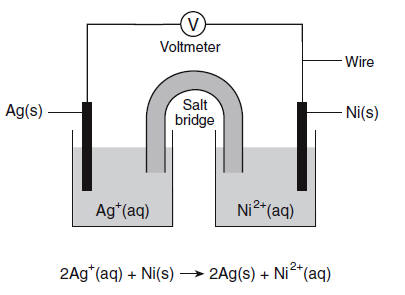
What reaction occurs at the anode?
a)
Ag+ + e- →Ag
b)
Ag → Ag+ + e-
c)
Ni2+ + 2e- → Ni
d)
Ni → Ni2+ + 2e-
16.
Voltaic cells are the same as which cells?1
a)
GALVANIC
b)
ELECTROLYTES
c)
ELECTRON
17.
If in a reaction, copper is reduced; its number of electrons has:
a)
Increased
b)
Decreased
c)
Remained Constant
d)
Varies Randomly
18.

What is a half-reaction?

a)

It is a reaction at equilibrium where half of the substances are reactants and half of the substances are products.

b)

It is the reaction that occurs when the switch of a galvanic cell is open.

c)

It shows EITHER the reduction component or the oxidation component of a redox reaction.

d)

It shows BOTH the reduction and oxidation components of a redox reaction.

19.

What is an anode?

a)

It is the electrode where oxidation takes place.

b)

It is the electrode where reduction takes place.

c)

It is an aqueous solution containing an electrode.

d)

It is the salt bridge that connects half-cells.
20.

What is a cathode?

a)

It is the electrode where oxidation takes place.

b)

It is the electrode where reduction takes place.

c)

It is an aqueous solution containing an electrode.

d)

It is the salt bridge that connects half-cells.

21.
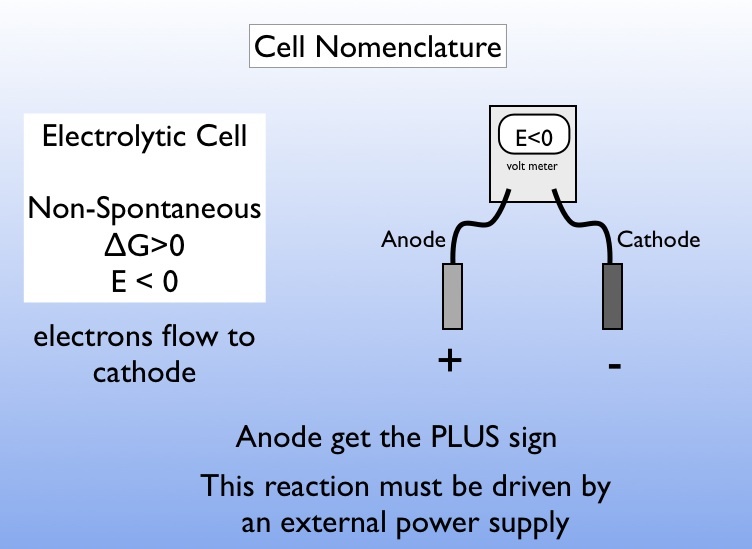
What is an electrolytic cell? 
a)
a cell that converts chemical energy into electrical energy 
b)
a cell that converts electrical energy into electrical energy 
c)
a cell that converts electrical energy into chemical energy 
d)
A cell that converts kinetic energy into potential energy. 
22.

The reaction is non-spontaneous in ...

a)

A Galvanic/ Voltaic Cell

b)

A Electrolytic Cell

c)

Both Galvanic and Electrolytic cells

23.

Which of the following reactions would be spontaneous?

a)

3Ag + Al3+ --> 3Ag+ + Al

b)

Pb + Cr2+ --> Pb2+ + Cr

c)

Ni2+ + Zn --> Zn2+ + Ni

d)

Cd + 2Na+ --> 2Na + Cd2+

24.

Which of the following reactions is spontaneous?

a)

Cu + Cd2+ --> Cu2+ + Cd

b)

Fe2+ + Cr --> Cr2+ + Fe

c)

Ni + Mg2+ --> Mg + Ni2+

d)

Al + 3Li+ --> 3Li + Al3+

25.

Which of the following reactions is non-spontaneous?

a)

Fe + Cr2+ --> Fe2+ + Cr

b)

Ag+ + Na --> Na+ + Ag

c)

Sn2+ + Zn --> Zn2+ + Sn

d)

2H+ Mg --> Mg2+ + H2

26.

Which of the following reactions is non-spontaneous?

a)

2Au3+ + 3Ni --> 2Au + 3Ni2+

b)

Pb2+ + Zn --> Pb + Zn2+

c)

Cu2+ + Fe --> Fe2+ + Cu

d)

Hg + Cr2+ --> Cr + Hg2+