
NEW
Font size
 Worksheets
Topic 9 Simple Harmonic Motion (SHM)
Total questions: 40
Worksheet time: 40mins
Which is NOT true of a simple harmonic motion ?
The acceleration is always constant.
The period of oscillation is always constant.
The acceleration is directly proportional to the displacement from the equilibrium position
The resultant force is directly proportional to the displacement from the equilibrium position.
A mass on a spring undergoes SHM. The maximum displacement from the equilibrium is called......... and the time required to complete one cycle is called ......................
displacement ; frequency
amplitude ; period
amplitude ; frequency
displacement ; period
In SHM motion, velocity at equilibrium position is
constant
maximum
minimum
zero
A body executes simple harmonic motion (SHM). The potential energy (U), the kinetic energy (K) and total energy (E) are measured as a function of displacement x. Which of the following statements is TRUE ?
Potential energy, U is maximum when x = 0
Kinetic energy, K is maximum when x = 0
Total energy E is zero when x = 0
Kinetic energy, K is maximum when x is maximum.
The period of oscillation of a pendulum depends on all the following factors EXCEPT
mass of the bob.
length of the string.
gravitational acceleration
pendulum initial angular displacement
A mass on a spring undergoes SHM. When the mass is at its maximum displacement from equilibrium, its instantaneous velocity
is maximum
is less than maximum but not zero
is zero
cannot be determined from the information given
A mass is attached to a vertical spring and bobs up and down between point A and B. Where is the mass located when its kinetic energy is zero?
at either A or B
midways between A and B
one fourth of the way between A and B
none of above
When the mass of a simple pendulum is tripled, the time required for one complete oscillation
increased by a factor of 3
does not change
decreases to one third of its original value
None of the above
A mass oscillates on the end of a spring performs SHM, both on Earth and on the Moon. Where is the period the greatest ?
Earth
Moon
same on both Earth and Moon
can not be determined from the information given.
The time required to complete one oscillation is called
Period
Frequency
Amplitude
Vibration
The force which opposes the applied force producing the displacement in a spring that tends to bring the system back to equilibrium is called
Periodic force
centripetal force
Resistive force
Restoring force
Distance covered during one oscillation of a object performs simple harmonic motion in term of amplitude A is
A / 2
A
2A
4A
In simple harmonic motion
Potential energy remains constant
Kinetic energy remains constant
Total energy remain constant
Total momentum remain constant
Angular velocity of body attached with horizontal mass spring system is given by
ω=mk
ω=mk
ω=mk
ω=mk
For a system undergoes simple harmonic motion, which of the following terms represent the number of cycles or oscillations in one second?
amplitude
period
frequency
revolution
SI unit for angular velocity is
radian
radian per second
Herts
meter
If f is frequency of a body executing SHM, its angular frequency ω is
4πf
3πf
2πf
πf
In SHM, the restoring force is directly proportional to
velocity
acceleration
Displacement
Time period
The expression for instantaneous displacement of particle executing SHM is
a=−ω2x
x=Asinωt
F=kx
All of above
An object undergoes SHM has a maximum acceleration when its displacement from equilibrium is
Maximum
Zero
Half of the maximum value
One third of the maximum value
The phase
ωt of SHM describesDisplacement only
Direction of motion only
Both displacement and direction of motion
Neither displacement nor direction of motion
What are the two requirements for a simple harmonic oscillator?
The object vibrates about the equilibrium point and the restoring force is proportional to the displacement
The object moves left to right and the restoring force is proportional to the displacement
The object vibrates about the equilibrium and the restoring force is greater than the displacement
The object moves left to right and the restoring force is greater than the displacement
Potential energy of a SHM system is maximum at
Amplitude
Equilibrium position
one fourth of amplitude
one third of amplitude
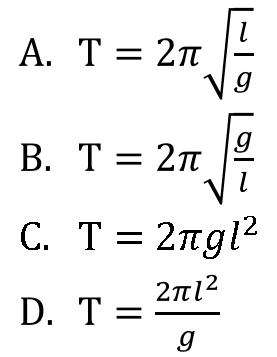
Based on your findings, which equation could best describe the pendulum’s period?
A
B
C
D
Which of the following equation represent the displacement of SHM:
x=Atanωt
x=Acoskxsinωt
x=Asin((ωt±kx))
x=Asinωt

An object is performing vertical SHM. X represents a position on its reference circle. Which point on the graph corresponds to X ?
A
B
A or B
C o D
For a simple harmonic oscillator, which of the following pairs of vector quantities CAN NOT both point in the same direction? (The position vector is the displacement from equilibrium.)
position & velocity
velocity & acceleration
position & acceleration
None of them.
Which of the following statement is TRUE about a particle that performs simple harmonic motion ?
it is in equilibrium at the center of its path due to zero acceleration.
It is in equilibrium at the ends of its path due to zero velocity.
There is a constant restoring force to sustain the motion.
The motion traces a circular path.
The amplitude of a system moving with simple harmonic motion is doubled. The total energy will then be
2 times larger
3 times larger
4 times larger
the same as it was

What is the period for this waveform?
2 s
1 s
4 s
0.75 s


Which of the following graphs correctly represents the total mechanical energy of this spring-mass system? Assume no damping.


The maximum displacement on either side of the equilibrium position of an object in simple harmonic motion represents
period
amplitude
wavelength
frequency

A mass on the end of a spring is released from rest from an initial displacement A. Its oscillations have total energy E.
Later, the same mass is extended and released from a displacement of 2A. Which of the following gives the correct new time period and new total energy?
Time period T; New energy 4E
Time period T; New energy 2E
Time period 2T ; New energy 4E
Time period 2T ; New energy 2E

Which of the following is the correct expression for the displacement x?
−x0 cos T2πt
x0 cos T2πt
−x0 sin T2πt
x0 sin T2πt

Which of the following is the expression for the above graph?
x = 2 sin (2πt)
x = 2 cos (2πt)
x = 2 sin (0.5πt)
x = 10 sin (2πt)

A block is attached to a spring and oscillates on a horizontal frictionless surface and the position vs. time graph is shown below. Which is the velocity vs. time graph?


An object oscillates with simple harmonic motion.
Which graph best shows the variation of its potential energy E with distance x from the equilibrium position?


Pendulum "A" is on Jupiter Pendulum "B" is on the Moon. The Moon has less gravity than Jupiter the pendulums have the same mass and length. Which pendulum is moving faster?
A
B
Same
The information is not enough to answer this
The period of a pendulum may be decreased by
shortening its length.
increasing the mass of the bob
moving its equilibrium point
decreasing the mass of the bob

