wayground logo

Free Printable Worksheets

NEW

Font size

S
M
L
XL
Worksheets

Ocean Zones

Total questions: 46

Worksheet time: 1hrs 2mins

Name
Class
Date
1.
In what zone does approximately 90% of all ocean life live?
a)
sunlight
b)
twilight
c)
midnight
2.
Animals that can use their bodies to make light are called _______________.
a)
magic
b)
shiny
c)
amazing
d)
bioluminescent
3.
As oceans become deeper, the water pressure ___________________.
a)
increases
b)
decreases
c)
stays the same
4.

The warm, top layer of ocean water

a)

surface zone

b)

bio-luminescence

c)

deep zone

d)

transition zone

5.

Which Zone is from 0-200 meter below sea level?

a)

Twilight Zone

b)

Sunlight Zone

c)

Midnight Zone

6.

The Twilight Zone is ______ meters below sea level.

a)

0-200

b)

200-1,000

c)

1,000-4,000

7.

The ___ Zone is 1,000-4,000 meters below sea level.

a)

Sunlight

b)

Twilight

c)

Midnight

8.

Our Earth, the water planet, has _______% of salt water.

a)

3

b)

97

c)

75

9.

Our Earth, the water planet, has ____% of fresh water.

a)

3

b)

75

c)

97

10.

The light from the sun _____ the water.

a)

chills

b)

heats

c)

freezes

11.

The ocean gets colder as you go _____.

a)

closer to the Equator.

b)

lower in latitude.

c)

deeper.

12.

As oceans become deeper, the salinity (amount of salt) ___________________.

a)

increases

b)

decreases

c)

stays the same

13.

True or False: We can scuba dive in the surface zone.

a)

True

b)

False

14.

True or False: We can scuba dive in the deep zone.

a)

True

b)

False

15.

The Mariana __________ is the deepest known place on Earth

a)

Volcanoe

b)

Seamount

c)

Ridge

d)

Trench

16.
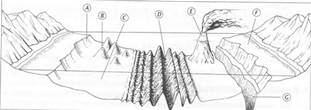
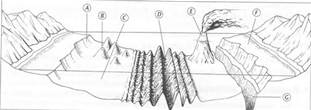
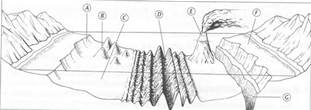
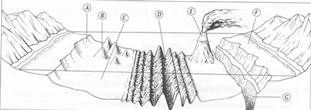
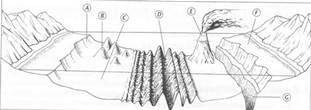
Which best represents the order of seafloor features as you move from the shoreline to the deep ocean?
a)
 Continental slope – continental shelf- continental rise – mid-ocean ridge
b)
 Continental rise – continental shelf – mid-ocean ridge -  continental slope
c)
 Continental shelf – continental slope – continental rise – mid-ocean ridge
d)
   Mid-ocean ridge – continental rise – continental shelf- continental slope
17.
What is letter D?
a)
Cont. Shelf
b)
Mid-Ocean Ridge
c)
Volcanic Island
d)
Seamount
18.
What is letter G?
a)
Mid-Ocean Ridge
b)
Rift
c)
Trench
d)
Cont. Shelf
19.
The gradually sloping part of a continent that extends under the ocean is the...
a)
continental slope
b)
continental shelf
c)
abyssal plain
d)
trench
20.
Seamount is similiar to...
a)
a volcanic island
b)
a small mountain or volcano
c)
The Great Plains
d)
The Grand Canyon
21.
The continental slope is located at the end of the...
a)
shoreline
b)
continental shelf
c)
mid ocean ridge
d)
abyssal plain
22.
What is letter A?
a)
Cont. Shelf
b)
Cont. Slope
c)
Seamount
d)
Abyssal Plain
23.
What is letter C?
a)
Mid-Ocean Ridge
b)
Cont. Shelf
c)
Cont. Slope
d)
Abyssal Plain
24.
The shallowest(least deep) part of the ocean is the ____________________
a)
trench
b)
abyssal plain
c)
continental shelf
d)
continental slope
25.
What is letter E?
a)
Volcanic Island
b)
Seamount
c)
Mid-Ocean Ridge
d)
Abyssal Plain
26.
What letter is B?
a)
Cont. Shelf
b)
Cont. Slope
c)
Mid-Ocean Ridge
d)
Seamount
27.
Ocean water contains stream-like movements of water called _____________  _____________.
a)
ocean currents
b)
ocean temperature
c)
surface currents
d)
deep current
28.
Currents are influenced by weather, the Earth's rotation, and the position of the _______.
a)
sun
b)
continents
c)
wind
29.
Warm-water currents begin near the _______ and carry ______ water to other parts of the ocean.
a)
pole, warm
b)
equator, warm
c)
equator, cold
d)
pole, cold
30.
Where is ocean water the densest.
a)
The surface
b)
The middle
c)
The bottom
d)
Lake Michigan
31.
Two types of ocean currents are
a)
local and global
b)
sea and land
c)
surface and deep
d)
warm and cold
32.
The Gulf stream carries _____________ water from the east coast of The United States to the West coast of Europe.
a)
Cold
b)
Warm 
c)
Freezing
d)
Fresh
33.
Surface currents are mainly caused by
a)
The Coriolis Effect
b)
Cold and Warm Water
c)
Convection
d)
Wind
34.
Currents that occur at or near the surface of the ocean are called 
a)
Deep Currents
b)
Convection Currents
c)
Surface Currents
d)
Wave Currents
35.
Regular movements of water far below the oceans surface are called
a)
Warm Currents
b)
Deep Currents
c)
Shallow Currents
d)
Surface Currents
36.
What is a trough?
a)
highest point on a wave
b)
lowest point on a wave
c)
longest point on a wave
d)
shortest point on a wave
37.
What is a crest?
a)
lowest point of a wave
b)
longest part of a wave
c)
shortest part of a wave
d)
highest point of a wave
38.
What is the distance between two waves?
a)
wave period
b)
wave frequency
c)
wave length
d)
wave height
39.
Stronger winds create __________ waves.
a)
larger
b)
smaller
40.

As the moon revolves around the earth, the water follows the motion and causes...

a)

sea levels

b)

waves and currents

c)

moon phases

d)

high tides and low tides

41.

Coral reefs are often found in shallow waters.

a)

True

b)

False

42.

Where is the Great Barrier Reef located?

a)

Philippines

b)

Australia

c)

China

d)

Brazil

43.

What is one big threat to coral reefs?

a)

sharks

b)

pollution

c)

turtles

d)

anemones

44.

Corals are types of __________________.

a)

plants

b)

rocks

c)

animals

d)

algae

45.

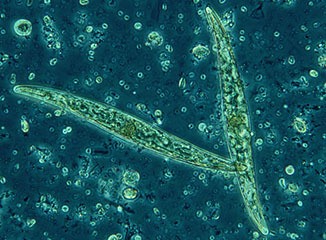
Plant-like plankton is called...

a)

Photosynthesis

b)

Phytoplankton

c)

Decomposer

d)

Consumer

46.

Animal-like plankton is called...

a)

phytoplankton

b)

zooplankton