wayground logo

Free Printable Worksheets

Font size

S
M
L
XL
Worksheets

Canterbury Tales

Total questions: 100

Worksheet time: 1hrs 3mins

Name
Class
Date
1.

Where are the pilgrims going on their pilgrimage?

a)

Tabard Inn

b)

To the Host's House

c)

Canterbury Cathedral

d)

London

2.

What is the Wife of Bath's philosophy on marriage?

a)

To love equally

b)

To be controlled by her husbands

c)

To dominate her husbands

d)

To have a job

3.

Death defeats the three rioters by appealing to.....

a)

Emotion

b)

Love

c)

Hatred

d)

Greed

4.

Which of the three rioters commits murder?

a)

All of them

b)

None of them

c)

Only the one who goes into town

d)

The two that stay behind

5.

Where do the pilgrims meet?

a)

Tavern Inn

b)

Best Western

c)

Talmud Inn

d)

Tabard Inn

6.

Why are the pilgrims visiting Canterbury Cathedral?

a)

Thomas Beckett's shrine

b)

To see the current archbishop

c)

They needed someplace to go

d)

Henry II's shrine

7.

The most accurate description of the group of pilgrims is as a...

a)

number of people who represent many different occupations, classes, and personalities

b)

collection of people who are obsessed with money and sensual pleasures

c)

group that comes from many walks of life, but consists of deeply flawed individuals

d)

variety of individuals who have qualities that are meant to make you unhapy

8.

The Canterbury Tales is unique because it is a frame story. What is the best way to describe a frame story?

a)

A story that is framed in a symbolic way

b)

A story that is framed around and overarching story

c)

A story that is framed in reverse order

d)

A story that is framed together by a large number of characters

9.

How do the pilgrims plan to keep themselves entertained along the trip to Canterbury?

a)

By telling stories about "the good ol' days"

b)

By telling stories about their most embarrassing moments

c)

By telling stories about real events in their lives

d)

By telling stories about fictional moral lessons

10.

When the audience knows the true plans of all the rioters, but the characters do not, this is known as...

a)

Personification

b)

Dramatic Irony

c)

Metaphor

d)

Verbal Irony

11.

How does the Pardoner keep up his extravagant lifestyle?

a)

His church pays for all his expenses.

b)

The Pope gives him money to spend.

c)

He sells authentic holy relics from Rome.

d)

He tells stories to make people buy pardons.

12.
Who is the author of The Canterbury Tales?
a)
Geoffrey Chaucer
b)
Henry V
c)
William Shakespeare
d)
Charles Dickens
13.
What season is described in the opening passage of The Canterbury Tales?
a)
summer
b)
winter
c)
spring
d)
fall
14.

What was the prize for who told the best story, and who came up with the idea for it?

a)

lunch - Chaucer

b)

dinner - the Host

c)

dessert - the narrator

d)

drink - the pardoner

15.
In what language were the tales originally written?
a)
Old English
b)
Middle English
c)
Modern English
d)
French
16.
What is the question the knight has to answer in "The Wife of Bath's Tale"?
a)
What do men want the most?
b)
What do women want the most?
c)
What does chivalry mean?
d)
What is the best age to marry?
17.

What is the name of this time period?

a)

Middle Ages

b)

Medieval Times

c)

Tudor England

d)

The Stuart Period

18.

In the Wife's story, what does the knight decide regarding his wife?

a)

She should become young.

b)

She should decide for herself.

c)

She should remain old.

d)

She should marry another man.

19.

What is the theme of the wife's tale?

a)

Knights cannot be trusted.

b)

Sometimes wisdom comes in unattractive packages.

c)

Women never know exactly what they want.

d)

Men should always submit to their wives.

20.

How many people are on the pilgrimage, and how many tales are they supposed to tell each?

a)

30 people, 4 tales

b)

25 people, 2 tales

c)

50 people, 5 tales

d)

17 people, 1 tale

21.

What is ironic about the attitude that the old man has toward Death?

a)

He refers to death like an old friend

b)

He actually wants to die, which is the opposite of what you'd expect from someone so close to death

c)

He likes death because he wants death to punish these rioters who were rude to him

d)

He uses death to bring him treasure to lure more people in

22.

How are stereotypes at work in The Canterbury Tales?

a)

Chaucer uses over-the-top stereotypes of different estates to promote social commentary

b)

Chaucer wants to lash out at certain types of people who have wronged him, so he creates cruel stereotypes of characters

c)

Chaucer has never actually met many of these people, so he relies on stereotypes to inform him of what they're like

d)

Chaucer wants to break the mold of how people in medieval times are viewed, so he creates characters that don't follow their stereotype

23.
The Father of English poetry is _________.
a)
William Shakespeare
b)
Harry Bailey
c)
Johnny Bailey
d)
Geoffery Chaucer
24.

What was the cause of so much death during this time period?

a)

unemployment

b)

wars

c)

starvation

d)

The Black plague

25.

What is the definition of allegory?

a)

Using "like or "as" to compare two things.

b)

A story/person/object that stands for abstract ideas

c)

A story inside of a story

d)

A character that goes through a significant change

26.
An allegory has both    
a)
A literal and figurative meaning
b)
A figurative and symbolic meaning
c)
A literal and symbolic meaning
d)
A historical and biblical meaning
27.
The Pardoner thinks that ...
a)
Money is the root of all evil
b)
Greed is the root of all evil
c)
The devil is the root of all evil
d)
Women are the root of all evil 
28.
Who are the rioters looking for in the tale?
a)
Heaven
b)
Death
c)
Money 
d)
Hell 
29.
Why do the rioters go looking for Death? 
a)
For repentance and salvation
b)
Avenge the death of their friends
c)
For great treasure
d)
To banish him from England 
30.
Which statement best describes the end of the Pardoner's Tale? 
a)
The rioters become rich
b)
The rioters meet death
c)
Death takes the gold florins
d)
Death takes a holiday
31.

What favor does the knight have to fulfill after the old woman saves his life?

a)

Work for her

b)

Give her money

c)

Go to jail

d)

Marry her

32.

The old woman offers the Knight a choice between....

a)

Love and Hate

b)

Beauty and Faithfulness

c)

Sin and Purity

d)

Good Manners and Good Deeds

33.
What is Chaucer's main purpose for writing the Prologue?
a)
describe a London inn
b)
introduce all the pilgrims
c)
explain religious customs
d)
reveal the narrator's thoughts
34.
Which of the following best describes the Knight?
a)
brave and strong
b)
truthful
c)
modest clothing
d)
all answer choices are correct
35.
Which of the following best describes the squire?
a)
expert woodsman, strong, and loyal
b)
would rather be hunting, loves the outdoors, big sparkly eyeballs
c)
very thin, only loves books, spends all his money on education
d)
a ladies' man who plays the flute and is proud of his appearance
36.
Which of the following best describe the Monk?
a)
big sparkly eyeballs, would rather be hunting, personable
b)
fancy dresser, always wanted to be first at the altar, married 5 times
c)
very thin, only loves books, spends all his money on education
d)
a ladies' man who plays the flute and is proud of his appearance
37.

Which of the following best describes the Oxford Student?

a)

bald and fat, had a preference for fine clothes and luxuries, and didn't care for hard work

b)

loved to learn for the sake of learning, very thin, loves books

c)

wise, made a lot of money, knew the law, less busy than he seemed to be

d)

the Squire's servant, a woodsman

38.
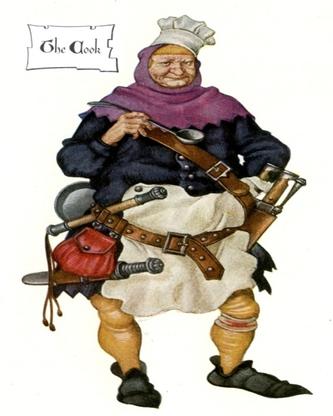
Which of the following best describes the cook?
a)
very fancy dresser, always wanted to be first at the alter to give her offering, well-traveled, married 5 times
b)
big, brawny, tells dirty tavern stories, he is strong and plays the bagpipes
c)
has an oozing ulcer on his knee, questionable hygiene, great cook
d)
very poor, ideal parish priest,well-educated
39.

"She'd had five husbands, all at the church door".

a)

Wife of Bath

b)

Host

c)

Pardoner

d)

Miller

40.

This pilgrim made prisoners walk the plank; a possible pirate

a)

Skipper

b)

Manciple

c)

Reeve

d)

Doctor

41.

This pilgrim used his thumb to add weight when weighing grain so he could steal from his clients; Chaucer calls him a 'buffoon.'

a)

Miller

b)

Manciple

c)

Franklin

d)

Friar

42.

Nun's Priest's Tale: Identify Chanticleer and Pertelote.

a)

Pertelote is the devil disguised as a hen; she almost claims Chanticleer's soul

b)

Chanticleer is a rooster almost eaten by Pertolote the fox

c)

Chanticleer is the farmer who narrates this story; Pertelote is the rooster.

d)

Chanticleer is a rooster; Pertelote is his favorite hen.

43.

Nun's Priest's Tale: What was Chanticleer's dream?

a)

That he became rich and the master of the barnyard

b)

The he and Pertelote married and had a long happy life.

c)

That an animal similar to a dog killed him.

d)

The Pertelote took ill but he saved her with laxatives.

44.

Nun's Priest's Tale: Who is Chanticleer?

a)

A Fox

b)

An Elephant

c)

A Rooster

d)

A Rat

45.

Nun's Priest's Tale: What is Chaunticleer known for?

a)

Singing

b)

Dancing

c)

Cooking

d)

Hunting

46.

How does Pentelote's advice effect on Chanticleer's fate in the story?

a)

He becomes sad and depressed.

b)

He begins to think he isn't a good singer.

c)

It help's him overcome challenges later on

d)

He ignores his dreams

47.

"In principio, mulier est hominis confusion" - Chanticleer states that this means a Woman is a man's joy and source of all happiness. What does he really mean?

a)

A man and woman are both equal

b)

Without women, Men will struggle

c)

A man is as good as he has to be, and a woman is as bad as she dares.

d)

That Woman brought the downfall of man

48.
What was Chanticleer's dream?
a)
That he became rich and the master of the barnyard
b)
The he and Pertelote married and had a long happy life.
c)
That an unfamiliar animal killed him. 
d)
The Pertelote took ill but he saved her with laxatives. 
49.
To what did Pertelote attribute the dream?
a)
She said he listened to too many fables.
b)
She said he must have indigestion.
c)
She said they were signs from heaven and must be listened to. 
d)
She said he wasn't getting enough rest. 
50.
What was Pertelote's suggested remedy?
a)
She suggested he should sleep for two days.
b)
She suggested he get more exercise.
c)
She suggested he take a laxative.
d)
She suggested he pray more.
51.
Why did the fox flatter Chanticleer?
a)
He did it to get Chanticleer to tell him where the hen house was.
b)
He wanted to be friends.
c)
He wanted Chanticleer to give him Pertelote to eat.
d)
He did it to put Chanticleer at ease. So he would sing and make him an easy target. 
52.
What happened to Chanticleer?
a)
The fox hauled him away to eat him for dinner.
b)
He bit the fox on the nose and escaped.
c)
Pertelote saved him. He was grateful but embarrassed.
d)
The fox's grip on his neck caused him to loose  his singing voice. 
53.
How did Chanticleer escape? 
a)
He raised such a fuss that the other animals came to his rescue.
b)
He pecked the fox's eyes out and flew away. 
c)
He appealed to the fox's sense of superiority and told him not miss out on insulting the other animals when he did, Chanticleer got away.
d)
He pretended to be dead. The fox released his grip and Chanticleer got away. 
54.

Nun's Priest's Tale: What place does Chanticleer safely fly to?

a)

A Mountain

b)

A Tree

c)

A Barn

d)

A Home

55.

Nun's Priest's Tale: What is one moral of this story?

a)

Do not cheat

b)

Tell the truth

c)

Do not gossip

d)

Keep your mouth shut when you have nothing to say.

56.

The feudal system was based on:

a)

Land ownership

b)

Religious ideas

c)

How big a king's castle was

d)

The power of the church

57.

Who holds the most important position in the feudal system?

a)

Peasants

b)

Kings

c)

Knights

d)

Nobles

58.

Who was able to read and write in Medieval times?

a)

Kings

b)

Peasants

c)

Monks

d)

Knights

59.

Who is said to have selected the king?

a)

The people

b)

The royal family

c)

The knights

d)

God

60.
After William of Normandy triumphed at the Battle of Hastings, England political and social structure changed because of changed because of its —
a)
defeat of the Germanic tribes
b)
adoption of the Norman feudal system
c)
acceptance of the Anglo-Saxon culture
d)
emergence as the leading European power
61.
Feudalism’s religious concept of hierarchy featured —
a)
A caste system of lords, vassals, and serfs
b)
classes in Latin for young knights
c)
endless international warfare
d)
romantic attitudes toward women
62.
The Black Death, or Bubonic Plague, ultimately resulted in —
a)
increased awareness of proper sanitation   
b)
freedom for the serfs and greater power for the lower classes because of a labor shortage
c)
victory for the Lancasters over the Tudors
d)
The reemergence of the Anglo-Saxon religion
63.
The Crusades influenced everyday life in England by —
a)
causing writers to publish in many different languages   
b)
exposing the English to other civilizations, new methods of math and science.
c)
recapturing Jerusalem for Christianity   
d)
inspiring the authors of the Magna Carta
64.
The cathedral of Canterbury is considered sacred ground. What significant event in 1170 made the cathedral sacred ground?
a)
The baptism of Edward the Confessor   
b)
The assassination of Thomas Becket, the Archbishop   
c)
It is the burial ground of several kings and queens
d)
The building is blessed by Pope Urban
65.
Many knights of the period participated in a custom in which they would admire a woman, dedicate battles to her, bring her gifts from crusades, but she would never requite or return that affection. This custom is called:
a)
Feudal submission
b)
Courtly love
c)
husband training
d)
Courtney Love
66.

In 1066, the Anglo-Saxon period ended with the:

a)

fall of Rome

b)

invasion of the Vikings

c)

Battle of Hastings

d)

Black Death

67.

The ruler who brought the French language and customs to Anglo-Saxon England was:

a)

Harold II

b)

William the Conqueror

c)

Edward the Confessor

d)

King Norman

68.

A knight had to swear to be true to:

a)

God, his king, his queen

b)

Himself, his king, his people

c)

God, himself, his people

d)

God, his King, his woman

69.

During the Middle Ages, most people belonged to this faith:

a)

Catholicism

b)

Protestantism

c)

Atheism

d)

Lutheranism

70.

True or False: One result of the Black Death was that farm/plantation workers could move around and seek better wages for the first time.

a)

True

b)

False

71.

The hero is now

a)

brave and heroic

b)

romantic

c)

serious

72.

Labourers worked for the lord of the manor. What did most of them get in return?

a)

Money and housing

b)

Food and protection

c)

Food and housing

d)

Housing and land

73.

Which animal was responsible for spreading the Black Death?

a)

Cats

b)

Rats

c)

Dogs

74.

Who was at the very bottom of the Feudal social order?

a)

King

b)

Nobles and Knights

c)

Priests

d)

Serfs or Peasants

75.

This invention helped spread the gospel throughout Europe.

a)

The spinning jenny

b)

The automobile

c)

The printing press

d)

The steam engine

76.
What is the name for the system of promises between lords and vassals that governed Europe in the Middle Ages?
a)
Christianity
b)
Feudalism
c)
Shinto
d)
Chivalry
77.
What were the European motives for fighting the crusades?
a)
   Desire to be released from feudal obligations
b)
   Defense of the holy land
c)
 Forgiveness of sins
d)
All of the above
78.
Which statement best describes the results of the Crusades?
a)
 Europeans maintained lasting control over much of the Middle East
b)
   Islamic influence completely dominated Europe
c)
     Europeans developed tolerance of Non-Christian religious 
d)
   Trade between Europe and the Middle East increased
79.
Which is a characteristic of feudal society?
a)
 Rapid social change
b)
   High literacy rates
c)
   Factory system and the industrial based economy
d)
   Rigid social class structure, social hierarchy
80.
In European feudal society, an individual's social status was generally determined by...
a)
 Birth
b)
     Education and training
c)
     Marriage
d)
     Individual abilities
81.
Why was the Magna Carta important?
a)
   It approved money for war in France
b)
   It asserted that the monarch must obey the constitution and laws
c)
   It allowed the monarch to abolish Parliament
d)
     It increased the power of the Pope 
82.
In Europe during the Middle Ages, increases in trade and commerce resulted in...
a)
   Lower living standards for industrial workers
b)
   Decreased economic rivalry between kings
c)
     Increased political power for the clergy
d)
 Development of towns and cities
83.
A king or queen who is a supreme ruler is called a ____________.
a)
Top Dog
b)
Missionary
c)
Butterfly
d)
Monarch
84.
The rapid spread of a deadly disease over a wide area is called a/an ___________.
a)
Germ
b)
Flu
c)
Fleas on rats
d)
Plague
85.
Which best describes the influence of the Church during the Middle Ages?
a)
A child from almost every family became a monk or nun in the Church
b)
The Church encouraged people of other religions to settle in Europe
c)
Church officials and kings worked separately to govern countries
d)
Daily life in villages and towns revolved around the Church
86.

Upper class land owners

a)

Vassal

b)

Noble

c)

Serf

d)

Plebeian

87.

A nobleman who was trained as a warrior and lived their live according to a code of chivalry

a)

Samurai

b)

Navy

c)

Vassal

d)

Knight

88.

Title given to a young boy, ages 7-13, who was training to become a knight

a)

Monk

b)

Apprentice

c)

Monarch

d)

Page

89.

Code of conduct which a knight swore to uphold

a)

Ethics

b)

Semper Fi

c)

Chivalry

d)

Tithe

90.
The political order under feudalism was dependent upon the relationship between lords and their vassals.  The responsibility of the vassal included
a)
the promise to spread the Christian faith to their lands
b)
an oath of loyalty and a pledge of military service
c)
an agreement to keep lower classes under control
d)
the payment of taxes to the king or queen of the country
91.
What is the main feature of a medieval feudal society?
a)
the population was mostly rural, made up of farming communities
b)
the people began to assert their rights as individuals and demand greater freedoms
c)
the population was mostly urban because people sought opportunities in the cities
d)
an improved economic system was created based upon the introduction of paper money and credit
92.
The First Crusade had the intended goal of capturing which city?
a)
Jerusalem
b)
Cairo
c)
Mecca
d)
Rome
93.

Why did peasants enter into feudal agreements with Vassals?

a)

to make money

b)

for protection

c)

for better trade

94.

What was the main function of the Magna Carta?

a)

free serfs and peasants

b)

limit the king's power

c)

limit the pope's power

d)

provide money to the king

95.

What did the Peasants give Knights in return for their protection?

a)

Love

b)

Land

c)

Food

d)

Knights

96.
When was the Battle of Hastings?
a)
1066
b)
1065
c)
1088
d)
1064
97.
Name the place in France William the Conqueror came from.
a)
Paris
b)
Normandy
c)
Provence
d)
Toulon
98.
The leader of the Catholic Church is the...
a)
pope
b)
bishop
c)
archbishop
d)
priest
99.
What were people called who traveled to Jerusalem?
a)
Pilgrims
b)
Muslims
c)
Crusaders
100.
The Crusades were battles between the
a)
Christians and Jews
b)
Christians and Muslims
c)
Christians and Moors