
 Worksheets
Congruent Triangles
Total questions: 33
Worksheet time: 4hrs 38mins
Name
Class
Date
1.
∆ABC≅∆XYZ
which is true?
which is true?
a)
AB≅XY
b)
AB≅YX
c)
AB≅XZ
d)
BC≅CB
2.

What is the correct congruence statement? ΔDEC ≅________
a)
ΔAEB
b)
ΔEAB
c)
ΔBEA
d)
Not Congruent
3.
The hypotenuse of a triangle is...
a)
Invisible
b)
A myth
c)
The side opposite the right angle in a right triangle
4.
If ∆LMK ≅ ∆LMT, then
∠K ≅ ____
∠K ≅ ____
a)
T
b)
∠T
c)
∠M
d)
∠L
5.
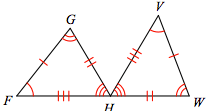
Remember order matters. Which of the following is true?
a)
∆FGH ≅ ∆VHW
b)
∆HFG ≅ ∆HWV
c)
∆HGF ≅ ∆VHW
d)
∆FGH ≅ ∆VWH
6.
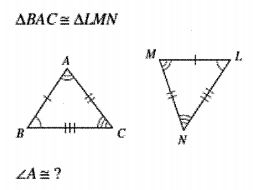
∠A = ≅
a)
∠M
b)
∠N
c)
∠L
7.
If ∆PIG ≅ ∆COW, WO≅?
a)
GI
b)
PI
c)
PG
8.
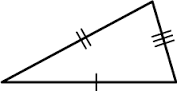
Name this triangle
a)
Acute, Scalene
b)
Obtuse, Scalene
c)
Right, Isosceles
d)
Acute, Equilateral
9.
How many acute angles must an acute triangle have?
a)
2
b)
1
c)
4
d)
3
10.
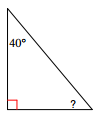
Find the measure of the missing angle.
a)
90o
b)
100
c)
130o
d)
50o
11.

Name this triangle.
a)
Right, Isosceles
b)
Scalene, acute
c)
Isosceles, acute
d)
Equilateral, obtuse
12.

Which type of triangle is pictured?
a)
Equilateral Triangle
b)
Right Isosceles Triangle
c)
Obtuse Scalene Triangle
d)
Obtuse Equilateral Triangle
13.

Find the measure of the indicated angle.
a)
26
b)
36
c)
85
d)
144
14.
The Triangle Sum Theorem states that the sum of all angles in a triangle is ______.
a)
45°
b)
90°
c)
180°
d)
360°
15.
What do the angles in an equilateral triangle measure?
a)
30, 60, 90
b)
45, 45, 90
c)
60, 60, 60
d)
35, 55, 90
16.
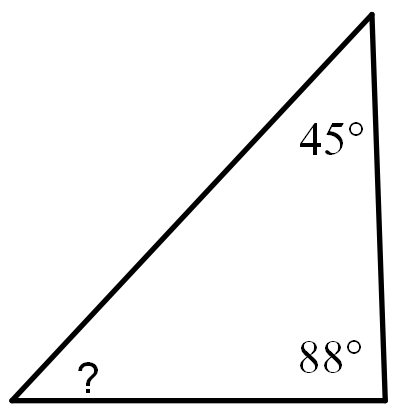
Find the measure of the missing angle.
a)
47
b)
57
c)
53
d)
133
17.

Solve for x.
a)
5
b)
12
c)
-7
d)
-6
18.

Solve for x.
a)
16
b)
11
c)
50
d)
6
19.

What is the measure of angle b?
a)
36o
b)
56o
c)
63o
d)
117o
20.

Which of the following angles can you add together to equal angle d?
a)
Angle a and Angle b
b)
Angle b and Angle c
c)
Angle a and Angle c
d)
Angle a and Angle b and Angle c
21.

Find the measure of the indicated angle.
a)
95
b)
85
c)
35
d)
45
22.
Two angles that add up to 90 degrees are called _____________ ______.
a)
supplementary angles
b)
complementary angles
c)
corresponding angles
d)
right angles
23.
Two angles that add up to 180 degrees are called _____________ ______.
a)
right angles
b)
corresponding angles
c)
complementary angles
d)
supplementary angles
24.
If ΔABC ≅ ΔXYZ, which statement is always true?
a)
AB = YZ
b)
∠C ≅ ∠Z
c)
∠B ≅ ∠C
d)
AC = XY
25.
If ΔABC ≅ ΔXYZ, which statement is always true?
a)
BC = XZ
b)
∠B ≅ ∠Z
c)
∠A ≅ ∠X
d)
AB = YZ
26.
If ΔABC ≅ ΔXYZ, which statement is always true?
a)
BC = AZ
b)
∠C ≅ ∠X
c)
∠B ≅ ∠A
d)
AC = XZ
27.
If ΔABC ≅ ΔXYZ, which statement is always true?
a)
AB = AZ
b)
∠B ≅ ∠Y
c)
∠X ≅ ∠C
d)
AC = XC
28.
If ΔDEF ≅ ΔRST, then we can conclude that DE = what?
a)
ST
b)
RS
c)
DF
d)
RT
29.
If ΔDEF ≅ ΔRST, then we can conclude that ST = what?
a)
ST
b)
RT
c)
EF
d)
RF
30.
If ΔDEF ≅ ΔRST, then we can conclude that EF = what?
a)
ST
b)
RT
c)
DF
d)
RS
31.
If ΔDEF ≅ ΔRST, then we can conclude that ∠T ≅ ____.
a)
∠F
b)
∠E
c)
∠D
d)
EF
32.
If ΔDEF ≅ ΔRST, then we can conclude that ∠R ≅ ____.
a)
∠F
b)
∠E
c)
∠D
d)
DF
33.
If ΔDEF ≅ ΔRST, then we can conclude that ∠S ≅ ____.
a)
∠F
b)
∠E
c)
∠D
d)
DE
100 %

