
 Worksheets
Light and optics
Total questions: 50
Worksheet time: 50mins

If you're standing 12 meters in front of a plane mirror, how far away is your image from you?
6
12
18
24

Which color has the shortest wavelength?
Red
Orange
Green
Violet

When light passes from one medium to a denser medium _________.
it is bent towards the normal.
it always lies along the normal.
it is unaffected.
it is bent away from the normal.
In a vacuum radio waves, visible light and gamma rays all have the same ________.
frequency
energy
wavelength
speed
Which of the following are the characteristics of the image formed in a plane mirror?
Virtual and upright
Virtual and inverted
Real and inverted
Real and upright

what is the cause of the phenomenon?
Summation of light
Dispersion of light
Scattering of light
Reflection of light
Mark the characteristics of the image formed on convex mirror.
upright
real
Mark for the correct explanation about the reflection of light on plane mirror.
Angle of incident is equal to angle of reflection
Image formed in inverted
Image distance from mirror is equal to object distance from mirror
Light refracted __________ normal when move from less dense to more dense mediums.
towards
away from

Diagram shows an image formed when an object is placed in front of a mirror.
What is the object of the image shown?


Diagram shows the formation of light spectrum on a screen by a glass prism. Which of the following is not true?
White light consist of seven colors
X is red light while Y is violet.
Different coloured lights are refracted at different angles by the glass prism
All colours of light travel at the same speed.

Diagram shows an object P placed in front of a convex mirror.
What are the characteristics of the image formed?
Real, inverted and diminished
Real, upright and magnified
Virtual, inverted and magnified
Virtual, upright and diminished

Diagram shows a light ray travels from medium R to medium S.
Suggest materials that may be represented by medium R and S
R: Glass
S: Air
R: Air
S: Glass

Diagarm show type of mirror.
Which of the following are the characteristics of the image formed by this mirror?
Upright
Virtual
Bigger
Laterally inverted

Diagram shows two students standing in front of plane mirror.
What is the distance between student K with the image of student L?
7 m
8 m
11 m
15 m

Diagram shows a light ray propagating from air into water.
What happen to the light ray in water?
Reflects in all directions
Refracts towards the normal
Refracts away from the normal
Reflects with the same angle as incident ray


A concave mirror is curved
inward
outward
Which lens represents the path light takes through a diverging lens?


Which figure represents the path light takes through a converging lens?
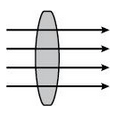
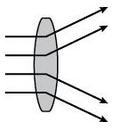
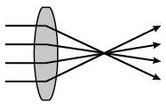
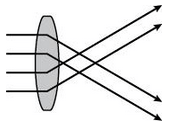

What type of lens creates the image seen in the eyeglasses?
convex
concave
reflection
plane

Which optical technology do we use to observe small things?
Telescope
Microscope
Camera
ALL of them

Which technology do we use to observe FARAWAY objects?
Telescope
Microscope
Camera
All of them

which type of lens will help correct this vision problem
convex
concave
opaque
plano

What type of image does this lens form?
Virtual image
Real Image
No Image
real and virtual
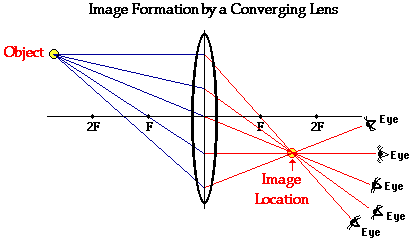
A magnified real image is formed by a convex lens when the object is at
F
between F and 2F
2F
both (a) and (b)

[SPM2015] Diagram 18 shows a crocodile in water and its
image. Which light phenomenon forms the image?
Reflection
Refraction
Diffraction
Total internal reflection

[SPM2015] Diagram 19.1 and Diagram 19.2 show a fish seeing a beetle at different position. Why does the difference in sighting occur by the fish between Diagram 19.1 and Diagram 19.2?
The sighting in Diagram 19.2 is done at an angle to the normal
The mass of fish in Diagram 19.1 is bigger
The distance between the fish and the beetle in Diagram 19.1 is further
[SPM2016] Which diagram shows the correct light path when light propagates through two layers of air with different temperature?


[SPM2016] Diagram 13 shows a boy observing a fish in a pond. The fish appears to be closer to the surface of the water. Which reason is correct to explain this situation?
The refractive index of air > the refractive
index of water
The speed of light in air > the speed of light in
water
The density of air > the density of water
The frequency of light in air> the frequency of
light in water

[SPM2018] Diagram 17 shows a refraction of light when the light propagates from air to glass. Which path of light ray is correct when glass is replaced with a denser medium?


[SPM2017] Mirage is seen on a road on a hot day. Which phenomena cause the appearance of mirages?
Refraction and reflection
Refraction and total internal reflection
Reflection and total internal reflection
Reflection, refraction and total internal reflection
[SPM2018] A diamond glitters when struck by incident rays. This phenomenon is caused by
reflection of light
refraction of light
interference of light
total internal reflection of light
[SPM2015] An object is placed 15.0 cm in front of a convex lens with a focal length of 10.0 cm. What is the image distance?
6 cm
25 cm
30 cm
150 cm

[SPM2016] Diagram shows light rays passing through a convex lens. Which point, A, B, C or D, is the focal point?
A
B
C
D
[SPM2017] Which ray diagram is correct for convex lens?


[SPM2018] Diagram shows the position of an image formed by a convex lens. Which position of A, B, C or D, the observer cannot see the image?
A
B
C
D
[SPM2019] An object with a height of 3 cm is placed 15 cm from a convex lens. A sharp image is formed on the screen, 30 cm from the convex lens. What is the height of the image?
0.5 cm
1.5 cm
2.0 cm
6.0 cm
Which of the following ray diagrams shows the convex lens can act as a magnifying glass? The focal length of the lens is 10 cm.
Antara gambar rajah sinar berikut, yang manakah menunjukkan kanta cembung boleh bertindak sebagai kanta pembesar? Panjang fokus bagi kanta itu ialah 10 cm?



