Wayground logo

Free Printable Worksheets

Font size

S
M
L
XL
Worksheets

Waves

Total questions: 53

Worksheet time: 1hrs 22mins

Name
Class
Date
1.

What is a wavelength?

a)

How many waves pass a certain point

b)

The distance from one wave crest to another

c)

The entire length of a wave

2.
What is the longest wavelength on the EMS (electromagnetic spectrum)?
a)
Radio Waves
b)
Micro Waves
c)
Gamma Rays
d)
X-Rays
3.
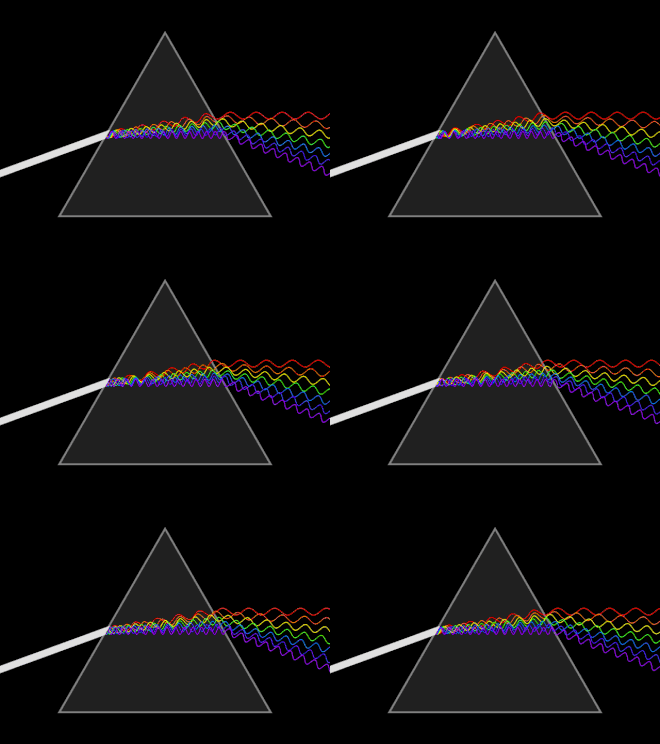
When light hits something like a raindrop or a prism, it will...
a)
Be absorbed
b)
Refract, or bend
c)
Neither 
4.
Which color has the longest wavelength?
a)
Orange
b)
Green
c)
Blue
d)
Indigo
5.
Waves move ___ through vibrations
a)
Energy
b)
Matter
c)
Mass
d)
Weight
6.

The highest point on a wave is:

a)

the crest

b)

the trough

c)

the top

d)

the coast

7.
What kind of wave is pictured below?
a)
compressional wave
b)
transverse wave
c)
sound wave
d)
mechanical wave
8.

You can't hear sounds in outer space because there is no

a)

medium

b)

light

c)

energy

d)

heat

9.

All waves carry ________ as they travel from one place to another.

a)

matter

b)

space

c)

energy

d)

water

10.
Which part of the wave is shown at letter E?
a)
trough
b)
crest
c)
resting point
d)
amplitude
11.
Any material that a wave travels through is called a ____________________.
a)
vibration
b)
compression
c)
medium
d)
crest
12.
In longitudinal waves, the parts where the coils are spread apart are called what?
a)
rarefactions
b)
compressions
c)
mechanicals
d)
longitudes
13.
In what type of wave does the medium move perpendicular to the movement of the wave?
a)
Transverse
b)
Longitudinal
c)
Electromagnetic
d)
Radio
14.
In a longitudinal wave, the parts where the coils are close together are called what?
a)
longitudes
b)
rarefactions
c)
compressions
d)
contractions
15.
Which travels faster, light or sound?
a)
light
b)
sound
16.
What type of wave move a slinky back and forth?
a)
longitudinal
b)
transverse
17.
Which type of wave does sound travel in?
a)
Transverse
b)
Longitudinal
18.
Which answer best explains what causes a wave?
a)
Shaking
b)
Potential energy
c)
Light
d)
Vibrations
19.
What kind of wave is pictured?
a)
Transverse
b)
Longitudinal
c)
surface
d)
none of the above
20.

What does a wave carry from place to place?

a)

energy

b)

matter

c)

people

21.

A wave that can travel through matter and empty space is a:

a)

electromagnetic wave

b)

longitudinal wavy

c)

transverse wave

22.
Waves that require a medium are called 
a)
mechanical waves
b)
transverse waves
c)
light waves
d)
gamma rays
23.
What happens when you increase the amplitude of a sound?
a)
it makes the sound louder
b)
it makes the sound travel faster
c)
it increases the wavelength of the sound
d)
it increases the frequency of the sound
24.
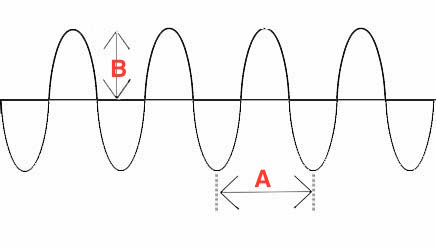
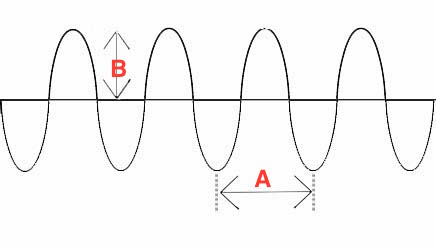
What property of this wave is represented by the letter "A"
a)
amplitude
b)
crest
c)
trough
d)
wavelength
25.
What property of the wave is represented by the letter "B"?
a)
amplitude
b)
crest
c)
trough
d)
wavelength
26.
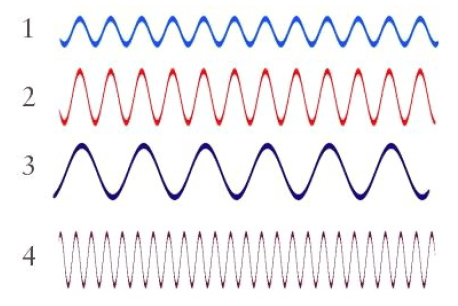
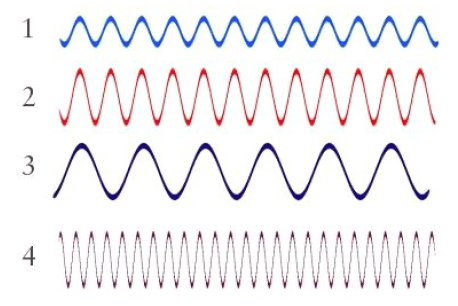
Which wave in the diagram has the greatest frequency?
a)
1
b)
2
c)
3
d)
4
27.
Which wave in the diagram has the greatest wavelength?
a)
1
b)
2
c)
3
d)
4
28.
Which of the following can sound travel through?
a)
solid
b)
liquid
c)
gas
d)
all of the above
29.

Increasing the amplitude means you are increasing the _______________ of a wave.

a)

frequency

b)

amplitude

c)

energy

d)

wavelength

30.

What causes the refraction of a wave?

a)

the density of the medium changes the speed

b)

the amount of the medium changes the direction

c)

the color of the medium changes the speed

d)

the type of wave changes the direction

31.

When a wave bounces back, it is called?

a)

diffraction

b)

refraction

c)

transmission

d)

reflection

32.

What is the unit for frequency?

a)

Meters

b)

Hertz

c)

Decibels

d)

Meters/Second

33.

When a wave spreads out, it is called____________________?

a)

reflection

b)

refraction

c)

diffraction

d)

absorption

34.

Objects appear different in size and shape in a container of water due to ____________________________.

a)

transmission

b)

reflection

c)

absorption

d)

refraction

35.
A mechanical wave cannot travel through...
a)
a vacuum(empty space).
b)
water.
c)
air. 
d)
glass.
36.
which material does sound travel the fastest?
a)
solid 
b)
liquid 
c)
gases
37.
When a wave bends as it passes through at an angle from one medium to another.(example: pencil in a glass of water-)
a)
medium
b)
refraction
c)
reflection
d)
interference
38.
Which form of Interference is occurring in this picture?
a)
Reflection
b)
Refraction
c)
Diffraction
d)
Radiation
39.
When light waves are absorbed, they can become heat.
a)
True
b)
False
40.
When waves meet, and form either a larger or smaller amplitude
a)
Radiation
b)
Interference
c)
Diffraction
d)
Microwaves
41.
The combination of two waves to form a larger amplitude is what type of interference?
a)
Constructive
b)
Destructive
c)
Diffractive
d)
Refractive
42.
Waves can meet and form a smaller amplitude.  If this occurs, it is called
a)
Constructive
b)
Destructive
c)
Diffractive
d)
Refractive
43.
The picture best represents
a)
Refraction
b)
Reflection
c)
Diffraction
d)
Interference
44.
Standing waves occur when the wave is ______________ at the same frequency.
a)
Reflected
b)
Refracted
c)
Diffracted
d)
none of these
45.
Standing waves resemble _________ waves, but the energy actually does not keep moving in one direction.
a)
Longitudinal
b)
Compressional
c)
Transverse
d)
Medium
46.
These waves are experiencing
a)
Reflection
b)
Refraction
c)
Diffraction
d)
Diffusion
47.
What is "?" ?
a)
rarefaction
b)
compression
c)
expansion
d)
reflection
48.

This is the term that describes when light passes through matter.

a)

Transmission

b)

Transparent

c)

Translucent

d)

Opaque

49.

Which type of interaction is shown in the image?

a)

Destructive Interference

b)

Absorption

c)

Constructive Interference

d)

Reflection

50.
One end of the rope is vibrated to produce a wave with a wavelength of .25 m.  The Frequency of the wave is 3.0 Hz.  What is the speed of the wave?
a)
3.00 m/s
b)
2.50 m/s
c)
.75 m/s
d)
1.25 m/s
51.
 A wave has frequency of 5 Hz and a speed of 25 m/s. What is the wavelength of the wave?
a)
25 m
b)
125 m
c)
5 m
d)
25 m/s
52.
 A wave has frequency of 50 Hz and a wavelength of 10 m. What is the speed of the wave?
a)
500 m/s
b)
50 m/s
c)
5 m/s
d)
0.5 m/s
53.
A wave has wavelength of 10 m and a speed of 340 m/s. What is the frequency of the wave?
a)
34 m/s
b)
3400 Hz
c)
3400 m/s
d)
34 Hz