wayground logo

Free Printable Worksheets

Font size

S
M
L
XL
Worksheets

Unit 4 Political Organization of Space

Total questions: 57

Worksheet time: 49mins

Name
Class
Date
1.

Sovereignty and ethnic homogeneity are most often defined as which political entity?

a)

Nation state

b)

State

c)

Multiethnic state

d)

Country

2.

By using the popular media to promote the idea of a national identity and culture, a political leader may seek to conform their country as a

a)

representative of the UN

b)

a nation state

c)

epicenter of civil disobedience

d)

bicameral legislation in court

3.

Why is the government's role in the establishment of a nation-state considered critical?

a)

the government is required to protect its borders and resolve any internal conflicts.

b)

the government is required to locate and restore lost items of cultural heritage.

c)

the government is required to serve as an intermediary to resolve conflicts between its religious leaders

d)

the government is required to prevent the exportation of local agricultural products.

4.

The European Union, an international organization of European countries, limits the sovereign power of its members by

a)

planning joint attacks on common enemies

b)

promoting tourism in member states

c)

coordinating free trade agreements among member states

d)

funding the building of walls in member states

5.

Which of the following concepts describes the North Atlantic Treaty Organization (NATO), one of the world's most powerful military alliance?

a)

League of Nations

b)

Supranationalism

c)

The United Nations

d)

Fiscal Union

6.

The EU requires it member states to

a)

transfer some of its power to a central authority

b)

invested all of its power in a prime minister

c)

create a single annual election

d)

create a single intergovernmental bank

7.

The United Nations has a policy of using economic and military sanctions to limit the sovereign powers of

a)

only contested states

b)

humanitarian organizations such as the Red Cross

c)

any country that disrupts international peace

d)

only its member states

8.
A group of people that share a common cultural heritage, common beliefs, claim a space as their homeland, and desire to establish their own state.
a)
State
b)
Nation
c)
Autonomous region
d)
Satellite state
9.

Iceland and Japan are the best examples of a:

a)

Nation-State

b)

Multinational State

c)

Stateless Nation

d)

Multistate Nation

10.

A country that contains more than one group of people who have different heritages and beliefs.

a)

Nation-State

b)

Multinational State

c)

Stateless Nation

d)

Multistate Nation

11.
Cultural groups that have no independent political entity.
a)
Nation-State
b)
Multinational State
c)
Stateless Nation
d)
Multistate Nation
e)
Nationless State
12.
The largest stateless nation
a)
Kurds
b)
Basque
c)
Palestinians
d)
Muslims
e)
Jews
13.

Occurs when a nation has a state of its own but stretches across border of other states.

a)

Nation-State

b)

Multinational State

c)

Stateless Nation

d)

Multistate Nation

14.
The Korean nation is divided primarily between two states - the Democratic People's Republic of Korea (North) and the Republic of Korea (South). This is an example of a:
a)
Nation-State
b)
Multinational State
c)
Stateless Nation
d)
Multistate Nation
e)
Nationless State
15.
The power of a political unit to rule over its own affairs.
a)
Sovereignty
b)
Imperialism
c)
Colonialism
d)
Neocolonialism
e)
Decolonization
16.
A defined area within a country that has a high degree of self-government and freedom from its parent country.
a)
State
b)
Nation
c)
Autonomous region
d)
Satellite state
17.
Unify people
a)
Centripetal forces
b)
Centrifugal forces
c)
Geopolitics
d)
Human Geography
e)
Geology
18.
Separate people
a)
Centrifugal forces
b)
Centripetal forces
c)
Geopolitics
d)
Human Geography
e)
Geology
19.
A type of imperialism in which people move into and settle on the land of another country.
a)
Sovereignty
b)
Imperialism
c)
Colonialism
d)
Neocolonialism
e)
Decolonization
20.
Control over developing countries was exerted through indirect means; literally means new-colonialism
a)
Sovereignty
b)
Imperialism
c)
Colonialism
d)
Neocolonialism
e)
Decolonization
21.
The conflict between the Rwandan Hutus and Tutsis is an example of
a)
Genocide
b)
Ethnic cleansing
c)
Colonialism
d)
Neocolonialism
e)
Decolonization
22.
The forced removal of a minority ethnic group from a territory.
a)
Ethnic cleansing
b)
Genocide
c)
Colonialism
d)
Neocolonialism
e)
Decolonization
23.
Identified by physical objects placed on the landscape; could be a sign or fence/wall.
a)
Defined boundary
b)
Delimited boundary
c)
Demarcated boundary
d)
Geometric boundary
e)
Cultural boundary
24.
Definition: a boundary drawn before a large population was present.
a)
Antecedent boundary
b)
Subsequent boundary
c)
Relic boundary
d)
Superimposed boundary
e)
Militarized boundary
25.
Definition: a boundary drawn to accommodate religious, ethnic, linguistic, or economic differences.
a)
Antecedent boundary
b)
Subsequent boundary
c)
Relic boundary
d)
Superimposed boundary
e)
Militarized boundary
26.
Definition: a boundary that no longer exists but evidence of it still exists on the landscape.
a)
Antecedent boundary
b)
Subsequent boundary
c)
Relic boundary
d)
Superimposed boundary
e)
Militarized boundary
27.

Example: the boundary between North Korea and South Korea

a)

Antecedent boundary

b)

Subsequent boundary

c)

Relic boundary

d)

Demilitarized zone

28.
One of four UNCLOS zones; coastal states can explore, extract minerals, and manage up to 200 nautical miles.
a)
Territorial Sea
b)
Contiguous Zone
c)
Exclusive Economic Zone (EEZ)
d)
High Seas
29.
A region that suffers instability because it is located between two very different regions.
a)
Shatterbelt
b)
Morphology
c)
Annexation
d)
Gerrymandering
e)
Hijacking
30.
Occurs when multiple countries form an organization to collectively achieve greater benefits for all members.
a)
Supranationalism
b)
Subnationalism
c)
Regionalism
d)
Nationalism
e)
Balkanization
31.
When something helps bond the people within a country, it is called a:
a)
Nation-State
b)
Centripetal Force
c)
Centrifugal Force
d)
Stateless Nation
32.
The celebration of a national holiday is an example of 
a)
Centrifugal Force
b)
Centripetal Force
c)
Terrorism
d)
Revolution
33.

Vatican city is an example of what?

a)

Microstate

b)

Church

c)

Stateless nation

d)

autonomous region

34.

What is the largest state in the world by land area?

a)

United States

b)

China

c)

Russia

d)

Texas

35.

Where did the concept of a nation-state develop? (Fall of the Roman Empire)

a)

Asia

b)

Central America

c)

Africa

d)

Europe

e)

1776: The United States of America

36.

The first forms of states (Mesopotamia) were known as

a)

empires

b)

city-states

c)

colonies

d)

nation-states

37.

The concept that ethnicities have the right to govern themselves is known as

a)

centripetal forces

b)

centrifugal forces

c)

self determination

d)

sovereignty

38.

The world's smallest state is

a)

Monaco.

b)

Bahrain.

c)

Andorra.

d)

Vatican City.

e)

Tuvalu.

39.

North and South Korea provide a good example of

a)

defeated states.

b)

nation-states existing in a unified condition.

c)

ethnicities divided between more than one state.

d)

colonies divided between more than one ethnicity.

e)

nuclear states.

40.

Though not recognized as an established sovereign state, this particular micronation laid claim to HM Fort Rough, an offshore platform off the coast of Suffolk, UK.

a)

Northern Ireland

b)

Principality of Sealand

c)

Robinville

d)

Newfoundland and Labrador

41.

An area organized into an independent political unit is a

a)

colony.

b)

nationality.

c)

nation.

d)

state.

e)

territory.

42.

Extremely small states in the world are called

a)

island nations.

b)

macrostates.

c)

microstates.

d)

small nation-states.

e)

island-colonies.

43.

Which term describes a state with control over its internal affairs, independent of outside influence?

a)

centripetal

b)

nationality

c)

centrifugal

d)

sovereignty

e)

ethnicity

44.
How far out from a country's coastline does the Exclusive Economic Zone (EEZ) go?
a)
12 nautical miles
b)
20 nautical miles
c)
100 nautical miles
d)
200 nautical miles
45.
Voting districts in the United States are redrawn every _____ years by the state legislatures.
a)
5
b)
10
c)
15
d)
20
46.
Palestine and Kurdistan are both excellent examples of what major concept?
a)
perforated states
b)
multinational states
c)
stateless nations
d)
nation-states
47.
Illinois' 4th congressional district shown here is a clear example of which concept?
a)
salamandering
b)
gerrymandering
c)
blockbusting
d)
redlining
48.
Where do we find most of the world's landlocked states?
a)
Africa
b)
Asia
c)
South America
d)
Europe
49.
NATO, the UN, the EU, and OPEC are all examples of what type of organization?
a)
supernatural
b)
supernational
c)
supranational
d)
superstitious
50.
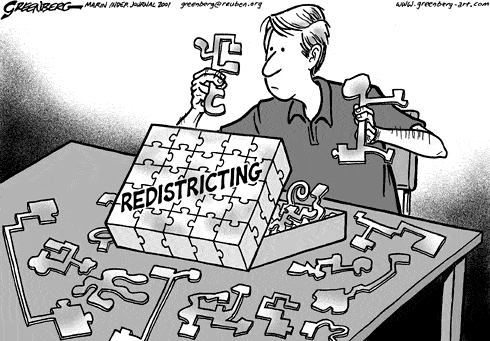
What is redistricting?
a)
the process of establishing the number of representatives in the U.S. Senate
b)
the process of drawing United States and state  electoral district boundaries
c)
the idea that all states should have an equal number of people in Congress
d)
the use of the Census to determine who should run for office
51.

Gerrymandering affects:

a)

The House of Representatives

b)

The Senate

c)

The Presidency

d)

Congress as a whole

52.

What do we call the official count of the population?

a)

Reapportionment

b)

Census

c)

Century

d)

Redistricting

53.

How often does the census occur?

a)

Every 4 years

b)

Every 8 years

c)

Every 10 years

d)

Every 25 years

54.

Only the ____ is reapportioned based on population changes.

a)

Senate

b)

House of Representatives

55.

Which type of gerrymandering concentrates voting power of the opposition into a few districts?

a)

stacked

b)

excess

c)

blocked

d)

wasted

56.

Which type of gerrymandering dilutes voting power of the opposition across many districts.

a)

stacked

b)

blocked

c)

excess

d)

wasted

57.

Which type of gerrymandering involves the drawing of bizarre boundaries?

a)

stacked

b)

blocked

c)

excess

d)

wasted