
 Worksheets
Ch 4 Population Ecology QUIZ
Total questions: 20
Worksheet time: 3600secs
Which limiting factor would increase due to the number of individuals in a population?
Unusual weather
Natural disaster
Births
Disease

What is happening at the 'A' on the graph?
the population overshoots above the carrying capacity
the population stops growing
growth begins to slow down due to limited resources
growth is speeding up due to an abundance of resources
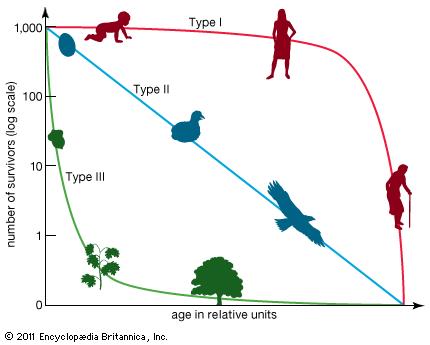
The mortality rate of organisms following a type I survivorship curve is __________.
fairly constant throughout life
higher in post-reproductive years
lower after the organisms become established
unrelated to age
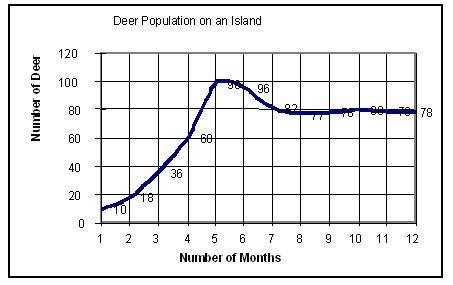
Which choice most closely approximates the deer population's carrying capacity based on the graph?
100
80
60
10
Which of the following populations is most likely to go extinct?
a very small population in an unstable environment
a moderate-sized population of r strategists
a large population with lots of genetic variability
all would be equally likely to go extinct

Which population growth model most closely describes the human population in the modern age?
logistic growth
exponential growth
upward growth
tumor growth
If you are counting the number of deer in Calumet County, you are measuring the
density
population
distribution
growth

Which of the following best describes an analysis of the population distribution graph below?
Stable
Growing
Declining
Cannot be determined

Which of the following best describes an analysis of China's population distribution graph below?
Stable
Growing
Declining
Cannot be determined

The ability to reproduce under ideal conditions, enough space, food, water, lack of predators.
Primary Consumers
Pioneer Species
Biotic Potential
Abiotic Factors
What is a habitat?
A way an animal behaves.
A group of the same animals living together.
A specific place where an animal naturally lives.
When an animal lives in a place that is not their home eg. a zoo
Which contribute to a positive population growth?
immigration
positive birth rate
emigration
positive death rate
What type of factor has an increasing impact as the population size increases?
density-independent
density-dependent
cohort effect
survivorship factor

