wayground logo

Free Printable Worksheets

NEW

Font size

S
M
L
XL
Worksheets

Unit 3: American Revolution

Total questions: 50

Worksheet time: 50mins

Name
Class
Date
1.
After the Boston Tea Party, King George passed a set of laws that included the Quartering Act. The name of these laws were 
a)
the Tea Act.
b)
the Stamp Act.
c)
the Intolerable Acts.
d)
Treaty of Paris.
2.
Why were the colonists OUTRAGED about the Proclamation of 1763?
a)
It made them move west
b)
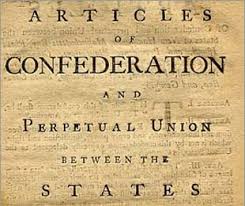
It created a religious divide in the colonies
c)
It stopped them from moving west of the Appalachian Mountains
d)
It did not allow them to move east of the Atlantic Ocean
3.
What was the common slogan used in the Colonies?
a)
"Give me liberty or Give me death"
b)
"No Taxation without Representation"
c)
"No Stamp Act, No Sugar Act"
d)
"Never eat spinach with a stranger"
4.
Who was the King during the American Revolution?
a)
King Arthur
b)
Martin Luther King Jr.
c)
King George III
d)
King Charles II
5.
What is the meaning of taxation without representation?
a)
When people are taxed, but they have no say in the government
b)
When people are taxed twice on the same item
c)
When some people get taxed and others don't
d)
When people in the Colonies are taxed, but no one in England is
6.
Who were the two Nations that fought in the French and Indian War?
a)
Indians and French
b)
Colonists and Britain
c)
Britain and Spain
d)
Britain and France
7.
A secret organization formed to protest the Stamp Act was called
a)
Congress
b)
Sons of Liberty
c)
Parliament
d)
Loyalists
8.
The Sons of Liberty dressed up as Native Americans and threw boxes of tea from a ship into the harbor during the _____________. 
a)
Congressional Meeting 
b)
Boston Massacre
c)
Boston Tea Party
d)
The Second Continental Congress
9.
The Quartering Act required colonists to provide _____________ and __________ for soldiers stationed in their town. 
a)
food & shelter
b)
food & clothing 
c)
Clothing & shelter
d)
Money & food
10.
What law that forced colonists to provide places to live for all the Redcoats in America?
a)
Townshend Acts
b)
Quartering Act
c)
Sugar Act
d)
Navigation Act
11.
Thousands of people died during the Boston Massacre.
a)
True
b)
False
12.
What was stated in the Proclamation of 1763?
a)
Colonists were banned from settling west of the Appalachian Mountains.
b)
Colonists were encouraged to begin settling west of the Appalachian Mountains.
c)
The Proclamation ended the French and Indian War. 
d)
The Proclamation proclaimed independence for the American colonists. 
13.
Who Founded the sons of Liberty?
a)
Benedict Arnold
b)
Christopher Gadson
c)
Samuel Adams
d)
Hercules Mulligan
14.
Why did the king begin to tax the colonists?
a)
He wanted more money to make England look better
b)
He needed money to pay off war debts
c)
He needed money to pay for Boston soldiers
d)
He hated the colonists' guts
15.
What is Salutary Neglect
a)
When a parent drops a child off and never go back to get him/her
b)
When a marine salutes an officer in the army
c)
Britain left the colonies alone to fend for themselves
d)
Not allowing the colonies to interact with Native Americans
16.
Which statement best describes MERCANTILIMS
a)
Great Britain receives raw materials from the Colonies in exchange for charging high prices to the colonies for manufactured goods.
b)
Colonies received raw material from Britain in exchange for their loyalty to the Crown
c)
Britain received manufactured good from the colonies in exchange for guns
d)
Native Americans exchanged fur with the French
17.
Why did Salutary Neglect exist?
a)
Colonists wanted it that way
b)
Distance for the mother country
c)
Indians surrounded the Atlantic Ocean to isolate the colonies
d)
France and Spain wanted to control the colonies
18.
Why did the colonists dump tea into the Boston Harbor (Boston Tea Party)? 
a)
To have a tea party
b)
To protest the British government imposing taxes
c)
To declare war on France
d)
To show agreement with the king
19.
The picture above was published in an American newspaper shortly after the Stamp Act was passed in Britain.  How does this help explain colonial response to the Stamp Act? 
a)
The use of the skull and crossbones indicates that Americans were opposed to the Stamp Act.
b)
It was obviously welcomed since American newspapers were reporting about it.
c)
The colonies were using the skull and crossbones as their primary symbol and they welcomed it.
d)
The Stamp Act was barely even noticed and this picture indicates the Act was dying.
20.
Who wrote a pamphlet called Common Sense, arguing that the time had come for American independence? 
a)
Thomas Jefferson
b)
Benjamin Franklin
c)
Thomas Paine
d)
John Locke
21.
“. . . I challenge the warmest advocate for reconciliation, to show, a single advantage that this continent can reap, by being connected with Great Britain. I repeat the challenge, not a single advantage is derived. Our corn will fetch its price in any market in Europe, and our imported goods must be paid for, buy them where we will. . . .” — Thomas Paine, 1776  

In this statement, Thomas Paine suggested that the American colonies should
a)
negotiate an end to the conflict with England
b)
form an alliance with England
c)
declare independence from England
d)
boycott goods from England
22.
Which branch of government existed when the Articles of Confederation was created?
a)
Legislative (congress)
b)
Judicial (Supreme court)
c)
Executive (President)
d)
Legislative, Executive, and Judicial
23.
Under the Articles of Confederation, which government had the MOST power?
a)
Legislative branch
b)
the president
c)
the state governments
d)
national government
24.
Which of the following is an example of a weakness in the Articles of Confederation?
a)
Congress couldn't collect taxes
b)
Weak national government
c)
Provided no common currency/money for all 13 states
d)
All of the  above
25.
The Articles of Confederation created a ________ national government.
a)
weak
b)
strong
c)
both strong and weak
d)
neither  strong nor  weak
26.
What is the name of the first written plan of government for the newly independent U.S.A.?
a)
Constitution
b)
Treaty of Paris
c)
Declaration of Independence
d)
Articles of Confederation
27.
Under the Articles of Confederation Congress could only pass a law if ____________ out 13 states agreed. 
a)
13
b)
8
c)
9
d)
10
28.

What was the main weakness of the Articles of Confederation?

a)

the federal government was too weak

b)

It had no legislative branch

c)

The judicial was too powerful

d)

The executive was too powerful

29.

What did Shays Rebellion demonstrate to the U.S. Confederal Government?

a)

That the people were not to be trusted

b)

That the Articles of Confederation was too weak and needed to be replaced

c)

That state governments were too strong

d)

That more laws needed to be passed

30.

What would be the best title for this graph?

a)

Federal System of Government

b)

Weaknesses of the Articles of Confederation

c)

Weaknesses of the Declaration of Independence

d)

Weaknesses of the U.S. Constitution

31.

What is depicted or shown in the cartoon?

a)

Weakness of the Articles of Confederation

b)

Problems of the U.S. Constitution

c)

Federalist argument for a weak central government

d)

A colonial legislature

32.

What major era in U.S. history is referred to in the graphic?

a)

Colonial

b)

Civil War

c)

Revolutionary

d)

Reconstruction

33.

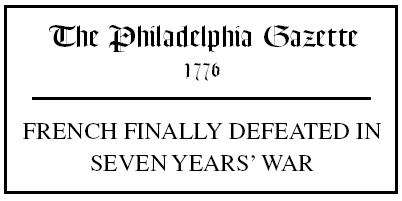
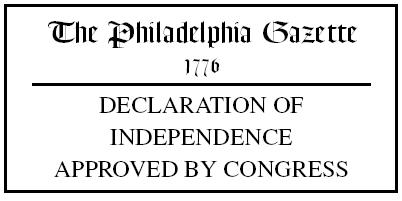
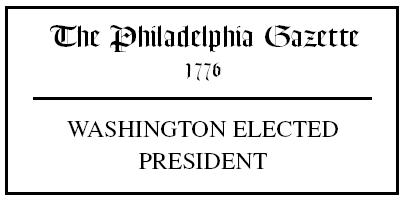
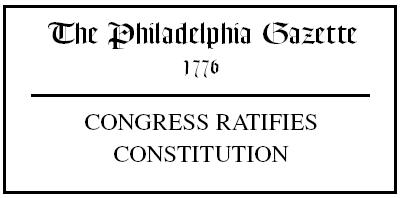
Which newspaper headline would most likely have appeared in Philadelphia in 1776?
a)
b)
c)
d)
34.

The excerpt above shows the growing pre-Revolutionary bias of some American colonists against-

a)

economic controls by Great Britain

b)

the presence of British troops

c)

self-government in the colonies

d)

settlements on the western frontier

35.

The Battle of Saratoga was a turning point in the American Revolution because-

a)

the colonists were defeated and lost possession of New York

b)

Native Americans joined the war against the colonies during the battle

c)

Great Britain was forced to form an alliance with France against the colonies

d)

the colonial victory convinced France to support American Independence

36.

"The shot heard round the world" was fired at the Battle of __________________.

a)

Lexington and Concord

b)

Valley Forge

c)

Saratoga

d)

Yorktown

37.

"We had nothing to eat for two or three days previous...the greatest part were not only shirtless and barefoot, but destitute of (without) all other clothing, especially blankets."


The above quote describes the conditions at

a)

Yorktown

b)

Saratoga

c)

Valley Forge

d)

Lexington

38.

Which excerpt from the Declaration of Independence best explains why colonists were unhappy about their lack of representation in the British parliament?

a)

"He has refused to pass other Laws for the accommodation of large districts of people."

b)

"For imposing Taxes on us without our Consent."

c)

"He has refused his Assent to Laws, the most wholesome and necessary for the public good."

d)

"For transporting us beyond Seas to be tried for pretended offences."

39.

This list includes rights that are considered-

a)

transferable

b)

legislated

c)

unalienable

d)

inherited

40.

Which of these completes this graphic organizer?

a)

Parliament repeals the Stamp and Sugar Acts

b)

King George III allows colonists to petition Parliament for tax relief

c)

Parliament passes the Intolerable Acts

d)

King George III appoints colonial representatives to Parliament

41.

Which of the following groups opposed the Declaration of Independence?

a)

Patriots

b)

Loyalists

c)

Sons of Liberty

d)

Continental Congress

42.

Which Founding Father of the United States had the most significant role in writing the Declaration of Independence?

a)

Thomas Jefferson

b)

George Washington

c)

John Adams

d)

Benjamin Franklin

43.

Which of the following events completes the time line?

a)

British surrender at Yorktown

b)

Americans hold Stamp Act Congress

c)

British occupy Fort Ticonderoga

d)

Americans issue the Declaration of Independence

44.

What is mercantilism?

a)

system of trade that benefitted the Mother Country

b)

allowed American colonists to create their own businesses

c)

taxes passed on all imported goods

d)

required colonists to house and feed British soldiers

45.

Stamp Act

a)

tax passed on all imported goods

b)

tax passed on all printed paper

c)

caught smugglers

d)

3 cent tax on tea

46.

Why was the Battle of Saratoga considered the turning point of the war?

a)

the battle extended the fighting for another year

b)

the American defeat caused American soldiers to leave the army

c)

the Patriot victory convinced France to ally with Americans

d)

it convinced the British that they needed to find more help

47.

Which of the following best completes this diagram?

a)

Colonists sought military support from France

b)

Colonists organized boycotts of British goods

c)

Colonists signed the Declaration of Independence

d)

Colonists dumped tea into Boston Harbor

48.

These acts contributed to the start of the Revolutionary war by-

a)

restricting colonial trade with American Indians

b)

imposing regulation on colonial agriculture

c)

angering colonists who believed that their civil liberties had been violated

d)

punishing colonists for resisting the authority of parliament

49.

What are/were the first battle(s) of the American Revolution

a)

Boston Massacre

b)

Lexington & Concord

c)

Bunker Hill

d)

Yorktown

50.

The ____________________ ended the Revolutionary War, recognized the independence of the American colonies

a)

Writ of Assistance

b)

Treaty of Paris 1783

c)

Common Sense

d)

Proclamation of 1763