
 Worksheets
Review: US History 1st Semester Exam (20-21)
Total questions: 133
Worksheet time: 4hrs 26mins


The business practice described above eventually led to the enactment of legislation that —
guaranteed public access to corporate records
protected consumers by prohibiting monopolies
protected domestic industries from foreign competition
required reciprocity agreements between state governments
How did Andrew Carnegie contribute to civic and social life in the United States?
By promoting spiritual and moral values in public schools.
By supporting conservative ideals in federal legislation and foreign policy.
By establishing philanthropic organizations dedicated to education and the arts.
By creating a charitable foundation to end hunger
Which benefit resulted from the introduction of the Bessemer steel process?
Mechanical reapers to replace horse-drawn reapers
Stronger and cheaper material for railroads and bridges
Transistors for radios
Electric lightbulb
Which application of a new technology can attributed to an invention of Thomas Edison?
Refrigerated railroad cars allowed food to be transported long distances
Light bulbs made it efficient for factory workers to work at night
Diesel engines were used in production of airplanes
Sonar technology was used to track submarines


One way the U.S. government responded to the problems caused by the conditions in this list was by —
passing the Interstate Commerce Act
implementing the silver standard for currency
creating federal jobs program for the unemployed
establishing a new tax on capital gains

How did the expansion of railroad transportation most benefit farmers in the United States?
By raising the consumer price of agricultural products
By increasing the variety of locally grown crops
By providing farmers with affordable access to distant markets

Which result completes this diagram?
Ratification of a suffrage amendment
Building of the transcontinental railroad
Passing of prohibition legislation
Expansion of labor unions
The Knights of Labor and the American Federation of Labor developed in response to the —
increased need to protect worker interests
decreased power of political machines
increased demand for skilled workers
decreased profitability of the agricultural sector
Which of the following occurred between 1865 and 1900 as a result of the rapid industrialization of the United States?
Social and economic class divisions began to disappear
Concerns about air pollution led to stricter environmental regulations
Union membership increased as workers sought better pay and conditions
Factory owners introduced wage-equality policies for women in the workplace

What was the main reason given for the creation of these restrictions?
Preventing the depletion of natural resources
Discouraging anti-American activism
Reducing competition for U.S. jobs
Addressing a lack of urban housing

During the late nineteenth century, many Irish immigrants were discriminated against for being —
opposed to machine politics
loyal to the United Kingdom
conscientious objectors
Roman Catholics

A high school teacher wrote these bullet points on the whiteboard. What was most likely the topic of discussion?
Reasons for immigration to the United States
Principles of social Darwinism
Objectives of the Grange movement
Goals of U.S. assimilation policies
The Chinese Exclusion Act of 1882 was primarily a response to
increased U.S. presence in China
competition for jobs on the West Coast
rapid population growth in the Northeast
China's actions during the Boxer Rebellion


Which factor prompted the Americanization movement of the early twentieth century?
The increasing numbers of immigrants from Eastern and Southern Europe
The strengthening of Jim Crow laws in the southern United States
The rising tensions between the United States and the Soviet Union
The growing concern about environmental issues in the western United States

In 1895 the Department of Street Cleaning in New York City created a permanent group of sanitation workers known as the White Wings. This image shows the White Wings at work in 1896.
Increased urban population
The passage of labor laws
Decreased regulation of urban rail systems
The establishment of immigration quotas

Which demographic change in the United States is most associated with this transformation?
Increased property values in rural areas
Increased life expectancies in urban areas
Increased birth rates in rural areas
Increased migration to urban areas
Which example best defines a historical era?
A piece of landmark legislation
A genre of music and food specific to a region of a country
A collection of art by a world renowned artist
A period of time characterized by certain political, social, or economic events
Which of these is the best definition of an era?
A period of time identified by political, economic, or social trends
A series of various changes over many years
A series of events unified by individual or organized protests
A period of time lasting between 10 and 15 years
Which of the following best characterizes the Gilded Age?
The discovery of goldfields in the West led to an increase in the amount of money issued for circulation.
Industrialists used their connection with corrupt government officials for material gain and political power
In the Deep South a sharp increase in immigration brought a boom in construction and industry
Small, family-owned farms were bought and consolidated to form large agricultural corporations
The primary objective of the Dawes Act was to
promote cultural assimilation of American Indians
turn American Indian reservations into corporate farmland
end warfare between American Indians and the U.S. military
promote American Indian investment in private industry

Tom Torlino, Navajo As He Entered the As He Appeared Three School in 1882 Years Later
These photographs are of the same student at Carlisle Indian School during the late nineteenth century.
Which word best explains the changes shown in these photographs?
Immigration
Assimilation
Nullification
Nativism

What is the best title for this list?
How sharecroppers lived in the deep south
Ways migrant workers lived in the Southwest
How miners took advantage of Gold Rush opportunities
Ways settlers adopted to life on the Great Plains

Which factor facilitated statehood for the darker shaded areas?
The introduction of barbed wire throughout the Great Plains.
The expansion of railway lines throughout the West.
The acceptance of Mormons by other religious sects in the East.
The peaceful integration of settlers with American Indian populations.
Which of the following contributed most to increased settlement of the Great Plains?
The availability of buffalo
The discovery of precious metals
A series of federal land grants
A decreased in agricultural production

The process described above led to
peaceful resolution of territorial disputes with American Indians.
the establishment of agricultural communities on the American frontier.
federal regulation of agriculture.
a decline in immigration to urban areas.
How did the completion of the Transcontinental Railroad contribute to the settlement of the West?
By providing people with access to essential goods
By raising money to build factories along the routes
By giving funds to local leaders to build schools
By establishing military forts along the routes


Why did the Populist party want unlimited coinage of silver?
To increase the amount of money in circulation and raise farm prices
To raise campaign contribution limits
To reduce economic inflation
To decrease the bargaining power of labor unions

Which American value is described in this excerpt?
Individualism
Populism
Liberty
Laissez - faire

Which value important to America’s success as a constitutional republic is best illustrated in this excerpt?
Social justice
Populism
Laissez-faire
Egalitarianism

Which value is best reflected in this excerpt?
Liberty
Populism
Laissez-faire
Egalitarianism

What is one way the Progressive Era reform outlined in this diagram has affected U.S. politics?
More women have been elected to Congress.
Citizens have a more direct influence on lawmaking.
Corrupt officials can be removed from office.
Primary elections are prohibited in several states.
During the Progressive Era, one goal of state-level political reformers was to —
prevent party leaders from amending campaign platforms
increase the influence of business owners on regulatory legislation
promote the principle of direct democracy
limit the use of judicial review by circuit courts
The creation of initiative, referendum, and recall procedures during the Progressive Era resulted in —
a system of separate schools for new immigrants
the expansion of citizens’ direct participation in the democratic process
a redistribution of the tax burden among citizens
more sources of revenue for state governments

What were photographs such as this one taken by Lewis Hine primarily intended to accomplish?
Encourage leaders to make segregation in schools illegal
Document labor conditions during an economic crisis
Depict the evils of capitalism in communist propaganda
Focus attention on the need for child labor reforms
In response to public concern over issues raised by Upton Sinclair's the Jungle, the federal government expanded its role in -
working with labor unions to increase worker salaries
taking responsibility for the safety of consumers
setting limits on the growth of private industry
implementing social welfare programs

Which of the following was implemented in 1913 to solve these problems?
Each state held party conventions in order to select senators
A national referendum was held to standardize the procedures for selecting senators
Open primaries were used to limit the choices of senators who could be confirmed by state legislatures
A constitutional amendment was ratified that required senators to be elected directly by popular vote
26. This model was evident in the United States through the works of —
In 1884 Toynbee Hall was founded in a poor neighborhood in London. The primary mission of Toynbee Hall was to offer services to those in need, but it also gave university students first-hand experience with the effects of poverty. This allowed the students to develop practical solutions to further assist people in need. Many reformers in the United States soon adopted this model.
Frances Willard and her support of the temperance movement
A. Philip Randolph and his protests during World War II
Jane Addams and her programs for new immigrants
Eugene V. Debs and his establishment of the American Railway Union
Which of these was a major goal of Jane Addams’s Settlement House movement in Chicago?
The founding of women’s colleges
The introduction of prison reform
The assimilation of immigrants
The establishment of public libraries

These lyrics are representative of a movement that culminated in a constitutional amendment during the —
Harlem Renaissance
New Deal
Reconstruction Era
Progressive Era
How did the Nineteenth Amendment expand the democratic process?
By prohibiting discrimination in voting on the basis of race
By eliminating the poll tax
by prohibiting discrimination in voting on the basis of gender
by lowering the voting age

The issue addressed in this political cartoon was later settled by --
the creation of the Temperance Society
the repeal of the 18th Amendment
the initiation of the Settlement House movement
the ratification of the 19th Amendment

The Progressive goal of to implement women's suffrage was accomplished by:
a national referendum
an executive order
a Supreme Court decision
a constitutional amendment


Which caption best replaces the question mark in this photograph?
Abolish the Poll Tax and the Literacy Test
Demand the Direct Election of Senators
Come in and Learn Why Women Ought to Vote
Lower the Voting Age for Women to Eighteen
Which of these contributed to the ratification of the Eighteenth Amendment?
Veteran soldiers protesting to obtain benefits
The growing political influence of women
Politicians campaigning for education reform
The growing number of workers organizing into labor unions


We claim for ourselves every single right that belongs to a freeborn American, political, civil and social; and until we get these rights we will never cease to protest and assail the ears of America. The battle we wage is not for ourselves alone but for all true Americans.
—W. E. B. Du Bois, Niagara Movement Address to the Country, 1906
How did the ideas presented in this address affect the early Civil Rights movement in the United States?
By encouraging African Americans to achieve equality through vocational education
By directly supporting Marcus Garvey’s Black Star Steamship Line
By encouraging African Americans to accept Jim Crow laws
By forming the basis for the National Association for the Advancement of Colored People (NAACP)
Which groups were most influential in passing the Pure Food and Drug Act?
Southern farmers and clergy members
Factory owners and bankers
Muckrakers and women’s organizations
College students and immigrants
And shortly afterward . . . a physician, made the discovery that the carcasses of steers which had been condemned as tubercular by the government inspectors . . . were left upon an open platform and carted away to be sold in the city. . . . —Upton Sinclair, The Jungle, 1906
Public response to revelations such as the one in this excerpt led to the establishment of regulations that were eventually enforced by the —
Food and Drug Administration
Centers for Disease Control
Department of Commerce
Institution of Education Sciences

30. What was the most likely topic of discussion between these men? President Theodore Roosevelt and John Muir on Glacier Point, Yosemite Valley, California, 1903
F. Limiting the power of major railroad companies
G. Creating alternative maritime shipping routes
H. Designating additional land as national parks
J. Reducing the influence of environmental lobbyists

What was the primary result of this legislation?
States instituted their own environmental regulations.
Settlement on lands with fragile ecosystems was prohibited.
Monopolies seized control of natural resources.
National parks were create as a way to manage land resources.

What was the purpose of the Pure Food and Drugs Act of 1906?
To protect consumers by regulating the food and drug industry
To lower the cost of essential foods and drugs for consumers
To prevent shortages by regulating the supply of food and drugs
To reduce production costs for food and drug manufacturers

What was the most likely result of the publication of images such as this 1906 political cartoon?
The government passed the Sherman Antitrust Act.
Private companies refused to import foreign foods.
The government passed the Pure Food and Drug Act.
Labor unions protested unsafe working conditions.


Which numbered territory did the United States gain by winning the Spanish American War?
1
2
3
4
Which numbered territory did the United States gain by winning the Spanish American War?
1
2
3
4

Which of the following best replaces the question mark in this list of information about Puerto Rico?
Became a U.S. state during the Reconstruction era
Was ceded to the United States as a result of the Spanish-American War
Signed an annexation treaty with the United States after World War I
Was promised U.S. military protection as part of Woodrow Wilson's Fourteen Points

How did these events affect of the United States?
The increased public support for cuts in US defense spending
They prompted the end of Dollar Diplomacy in Latin America
They set a precedent of including territorial acquisitions in settlements
They helped establish the United States as an imperial power similar to European nations
What was one economic effect of the Spanish-American War?
The United States gained direct access to additional natural resources and overseas markets.
Shipbuilding industries in the United States declined.
Demand for coal and petroleum as energy sources declined.
New free and fair trade treaties were established between the United States and developing countries.

Which of the following was primarily responsible for the change depicted in this illustration?
New immigrant screening procedures at Ellis Island
A crackdown on anarchism after the assisination of President William McKinley
Overseas expansion associated with the Spanish American War
An increase in circulating currency after the discovery of gold in Nome, Alaska.


This cartoon comments on tactics used to-
(2017-4a)
secure the southern border of California.
protect shipping lanes in the Great Lakes
create a defensive alliance with France.
obtain control of the Panama Canal Zone.


What was the main effect of the changes shown in the graph on the western United States?
Immigration from Europe to western U.S. cities increased rapidly.
Western U.S. businesses trade more efficiently with the East Coast and Europe.
Asian businesses bypassed the West Coast to trade directly with the East Coast.
Western States recruited quest workers from the Caribbean and South America.

Which outcome was an important effect of the 1898 event illustrated by this map?
Increased U.S. foreign aid to the developing countries in South America
Increased U.S. public support for the construction of a canal through Central America
Decreased U.S. economic influence in the Western Hemisphere
Decreased U.S. naval presence in the Caribbean Sea

This cartoon depicts President Woodrow Wilson calling on Congress to —
ratify the Treaty of Versailles
issue a declaration of war against Germany
authorize the use of funds to support Russian revolutionaries
enact trade sanctions against Germany
*Rise of Militarism
*Political interference in the Balkan Peninsula
*The Triple Entente vs. Central Powers
Which of the following is the best title for this list?
Issues Contributing to the Outbreak of World War I
Principal Reasons for U.S. Entry into World War II
Consequences of Twentieth-Century European Isolationism
Economic Rivalries Between Cold War Superpowers


This photograph shows a military tactic that --
made troops more vulnerable to long-range missiles, resulting in heavy casualties
required highly skilled soldiers, resulting in lengthy training periods
made frontal assaults difficult, resulting in long periods of stalemate
required the ability to attack quickly, resulting in a reliance on cavalry forces
During World War I, tanks were used on the western front primarily to-
lead infantry advances across no-man's land and into enemy territory
destroy railroads and bridges used by enemy troops
release chemical weapons in advance attacks on enemy positions
launch long-range rockets at enemy aircraft


Which action completes this diagram?
Submarines attacked unarmed ships
Armored tanks crossed fortified lines
The use of machine guns resulted in massive casualties
Airplanes conducted reconnaissance missions
Which pull factor contributed to the Great Migration?
The availability of land grants for homesteaders
Economic opportunities in industrialized cities
Better soil conditions in previously uncultivated areas
The lower cost of living in urban areas


This 1917 illustration was published as a commentary on a proposed piece of legislation. Which of the following best replaces the question mark in the illustration?
Pendelton Act
Dyer Anti-Lynching Bill
Standard Time Act
Espionage Act


Senator Lodge made this statement in opposition to-
(2017-4f)
U.S. membership in the League of Nations
the funding of a massive buildup of the U.S. Navy
a relaxation of U.S. citizenship requirements
U.S. entry into the Spanish-American War

One reason this provision was included in the Treaty of Versailles was to -
create a democratic government in Germany
divide Germany into smaller states to be governed by Allied countries
grant independence to all German colonies
weaken the power of Germany in the international community
President Woodrow Wilson's Fourteen Points supported Poland by calling for its-
establishment as a Soviet satellite nation
annexation by great Britain
establishment as an independent nation
inclusion in one of the larger empires

Which action did the federal government take to recognize these soldiers?
Passing the GI Bill to give them educational benefits.
Awarding them the Congressional Medal of Honor for actions above the call of duty.
Providing them with monetary bonuses for demonstrating courage under fire.
Awarding them battlefield promotions from enlisted to officer.
The Roaring Twenties were characterized by-
internment camps, the rationing of goods, and the first use of an atomic bomb
bank failures, the New Deal, and bread lines
installment plans, prohibition, and flappers
brinkmanship, McCarthyism, and a policy of containment
Which of these is an example of a successful innovation of the assembly- line production model?
a social media company initiates a new privacy policy for its subscribers
a financial adviser redistributes money throughout a customers portfolio
a computer is built to a purchaser's specification using the availability of supplies
a cable-television company updates its system to include more chanels

How did these developments in transportation most affect the standard of living in the U.S. cities?
By increasing the expenses associated with relocation
By giving residents more flexibility in employment
By expanding the options for personal education
By increasing traffic congestion on city streets
During the 1920s, what was one result of innovations in U.S. transportation technology?
Commercial airplanes replaced ocean liners as the primary means of travel to Europe.
Mass-produced automobiles made travel more affordable for many people.
Cable cars provided a comfortable means of quick travel to any city within a state.
Container ships delivered agricultural goods to ports along the Pacific coast.


(2017)How did the introduction of these new practices most benefit U.S. business?
By increasing production efficiency
By preventing shortages of goods
By increasing protective tariffs
By decreasing exports
Why did the “Return to Normalcy” agenda of U.S. presidential candidate Warren G. Harding appeal to many voters in the 1920 election?
The public wanted to concentrate on domestic economic issues.
The public wanted to help rebuild war-torn countries.
There were significant shortages of military supplies
There was a decrease in demand for consumer goods.


The establishment of speakeasies in the 1920s was an unintended consequence of which federal government action?
The taxation of imported luxury goods
The deportation of suspected communist sympathizers
The prohibition of the sale of alcoholic beverages
The implementation of immigration restrictions


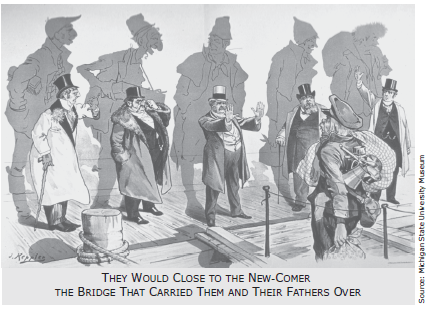
Cartoons such as this one took the position that deportation was necessary because--
assimilation programs in the US has been unsuccessful
economic decline had increased the competition for jobs
communists were infiltrating the US
political machines had too much power in urban areas

Which inference about the 1920's is supported by this illustration?
Women confronted discrimination in employment and education
Women challenged traditional attitudes and social norms
Reform organizations targeted women's issues
Mass media reflected trends popular in rural communities
Which of the following identifies two effects of the Harlem Renaissance?
o Increased geographic concentration of African Americans
o Increased popularity of venues featuring African American Artists
o Founding of colleges for African Americans
o Founding of the Socialist Party
o Founding of Tuskegee University
o Migration of African Americans to western states
o Ratification of constitutional amendments ensuring right for African Americans
o Increased support for the prohibition of alcoholic beverages
Which of these cause-and-effect relationships is accurate?
The ideas of social Darwinism led to the passage of Prohibition laws.
The signing of the Treaty of Versailles contributed to the implementation of the New Deal.
The ideas of the Harlem Renaissance influenced the growth of the Civil Rights movement.
The rise of fascism in Italy influenced the onset of the Red Scare
Which of the following was a major contribution of the Harlem Renaissance to US culture?
It led to the increased popularity of vaudeville stage performers.
It brought the most significant beat poets together.
It established jazz as a prominent musical form.
It focused attention on the antiwar literary genre.

The economic conditions described in this excerpt contributed to --
a global economic depression
an increase in foreign investments in the US market
the adoption of the gold standard
an increase in free market activity

Lines like the one shown above were partially the result of —
growing demand for payment of military pensions
a sudden increase in agricultural exports
the passage of the Selective Service Act
widespread business failures

Which of the following best completes this diagram?
Led to a decrease in U.S. international trade
Helped stabilize the U.S. economy
Strengthened U.S. relationships overseas
Led to a decline in U.S. unemployment

Which of these factors contributed most to the Dust Bowl?
Flash flooding and intense deforestation.
Prolonged drought and poor farming practices
High winds and railroad construction
Severe heat and rapid suburban development.

Which of the following contributed most to the situation described in this excerpt?
The rise of corporate monopolies
Strict banking regulations and high income tax rates
The influx of immigrants into urban areas
High unemployment and widespread home foreclosures
Emilia Castaneda was born in Los Angeles to Mexican parents. In 1935, she and her father and brother were forced to board a train bound for Mexico.
This excerpt describes an instance of deportation during the 1930s as part of a repatriation effort. Why did the federal government implement repatriation?

