
 Worksheets
Chapter 12 : Introduction to Plants : Holt Science & Tech
Total questions: 29
Worksheet time: 10mins
Which of the following is thought to be the ancestor of land plants?
bacteria
red algae
ferns
green algae
Organisms that produce their own food are called __________.
heterotrophs
autosomes
autotrophs
herbivores
The sac inside a plant cell where water, food, and wastes are stored is the _____.
vacuole
chloroplast
chlorophyll
cuticle
Two structures found in plant cells but NOT in animal cells are _______.
cell wall and cell membrane
chloroplast and cell membrane
cell wall and chloroplast
vacuole and nucleus
What plant structure helps it retain water?
leafs
stem
cuticle
roots
During photosynthesis, plants do NOT produce ___________.
oxygen
carbon dioxide
food for itself
The green pigment found in specialized plant ctructures is called chlorophyll.
true
false
What is the tube-like structures inside a plant through which water, minerals, and food move?
roots
vascular tissue
cuticles
vacuoles
Nearly all plants are unicellular.
true
false
The energy for photosynthesis comes from the sun
true
false
Seedless vascular plants reproduce by...
Seeds
Spores
Pollen
Rhyzoid
Select all plant groups that are seedless vascular.
mosses
horsetails
hornworts
club mosses
ferns
Seedless vascular plants transport materials from cell to cell.
True
False
Seedless vascular plants have real roots, stems and leaves.
True
False
Why do seedless vascular plants need moist surroundings to survive?
Because they transport materials slowly.
Because they do not have real roots.
Because they reproduce by spores.
Because they do not have cuticle.
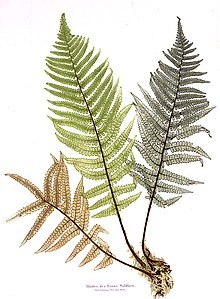
How many fronds can you see on the image?
1
2
3
4
Which of the following plants grows mostly near streams or in moist woodlands?
Club moss
Moss
Liverwort
Hornwort
Water lilly
Nonvascular and seedless vascular plants reproduce by...
Seeds
Spores
Pollen
Flowers
Seedless vascular plants are able to transport materials throughout the plant.
True
False
What is a gametophyte?
The stage that produces sperm cells and egg cells.
The spore-producing stage.
The rhizomes that produces roots and leaves.
The slender, hairlike threads of cells.
Why do bryophytes have to be around water part of the year?
So they are able to stay wet
So they can anchor in the soil better
So the sperm can swim to the egg.
So they can tolerate low temperatures
Ferns are a type of
Nonvascular Plant
Nonvascular plant
algae
Seedless vascular plant
Plants that have tube-like tissues inside them to transport water and nutrients are called
vascular plants
nonvascular plants
rhizoids
conifers
Which of the following is NOT a characteristic of seed plants?
They have highly developed vascular tissue.
They can only survive in moist environments.
They use pollen to reproduce.
They use seeds to reproduce.
They have true roots, stems and leaves.
A structure that contains a young plant in a protective coating is called _____________.
Spore
Seed
Sperm
Ovary
Select the term which closely describes what a "cotyledon" is.
seed stem
seed coat
seed root
seed leaf
Why do plants need to disperse their seeds as far as possible?
To cover more land area.
To not compete for resources.
To be better than other plants.
To evolve faster.
In the world, you can find several species of nonvascular seed plants.
True
False
Seed plants are classified into two groups: gymnosperms and angiosperms.
True
False

