Wayground logo

Free Printable Worksheets

Font size

S
M
L
XL
Worksheets

AQA Chemistry - Electrolysis

Total questions: 27

Worksheet time: 18mins

Name
Class
Date
1.
What is electrolysis?
a)
breaking down of a compound using a current
b)
making a compound using a current
2.
Which statement correctly describes the 2 electrodes?
a)
The anode is negative and the cathode is positive
b)
The anode and cathode are both positive
c)
The anode is positive and the cathode is negative
d)
The anode and cathode are both negative.
3.
What is the name given to the solution that is being electrolysed?
a)
Salt solution
b)
Electric solution
c)
Mineral solution
d)
Electrolyte
4.
It is essetial that the electrolyte is a liquid so that...
a)
Charged ions can migrate towards the electrodes. 
b)
Charged ions can migrate towards the electrodes.
c)
The solution can move around.
d)
The current can flow through it.
5.
Positive ions (cations) will move towards the cathode (-) where they will discharge by....
a)
Breaking apart
b)
Losing electrons
c)
Clumping together.
d)
Gaining electrons
6.
When NaCl solution is electrolysed what has forms at the anode?
a)
Hydrogen
b)
Oxygen
c)
Chlorine
d)
Sodium
7.
What is the equation to show what happens to Cl ions at the anode.
a)
Cl- --> Cl + e-   
b)
2Cl- --> Cl2 + 2e-   
c)
Cl2 + 2e-   2Cl- 
d)
Cl2 + 2e-  -->  2Cl- 
8.

___________ electrode is an inert electrode.

a)

Copper

b)

Iron

c)

Carbon

d)

Zinc

9.

Choose the half-equation that shows the discharge of aluminium ion.

a)

Al3+ - 3e- --> Al

b)

Al2+ + 3e- --> Al

c)

Al3+ + 3e- --> Al

d)

Al3+ --> Al + 3e-

10.

Ionic compounds do not conduct electricity when they are solid because,

a)

their electrons are not free to move

b)

their ions are free to move

c)

their ions are not free to move

d)

their electrons are free to move

11.
In an aqueous solution of copper chloride, which ions are attracted to the negative electrode?
a)
Cu2+ and Cl- and H+ and OH-
b)
Cu2+ and H+ 
c)
 Cl- and OH-
d)
Cu2+ 
12.

What are the ions present in molten Al2O3?

a)

Al2+ and O3-

b)

Al2- and O3+

c)

Al3+ and O2-

d)

Al3- and O2+

13.

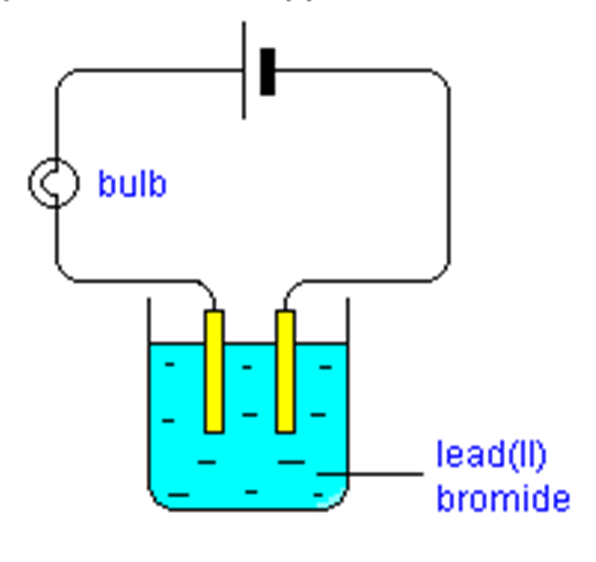
The diagram shows the electrolysis of lead(II) bromide using inert electrodes. Why does the bulb only light up when the lead(II) bromide is melted?

a)

Bromine atoms in lead(II) bromide are converted to ions when it is melted

b)

Electrons flow through the lead(II) bromide when it is melted

c)

The ions in lead(II) bromide are mobile charge carriers in the molten state.

d)

There are no ions in solid lead(II) bromide

14.
What is the product formed at the anode during the electrolysis of concentrated copper(II) chloride?
a)
copper
b)
chlorine
c)
hydrogen
d)
oxygen
15.

What is the half-equation for the discharge of hydroxide ions?

a)

2O2- --> O2 + 4e-

b)

OH- --> OH + e

c)

4OH- --> 2H2O + O2 + 4e-

d)

2H2O + O2 + 4e- --> 4OH-

16.

If the fork is to be electroplated with silver metal, what electrolyte should be used?

a)

Molten silver chloride

b)

Aqueous silver nitrate

c)

Sodium chloride solution

d)

Copper(II) sulphate solution

17.

The picture shows electrolysis of copper(II) sulphate solution using graphite electrodes. Besides formation of brown solid on the cathode, what other observations can be made?

a)

The mass of graphite anode decreases.

b)

The blue colour solution becomes paler.

c)

Bubbles of gas form at the anode.

d)

The blue colour solution becomes darker.

18.

What is the name of the ore that contains aluminum

a)

Bauxite

b)

Cryolite

c)

Aluminum oxide

19.

Which is not a reason that cryolite is used in aluminum extraction?

a)

Cryolite dissolves aluminum oxide

b)

Cryolite reduces the melting point of aluminum oxide

c)

Cryolite decreases the cost of aluminum extraction

d)

Cryolite removes impurities from aluminum oxide

20.

The anode has to be replaced because

a)

The oxygen reacts with the carbon anode to form carbon dioxide

b)

Aluminum reacts with the carbon to form aluminum carbide

c)

The anode gets impurities that impact the extraction

21.
What is an ore?
a)
a solid metal
b)
a rock cantaining a metal combined with other elements
c)
an element
d)
an object used to row a boat
22.
What is the removal of oxygen from a substance called?
a)
reduction
b)
extraction
c)
electrolysis
d)
oxidation
23.
What is oxidation?
a)
loss of oxygen
b)
gain of electrons
c)
gain of hydrogen
d)
loss of electrons
24.
Which series is used to predict the reactions of metals with carbon and other elements?
a)
reactionary series
b)
reaction series
c)
redox series
d)
reactivity series
25.

Which of the following solutions would produce hydrogen gas at the cathode upon electrolysis?

1 Dilute nitric acid

2 Aqueous potassium hydroxide

3 Aqueous sodium chloride

a)

1 only

b)

1 and 2

c)

2 and 3

d)

All of the above

26.
What does the Cathode (-) do to ions?
a)
Give electrons to the Positive ions to turn them back into atoms
b)
Take electrons from the positive ions?
c)
Turn ions back into atoms by removing electrons
d)
Turn atoms into ions by adding electrons
27.

Why is electrolysis of aqueous (dissolved) solutions more complicated than molten?

a)

Water is messy

b)

Water contributes hydrogen and hydroxide ions to the electrolyte

c)

It is easier to dissolve some substances in water than to melt them