wayground logo

Free Printable Worksheets

Font size

S
M
L
XL
Worksheets

IIT-JEE & NEET LEVEL-2 (8-O)

Total questions: 100

Worksheet time: 2hrs 40mins

Name
Class
Date
1.
Convert 0.444... to a fraction.
a)
4/10
b)
4.4/99
c)
4/9
d)
2/5
2.
a)
2/3
b)
-2/3
c)
3/5
d)
-3/5
3.
Is 64 divisible by 2?
a)
Yes
b)
No
4.
70 can be evenly divided by which number?
a)
5
b)
10
c)
2
d)
All of the above
5.
What is the divisibility rule for 3?
a)
Add up the digits. The sum must be even and divisible by 3.
b)
The digits must add up to 9.
c)
The last digit must be a 3.
d)
Add up the digits. The sum must be divisible by 3.
6.
You have two numbers, 20 and 100. What number can you divide out of both of them?
a)
3
b)
10
c)
9
d)
15
7.
What is the divisibility rule for 5?
a)
The digits must add up to 10.
b)
The last digit needs to be a 5 or 0.
c)
The last digit can only be a 5.
d)
The sum of the digits need to be divisible by 5.
8.

252 is divisible by 9 because:

a)

The digits add up to 18.

b)

The sum of the digits is divisible by 9.

c)

It's even and the sum of the digits is divisible by 3.

d)

The sum of the digits is even.

9.
List the first 5 multiples of 3
a)
3, 6 10, 15, 20
b)
1, 3
c)
3, 6, 9, 12, 15
d)
6, 9, 12, 15, 18
10.
Find the HCF of 21 and 28
a)
3
b)
4
c)
7
d)
14
11.
What is the LCM of 4 and 12? 
a)
4
b)
8
c)
12
d)
16
12.
Find the HCF of 40 and 60?
a)
10
b)
20
c)
30
d)
None of the above
13.

Find the HCF of 12 and 16...

a)

2

b)

4

c)

6

d)

8

14.

Which one are prime number?

a)

13, 19, 23,50

b)

41,59, 71, 84

c)

53, 59, 71, 79

d)

None of above

15.

Which one is NOT prime number?

a)

97

b)

89

c)

127

d)

95

16.

What are the factors of 25?

a)

1,2,5,10

b)

1,2,5,25

c)

1,5,25

d)

3,5,15,25

17.

Find the HCF of 30 and 25

a)

5

b)

6

c)

10

d)

15

18.
Identify the property
a + b = b + a
a)
Identity of addtion
b)
commutative of addition
c)
associative of addition
d)
symmetric
19.

Identify the property

(a ⋅ b) ⋅ c = (c ⋅ b) ⋅ a

a)

commutative property of multiplication

b)

identity property of multiplication

c)

inverse property of multiplication

d)

associative property of multiplication

20.
Pick the answer that is an example of the commutative property of multiplication
a)
b + c + a = a + b + c
b)
a(b + c) = ab + ac
c)
a ⋅ b = b⋅ a
d)
a ⋅ 1 = a
21.

What is the atomic number?

a)

the number of protons in the nucleus

b)

the number of protons and neutrons in the nucleus

c)

the number of neutrons in the nucleus

d)

the number of protons in the energy levels

22.

What is the mass number?

a)

the number of protons in the nucleus

b)

the number of protons and neutrons in the nucleus

c)

the number of neutrons in the nucleus

d)

the number of protons and electrons in the atom
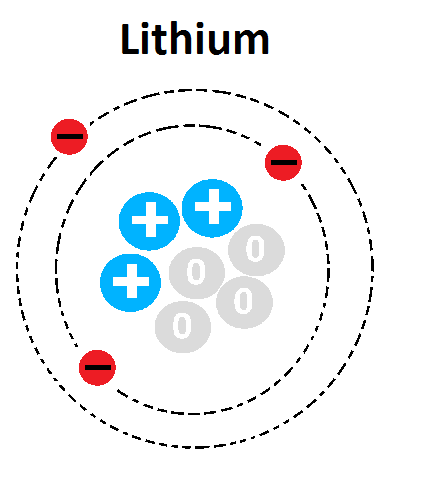
23.

What is the atomic number of this atom?

a)

1

b)

3

c)

4

d)

7

24.
Most of the mass in an atom is made up of _____________________?
a)
protons and electrons
b)
protons and neutrons
c)
neutrons and electrons
d)
electrons and quarks
25.

What does the 6 represent?

a)

Atomic mass

b)

atomic number

c)

chemical symbol

d)

element name

26.
What subatomic particles would you find in the nucleus of an atom?
a)
Protons only
b)
Protons and Neutrons
c)
Neutrons and Electrons
d)
Protons and Electrons 
27.
Which subatomic particles contribute the most to the mass of an atom?
a)
Protons, Neutrons, Electrons
b)
Protons only
c)
Protons and Electrons
d)
Protons and Neutrons
28.

How many electrons does this atom have?

a)

2

b)

4

c)

6

d)

10

29.
The atomic number of an element that has 9 protons, 9 electrons, and 10 neutrons is _____.
a)
9
b)
10
c)
19
d)
28
30.
Where is most of the mass in an atom located?
a)
in the nucleus
b)
in the protons
c)
in the neutrons
d)
in the electrons
31.
An atom has an atomic number of 15 and a mass number of 31. How many protons are there in the atom?
a)
15
b)
31
c)
16
d)
47
32.
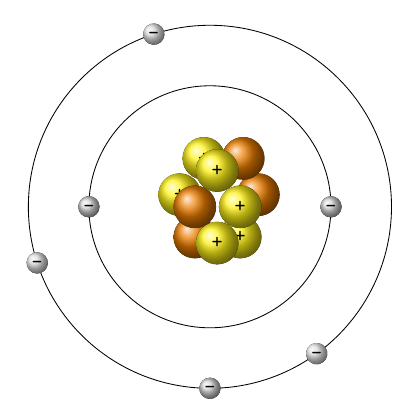
What is the atomic number of the atom pictured? 
a)
9
b)
10
c)
18
d)
19
33.

What is the smallest unit of matter? It is composed of protons and neutrons, held together in the nucleus, and electrons around the nucleus in different electron orbitals, which form an electron cloud.

a)

cell

b)

nucleus

c)

atom

d)

electron

34.
Particles in an atom that are neutral and have no charge are 
a)
negatrons 
b)
electrons 
c)
neutrons 
d)
protons 
35.
an atom with atomic number 6 would have how many protons 
a)
6
b)
12
c)
3
d)
cannot be determined 
36.
How many protons are in the element, "Sodium?"
a)
23
b)
11
c)
13
d)
14
37.
What is the atomic number for an element with three protons?
a)
2
b)
1
c)
3
d)
6
38.
A particle that moves around the nucleus is a(n)...
a)
Proton
b)
Neutron
c)
Electron
d)
Quark
39.
Most of the mass in an atom is concentrated in the...
a)
electrons
b)
nucleus
c)
protons
d)
empty space
40.
What does the nucleus consist of?
a)
Protons + Electrons
b)
Neutrons + Electrons
c)
Atoms
d)
Protons + Neutrons
41.

The diagram shows part of a ruler. The ruler is used to find the length of a nail.

What is the length of the nail?

a)

2.2 cm

b)

2.7 cm

c)

3.2 cm

d)

3.7 cm

42.

Four athletes run twice around a track. The table shows their times at the end of each lap. Which athlete runs the second lap the fastest?

a)

A

b)

B

c)

C

d)

D

43.

The diagrams show the readings on a measuring cylinder before and after a small metal cube is added.


How many MORE identical cubes can be added to the cylinder, without causing the water to overflow? DO NOT INCLUDE THE CUBE ALREADY IN THE CYLINDER.

a)

1

b)

2

c)

3

d)

4

44.

A cylindrical can is rolled along the ruler shown in the diagram.

The can rolls twice. What is the circumference (distance all round) of the can?

a)

13 cm

b)

14 cm

c)

26 cm

d)

28 cm

45.
What SI unit is used to measure electric current?
a)
seconds
b)
amperes
c)
Kelvin
d)
mole
46.

T or F: Square meter is a SI derived unit to measure the area of a 2-dimensional figure.

a)

True

b)

False

47.

SI stands for ___.

a)

Sports Illustrated

b)

Scientific Notation

c)

International System (of measurements)

d)

Instructional System (of measurements)

48.
Which of the following pairs of physical quantity and SI unit is correct ?
a)
Mass - SI unit : Gram
b)
Time - SI unit : Hour
c)
Electric current - SI unit : Volt
d)
Temperature - SI unit : Kelvin
49.
What is base quantities ?
a)
the branch of science concerned with the nature and properties of matter and energy
b)
the branch of science that deals with the identification of the substances of which matter is composed
c)
physical quantities that cannot be defined in terms of other physical quantities
50.
What is derived quantities ?
a)
a tendency to do nothing or to remain unchanged.
b)
combination of two or more base quantities
c)
the quantity of motion of a moving body, measured as a product of its mass and velocity.
51.
The SI base unit is
a)
second
b)
minute
c)
millisecond
d)
hour
52.

What is the derived unit for volume?

a)

square meter

b)

cubic meter

c)

kilograms per cubic meter

d)

grams per mole

53.

What is the derived unit for energy?

a)

Watts

b)

Kilojoules

c)

joules

d)

kilograms per cubic meter

54.

4 milligrams to grams

a)

4000 grams

b)

0.004 grams

c)

40 grams

d)

0.0004 grams

55.

Kristine measured a greeting card and found that it was 1 decimeter long. How many centimeters are in 1 decimeter?

a)

1 cm

b)

10 centimeters

c)

100 centimeters

d)

1000 centimeters

56.

Which of the following is best to measure the height of ACT building?

a)

meters

b)

decimeters

c)

hectometers

d)

kilometers

57.

Which unit would be best to measure the length of an envelope?

a)

inches

b)

miles

c)

feet

d)

span

58.

3,400 in scientific notation is____.

a)

3.4 x 10⁴

b)

3.4 x 10³

c)

34 x 103

d)

34 x 104

59.

Which of the following instruments best to measure the thickness of paper?

a)
b)
c)
d)
60.

4.0 x 103 cm3 to US gal

a)

980 US gal

b)

780 US gal

c)

880 US gal

d)

680 US gal

61.
All living things are made of of tiny structures called cells.
a)
true
b)
false
62.
This scientist was the first person to describe cells.
a)
Schwann
b)
Hooke
c)
Virchow
d)
Leeuwenhoek
63.
Where do all cells come from?
a)
animals
b)
ponds
c)
cells
d)
eggs
64.
What part of the cell forms a barrier between an animal cell and its environment?
a)
cell membrane
b)
cell wall
c)
ribosome
d)
cholesterol
65.
What part of the cell keeps the cell from collapsing?
a)
cell wall
b)
cytoplasm
c)
cytoskeleton
d)
nucleus
66.
A cell's nucleus contains DNA, which carries genetic material with 
a)
ribosomes
b)
the cytoskeleton
c)
the endoplasmic reticulum
d)
instructions for how to make protein
67.
What part of the cell acts as the cell's delivery system?
a)
nucleus
b)
nucleolis
c)
mitochondrion
d)
endoplasmic reticulum
68.
The part of the cell that keeps the cytoplasm inside and controls materials going in and out of the cell.
a)
archaebacteria
b)
cell membrane
c)
eubacteria
69.
What cell parts carry materials between organelles such as the ER and the Golgi complex?
a)
ATP
b)
ribosomes
c)
lysosomes
d)
vesicles
70.
Ribosomes, the organelles that make proteins, are found on the membrane of the
a)
cell wall
b)
endoplasmic reticulum
c)
mitochondria
d)
vacuoles
71.
Larger size, longer life, and specialization are three advantages to being a
a)
eukaryote
b)
prokaryote
c)
unicellular organism
d)
multicellular organism
72.
The lowest level of organization is
a)
organ
b)
tissue
c)
system
d)
cell
73.
The special, normal, or proper activity of an organ or part.
a)
organ system
b)
organism
c)
structure
d)
function
74.
A group of cells working together.
a)
organ system
b)
cell
c)
organ
d)
tissue
75.
Two or more tissues working together.
a)
blood vessels
b)
organ system
c)
cells
d)
organ
76.
Plants and animals have the same basic types of tissues - nerve, muscle, connective, and protective.
a)
true
b)
false
77.

The basic unit of a living thing is a ________________.

a)

cell

b)

cytoplasm

c)

nucleus

d)

cell membrane

78.

The purpose of the cytoplasm is to ______________ .

a)

have a cell boundary

b)

control activities in the cell

c)

provide a medium for cell reactions to occur

d)

control materials entering and leaving the cell

79.

Which part of the cell controls substances entering or leaving it?

a)

A

b)

B

c)

C

80.

Which part of the cell contains water and food materials?

a)

A

b)

B

c)

C

81.

This simple means 'the act of measuring'

a)

Computation

b)

Mensuration

c)

Formulation

82.

AREA OF CIRCLE IS ....

a)

2πr2\pi r

b)

πr2\pi r^2

c)

πr\pi r

83.

AREA OF SECTOR OF A CIRCLE IS .....

a)

X°360°×πr2\frac{X\degree}{360\degree}\times\pi r^2

b)

X°360°×2πr\frac{X\degree}{360\degree}\times2\pi r

c)

X°360°×πr3\frac{X\degree}{360\degree}\times\pi r^3

84.

CALCULATE THE PERIMETER OF THIS SHAPE

a)

440cm

b)

565cm

c)

630cm

85.

Choose the correct formula to find the perimeter of any shape

a)

b×h2\frac{b\times h}{2}

b)

Add all sides

c)

add base times length

86.

 b×h2\frac{b\times h}{2} this formula is to find the area of 

a)

square

b)

trapezium

c)

triangle

87.

 l×l l\times l\   This formula is to find area of 

a)

square

b)

trapezium

c)

traingle

88.

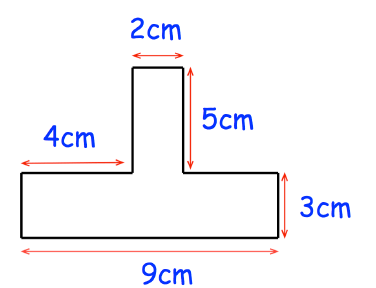
work out the perimeter of this shape

a)

29cm

b)

23cm

c)

35cm

d)

34cm

89.
The sum of lengths of all sides of plane figure is called its____
a)
Area
b)
Perimeter
c)
Boundary
d)
None of the above
90.
a)
24 cm
b)
24 cm²
c)
25 cm
d)
25 cm²
91.
The side of a square whose perimeter is 64 cm is __________
a)
32 cm
b)
8 cm
c)
16 cm
d)
12 cm
92.
What is the perimeter of an equilateral triangles whose side is 25 cm?
a)
50 cm
b)
100 cm
c)
75 cm
d)
125 cm
93.
Say 'TRUE' or 'FALSE'
The perimeter of square of area 36 cm² is 24 cm.
a)
TRUE
b)
FALSE
94.
Fill in the blanks:
1 m² = ___________ cm²
a)
100
b)
10000
c)
1000
d)
500
95.

6 km 435 m

a)

64,350 meters

b)

6,435 grams

c)

6,435 liters

d)

6,435 meters

96.

Which of these is a 3D shape?

a)

Square

b)

Rectangle

c)

Circle

d)

Cube

97.

Shape of all the faces of cube are

a)

square

b)

rectangle

c)

trapezium

d)

rhombus

98.

The given net when folded will give us which 3D Shape?

a)

cuboid

b)

cylinder

c)

cube

d)

sphere

99.

Area of circle is equal to

a)

πr2

b)

2πr

c)

πr3

d)

4πr

100.
a)
80 cm2
b)
160 cm2
c)
80 cm
d)
160 cm