
 Worksheets
Biology First Semester Review
Total questions: 263
Worksheet time: 3hrs 17mins

Eight components present in nucleic acids are listed in the box. Which components bond with adenine in a section of double-stranded DNA?
1, 3, 5, and 6 only
3 and 5 only
2 and 4 only
3, 4, 7, and 8 only

A segment of a DNA strand is shown.
Which of these is the correct complementary DNA strand for the segment shown?
5' AGGTCAGGT 3'
5' ACCUGAGGU 3'
5' TGGACTGGA 3'
5' TCCAGTCCA 3'
Which part of a DNA molecule is responsible for the direct coding of specific traits in an organism?
The number of hydrogen bonds that hold the strands of DNA together.
The number of carbons in the DNA molecule.
The sequence of nucleotide bases in the DNA molecule.
The sequences of phosphates along each DNA strand.
Students are given data from an investigation which identified some of the chemical elements in four samples. Which sample was most likely DNA?
Hydrogen, phosphorus, nitrogen
Aluminum, silicon, copper
Calcium, potassium, nitrogen
Iron, oxygen, magnesium
Which of these compounds are found in the cells of all living organisms?
estrogen and testosterone
hemoglobin and lymphocytes
cytosine and guanine
cellulose and chlorophyll

A table of four types of carbohydrates is shown.
Which list correctly matches the functions to the types of carbohydrates?
Energy: glycogen and starch
Structure: cellulose and chitin
Energy: cellulose and chitin
Structure: glycogen and starch
Energy: chitin and glycogen
Structure: cellulose and starch
Energy: cellulose and starch
Structure: chitin and glycogen

Transmembrane proteins span the width of cell membranes. Four types of transmembrane proteins are shown in a section of cell membrane.
Although these proteins have different specific functions, they all -
stop chemical reactions within the cell
synthesize molecules that signal other cells
help the cell interact with its external environment
remove large waste particles from the cytoplasm of the cell

Two biomolecules are shown.
Which of the following best describes these biomolecules?
Molecule X and Molecules Y are both carbohydrates
Molecule X is a nucleic acid and Molecules Y is a carbohydrate
Molecule X and Molecules Y are both nucleic acids
Molecule X is a carbohydrate and Molecules Y is a nucleic acid
Students were given a list of seven elements and asked to identify the four elements that are most abundant in biomolecules. Which table correctly identifies the four most-abundant elements in biomolecules?


Proteins and carbohydrates have many functions in the body of an organism. Specific proteins and carbohydrates perform specific tasks. Information about a protein and a carbohydrates is given.
How are ferritin and glycogen similar in their primary functions for an organism?
both store materials needed by the organism
both store energy used by the organism
both support the structure of the organism
both store information for the organism
Which of these best represents a fatty-acid molecule?


Enzymes are proteins that have a three dimensional shape that is specific to a particular substrate. Environmental conditions can change the shape of the protein.
What is the most likely result if the shape of the enzyme changes?
the substrate will change its shape to match the enzyme
the enzyme will no longer be able to catalyze the reaction with the substrate
the products made from the enzyme and the substrate will be changed
the enzyme will be able to bind to more diverse substrates than before

Taq polymerase is an enzyme used in the polymerase chain reaction (PCR) to replicate fragments of DNA. A study published in 1976 examined the properties of Taq polymerase after the enzyme was isolated from Thermus aquaticus, a thermophilic bacterium that lives in the hot springs of Yellowstone National Park. The graph shows one of the results of the study.
Which statement about enzyme activity is best supported by this graph?
An enzyme must be composed of multiple polypeptides, or subunits, to be active
An enzyme's rate of activity increases with time until it becomes inactive
An enzyme functions best under specific temperature conditions
An enzyme works equally well in bacteria that are adapted to high temperatures and in eukaryotic cells such as human cells

Some foods that are rich in complex carbohydrates can be difficult to digest. Gas often forms as the foods are slowly digested by bacteria in the large intestine. The advertisement is for a nutritional supplement that prevents intestinal gas.
Which of the following represents evidence that could be used to support the claims about this product?
Complex carbohydrates are found in vegetables and grains, which are good sources of fiber, vitamins, antioxidants, and minerals. Vegetables and grains are known to reduce the risk of heart disease.
Some nutritional supplements provide vitamins and minerals that are missing from a person's diet. These types of nutritional supplements contain important nutrients that reduce the risk of malnutrition.
Consuming enzymes specific for carbohydrate digestion helps the body digest complex carbohydrates more quickly in the stomach and small intestine.
Some nutritional supplements add beneficial bacteria to a person's diet. These bacteria populate the stomach and prevent carbohydrate digestion.
A biomolecule has the elements CHONP. Which molecule does this have to be?
Protein
Carbohydrate
Lipid
Nucleic Acid
A biomolecule has the elements CHO. Which biomolecule does this have to be?
protein
lipid
carbohydrate
nucleic acid
it can be either a carbohydrate or lipid
An amino acid is the monomer of a ...
lipid
protein
nucleic acid
carbohydrate

The picture shown is the monomer of a ...
carbohydrate
lipid
protein
nucleic acid

The picture shown is the monomer of a ...
lipid
protein
carbohydrate
nucleic acid
Large molecules made of smaller molecules connected by covalent bonds.
macromolecules
polymers
monomers
polypeptides
The process of breaking down a polymer into monomers and splitting a water molecule in the process.
dehydration synthesis
hydrolysis
disaccharide
activation
The process of building a polymer from monomer molecules, which removes water from the molecules.
hydrolysis
products
dehydration synthesis
dessication
Which of the base pairs are correctly arranged?
cytosine - guanine
adenine - guanine
cytosine - thymine
guanine - thymine
Which of these base pairs are correctly arranged?
adenine - thymine
cytosine - thymine
adenine - guanine
guanine - thymine
Which of the answers is the monomer of a lipid?
monosaccharide
amino acid
fatty acid
nucleotide
How does DNA code for traits?
a sequence of nucleotide bases in a particular order
a strand of DNA backbone
a series of deoxyribose and phosphate groups
the number of matched base pairs
Proteins which speed up chemical reactions in the body.
amino acids
enzymes
substrates
products
Chemicals which are changed after interacting with a catalyst in the cell.
substrate
product
enzyme
protein
Accelerate the rate of chemical reactions in the body.
catalyst
substrate
activation site
product
Enzymes can be damaged by these things and be unable to perform essential chemical reactions?
temperature and pH
acidity
excessive sweating
skipping a meal
Which of the following are differences in the structure between RNA and DNA
DNA uses deoxyribose sugar, RNA uses sugar ribose
DNA pairs Adenine with Uracil, RNA pairs Adenine with Thymine
DNA is a double helix, RNA is a single helix
DNA pairs Adenine with Thymine, RNA pairs Adenine with Uracil
Which organelle is the location where protein is made?
Ribosome
Nucleus
Cytoplasm
Nucleotide
Insertion, deletion, and substitution are all examples of a change in a genetic sequence which is also referred to as (a)
Gene
Amino Acid
Ribose
Mutation
During transcription, this type of ribonucleic acid is responsible for copying the DNA and brining it out of the nucleus.
tRNA
mRNA
rRNA
dRNA
When these bond together, they form a protein
Amino Acids
Peptide Bonds
Ribose
Nucleotides
These building blocks consist of a sugar, phosphate, and nitrogen base.
Ribose
Nucleotide
Gene
Protein
A string of nucleotides that contain the information to make a specific protein
Ribose
Amino Acids
tRNA
Gene
During translation, this type of ribonucleic acid is responsible for delivering amino acids to help make a protein.
mRNA
rRNA
tRNA
dRNA
There are a total of ____ different amino acids
20
1
4
unlimited
mRNA occurs during this process
Translation
Transcription
Replication
Delivery
How many amino acids are found on one tRNA?
20
4
1
3
Which of the following is the complementary mRNA sequence to this DNA strand: AACTGAA
UUGACUU
TTGACTT
AACTGAA
AACUGAA
Which of the following is the tRNA that will be used to decode to this DNA strand: AACTGA
AAC and TGA
TTG and ACT
UUG and ACU
AAC and UGA

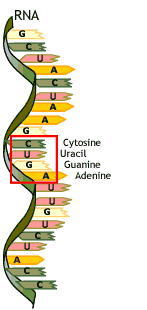
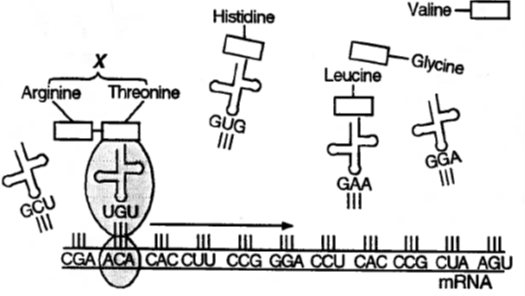

A model of a biological process is shown.
What is the purpose of this process?
To replicate the DNA of an organism before cell division
To translate the genetic code into a specific sequence of amino acids
To synthesize amino acids used to unzip strands of DNA and copy the genetic code
To assemble nucleotides in an mRNA chain along a DNA template

Different types of mutations can occur in DNA. The diagram represents a type of mutation.
Which statement describes the mutation in the diagram?
A silent mutation results in the insertion of a different amino acid.
A substitution occurs with the adenine base.
A deletion of a cytosine base occurs.
A base is inserted into one strand of the DNA.
Which of these is the direct result of an error in the transcription of a DNA nucleotide?
The nuclear membrane is ruptured.
Amino acids do not bond to tRNA.
A codon sequence is incorrect.
Transportation of mRNA does not occur.
Mutations within the DNA sequence of an organism can —
result in alterations that are harmful to an organism
result in alterations that are helpful to an organism
result in alterations that do not effect the organism
all answers are correct

The table shows a DNA sequence and three types of mutations that can change the DNA sequence.
Which mutation will cause a silent mutation?
Mutations 1 and 3 only
Mutation 1 only
Mutation 2 only
Mutations 1, 2, and 3
In the 1960s the molecular biologist George Streisinger developed the strand-slippage hypothesis. Streisinger noticed that mutations occurred in areas of DNA that contained many repeated sequences. When a strand-slippage error occurs, an insertion mutation can result. How does the insertion mutation affect the DNA?
Nitrogenous bases are added.
Nitrogenous bases are exchanged.
Nitrogenous bases are damaged.
Nitrogenous bases are deleted.

A segment of DNA produces methionine, threonine, histidine, aspartate, and glycine when translated. A substitution mutation occurs and causes the synthesis of the segment as shown.
Which is the new peptide chain when the new DNA segment is translated?
Methionine, leucine, histidine, aspartate, glycine
Methionine, phenylalanine, histidine, aspartate, glycine
Methionine, proline, histidine, aspartate, glycine
Methionine, serine, histidine, aspartate, glycine

Sickle-shaped red blood cells result from a mutation in the gene that codes for hemoglobin. This mutation results in sickle-cell anemia. A partial sequence of bases from a normal hemoglobin gene and a sequence that results in sickle-cell anemia are shown below.
What type of mutation is depicted in this sequence?
Substitution
Insertion
Deletion
Frameshift

The initial steps in gene expression are modeled below. Double-stranded DNA first unwinds into two strands.
Which process and product are missing in the diagrams?
Process: transcription; product: mRNA
Process: translation; product: protein
Process: replication; product: tRNA
Process: recombination; product: polymerase
Which of the following shows a mutation that does not change the shape or the chemical nature of the protein so that it still functions normally?
UCC to GAC
UCC to UAA
UCC to UGC
UCA to AGC

Which of these changes to the DNA triplet 3’ GCT 5’ will affect the protein produced?
GTT
TCT
TCC
GCA

Which of the following polypeptides is coded for by the mRNA sequence 5'AUGGUUAAACGACAAUCC3'?
Valine, Lysine, Phenylalanine, Glycine, Serine
Methionine, Aspartic Acid, Phenylalanine, Alanine, Arginine
Methionine, Valine, Lysine, Arginine, Glutamine, Serine
Isoleucine, Glutamine, Lysine, Aspartic Acid, Glycine, Leucine, Serine

The process represented in the diagram produces a molecule that is complementary to the template strand of DNA. What type of molecule is produced?
New DNA
Polypeptide
Carbohydrate
Messenger RNA
Which mutation would change the greatest number of amino acids in a protein?
the deletion of a single adenine in the middle of a gene
the substitution of a thymine with a cytosine near the beginning of a gene
the addition of the nucleotides that make up an additional stop codon to the end of a gene
the insertion of a thymine, a guanine, and an adenine in that order at the start of a gene

Part of an important cellular process involving a DNA strand is modeled below.
What is the purpose of this cellular process?
Preserving genetic information for future generations
Deleting the information in the sequence produced from the DNA template
Transcribing information in the DNA sequence for use by the cell
Producing more nucleotides for the DNA sequence
The disease sickle cell anemia is caused by a mutation in the hemoglobin protein. The code for glutamic acid has a mutation in one nucleotide that changes it to the code for valine. Which choice correctly shows this mutation?
GAA to GUA
GAG to UAG
GAA to GAC
GAG to CAG

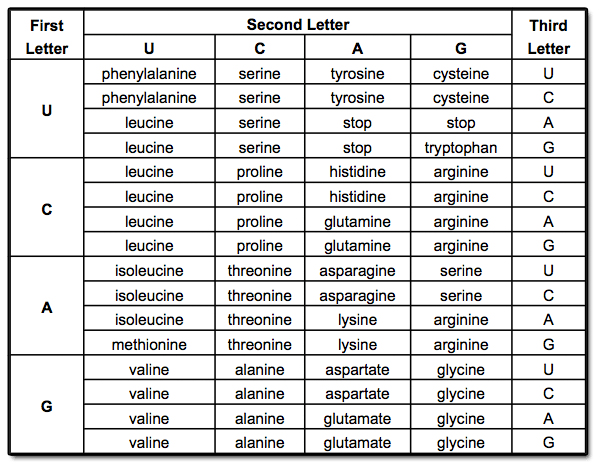
According to the RNA Codon Chart, which of the following statements is true?
Isoleucine is the only amino acid coded for by AUU.
AUG codes for both methionine and valine.
AAA is the only code for lysine.
Arginine is one of several amino acids coded for by AGA.

A DNA strand has a nucleotide sequence of TTA TGC TCC TAA for a gene segment. What is the amino acid sequence of the complementary mRNA strand of this DNA strand ?
Gly Val Val Phe
Leu Cys Ser Stop
Asn Thr Arg Ile
Phe Ser Ser Stop

What is the correct amino acid sequence that is coded from the RNA sequence UGGCAGAUU?
val-gly-trp
met-his-ser
tyr-pro-asn
trp-gln-ile

For which amino acid sequence does the RNA sequence UUUCCUCAA code?
leucine-threonine-glutamic acid
phenylalanine-proline-glutamine
phenylalanine-proline-histidine
serine-histidine-glutamine

Original mRNA Mutated mRNA
AGAUCGAGU ACAUCGAGU
The original mRNA strand above contains three codons. Which of the following changes would be expected in the resulting amino acid chain if the mutation shown above occurred?
The amino acid sequence would be shorter than expected.
The identity of one amino acid would change.
The amino acid sequence would remain unchanged.
The identities of more than one amino acid would change.

Study the sentences describing the steps in in the above process. Which sequence places the steps in the correct order?
1. Transfer RNA picks up individual amino acids and carries them to the ribosome.
2. Ribosomal RNA bonds mRNA and tRNA.
3. A single strand of DNA serves as a template for making mRNA.
4. Messenger RNA carries the sequence of nucleotides to the ribosomes.
5. A protein is synthesized.
3,4,1,2,5
2,5,3,4,1
3,2,4,5,1
2,4,1,5,3
The complementary mRNA strand of a gene segment is CUGCGGCAGGUGGUGUAG.
How many amino acids will result from the translation of the given mRNA strand?
5
18
8
6
In the process of translation, the ribosome is the site where —
DNA strands are separated and copied
amino acid chains are assembled from information in the mRNA
information from DNA is copied to RNA
free floating amino acids are picked up by tRNA

The chart below shows some of the mRNA codons and their corresponding amino acids.
Asp - Trp - Ile - Ile
Which of the following base sequences would code for the amino acid sequence shown above?
GCUGAUAUUAUA
GAUAUUAUCAUA
GAUUGGAUUAUA
AUUAUCGACUGG

Students use a microscope to look for structures present in four different cells. The students placed an X for each structure that was viewed for each cell on the table shown.
Which cell that was viewed is most likely a prokaryote?
Cell W
Cell X
Cell Y
Cell Z
You are told that the cells on a microscope slide are plant, animal, or bacterial. You look at them through a microscope and see cell walls and membrane-bound organelles. How should these cells be classified?
plant cells
animal cells
They could be plant cells or bacterial cells.
They could be plant cells, animal cells or bacterial cells.
Which of the following forms of life is NOT a eukaryote?
A protist such as an amoeba.
A plant cell such as Elodea.
A bacterial cell such as Streptococcus.
A human cell such as a red blood cell.
Which of the following is a major difference between a prokaryote and a eukaryote?
The need for nutrients.
The presence of a nucleus.
The presence of a cell membrane.
The presence of DNA.
Some ribosomes float free in the cytoplasm, while other ribosomes are attached to which of the following organelles?
cell (plasma) membrane
Golgi apparatus
mitochondrion
endoplasmic reticulum
When a cell is deprived of oxygen, its lysosomes tend to burst and release their contents into the cell. What will be the likely consequence for the cell?
Other organelles will assume lysosome functions.
The cell will produce more ER.
The cell will undergo division.
The cell will die due to internal damage.
When a cell is deprived of oxygen, its lysosomes tend to burst and release their contents into the cell. What will be the likely consequence for the cell?
Other organelles will assume lysosome functions.
The cell will produce more ER.
The cell will undergo division.
The cell will die due to internal damage.
The Rough ER plays a major role in the processing of which of the following biological molecules?
carbohydrates
proteins
ATP
DNA

What is the part of the cell marked by the arrow?
cytosol
chlorophyll
DNA
mitochondrion
Place the following levels of organization in the correct order from simplest to most complex.
Organism Organs Tissues Cells Organelles
Organs Organelles Organism Cells Tissues
Tissues Cells Organelles Organs Organism
Organelles Cells Tissues Organs Organism
Where is DNA found in a prokaryotic cell?
floating in the cytoplasm
surrounded by the nuclear membrane
contained in the Golgi body
contained inside the cell wall
Which of the following structures would NOT be found in your body cells?
mitochondria
cell walls
cell membranes
ribosomes
Why are chloroplasts found in plant cells but NOT in animal cells?
Plant cells are producers that make their own food.
Plant cells need additional protection from herbivores.
Animal cells do not need to store water.
Animal cells store their DNA in the nucleus.
Imagine that a protein produced in the cell that is going to exit the cell. Which of the following would be your pathway through the cell?
Mitochondrion...Chloroplast...Cell Membrane
Ribosome...Rough ER...Golgi Apparatus...Cell Membrane
Nucleus...Smooth ER...Golgi Apparatus...Cell Membrane
Nucleolus...Lysosome...Cell Membrane

What type of cell is pictured?
plant cell
animal cell
bacteria cell
prokaryote

What is the name of organelle F?
nucleus
endoplasmic reticulum
Golgi body
cell membrane

What is the name of organelle D?
mitochondrion
nucleus
Golgi body
vacuole

Which organelle breaks down food to release energy?
B
D
G
H

What is the function of the tiny dot-like structures in letter H?
make proteins
controls the cell activities
provide energy to the cell
break down waste products
A prokaryotic cell has which of the following?
Centrioles
Lysosomes
Plasma membrane
Mitochondria
A prokaryotic cell has which of the following?
Centrioles
Lysosomes
Plasma membrane
Mitochondria
Mitochondria are found in most eukaryotic cells and contain their own DNA and ribosomes that are similar to those typical of many prokaryotic cells. Which of the following statements is justified by these observations?
The mitochondrion is the only location in which eukaryotic cells can synthesize ATP.
An ancestral cell most likely engulfed anaerobic prokaryote in a relationship that proved beneficial for both cells.
Mitochondrial membranes provide abundant surface area for reactions because of the infoldings called cristae.
The mitochondrion plays a role in respiration, but it also stores the cell’s extra mRNA.

The muscle cells shown above require large amounts of energy. A muscle cell might contain large numbers of -
chromosomes
vacuoles
mitochondria
lysosomes

Why is the sensation of thirst important to maintaining homeostasis?
Water removed by the kidneys must be replaced
Oxygen cannot diffuse into cells if a person is dehydrated
Water molecules are needed to carry carbon dioxide waste to the kidneys

Why does pulse rate increase during exercise?
Oxygen and carbon dioxide must be removed from the body ASAP
Gas exchange must happen more quickly than when a person is at rest
Oxygen must be moved to the lungs and carbon dioxide must be moved to cells more quickly
Carbon dioxide must be moved to the kidneys to be excreted

Structures in a cell that have specialized jobs.
Similar concept to organs for the human body.
Tissue
Molecule
Atom
Organelles

Group of tissues with similar functions.
Organelles
Cells
Tissues
Organs

Group of organs with similar functions.
Organism
Cell
Organ
System

Organisms who are members of the same species in an ecosystem.
Organism
Population
Organ
Community
Photosynthesis occurs in the _______ of _____ cells.
mitochondrion / all
nucleus / animal
chloroplast / plant
chlorophyll / all
Photosynthesis and cellular respiration are both.....
chemical reactions
nuclear reactions
physical reactions
none of these are correct
In photosynthesis, _____ energy is converted to ______ energy.
radiant / kinetic
radiant / chemical
chemical / kinetic
chemical / radiant
Which of the following is the correct formula for photosynthesis.
C6H12O6 + 6O2 >>>> 6H2O + 6C02 + energy
C6H12O6 + 6C02 >>>>> light energy + 6O2 + 6H2O
6C02 + 6H2O + light energy >>>>>> C6H12O6 + 6O2
6H2O + energy >>>>>> 6O2 + 6C02 + C6H12O6
Plants take in _____ and give off _______.
water / carbon dioxide
oxygen / carbon dioxide
oxygen / glucose
carbon dioxide / oxygen
Cellular respiration takes place in the ________ of cells.
mitochondria
chloroplast
nucleus
cytoplasm
Which of the following is the word equation for cellular respiration?
oxygen + glucose ---> carbon dioxide + water + energy
carbon dioxide + glucose ---> oxygen + energy + water
carbon dioxide + energy ---> oxygen + water + glucose
The source of all energy for life on Earth is the ________.
plant
cell
sun
glucose
The basis for all life on Earth is ________.
respiration
photosynthesis
tropism
glucose
What organisms undergo cellular respiration?
plants
animals
bacteria and fungi
plants, animals, bacteria, fungi
Photosynthesis and cellular respiration help to cycle ________ through ecosystems.
carbon, oxygen & water
nitrogen & carbon
carbon only
water only
This reaction occurs in photosynthesis.
6C02 + 6H2O + light energy >>>>>> C6H12O6 + 6O2
This reaction is beneficial to plants because...
keeps ultraviolet light from damaging their cells.
produces chemical building blocks for proteins.
provides chemical energy to the cells.
results in a net increase in the mass of the atoms.

Glycogen is a polysaccharide that is formed from glucose and stored in the liver and muscle cells. Which biomolecule is glycogen?
Lipid
Protein
Carbohydrate
Nucleic acid
Which statement accurately describes the energy needs for photosynthesis and cellular respiration?
Solar energy is needed for cellular respiration but not for photosynthesis.
Chemical energy in the form of glucose is needed for both cellular respiration and photosynthesis.
Chemical energy in the form of glucose is needed for photosynthesis, and solar energy is needed for cellular respiration.
Solar energy is needed for photosynthesis, and chemical energy in the form of glucose is needed for cellular respiration.
Which statement accurately describes the energy needs for photosynthesis and cellular respiration?
Solar energy is needed for cellular respiration but not for photosynthesis.
Chemical energy in the form of glucose is needed for both cellular respiration and photosynthesis.
Chemical energy in the form of glucose is needed for photosynthesis, and solar energy is needed for cellular respiration.
Solar energy is needed for photosynthesis, and chemical energy in the form of glucose is needed for cellular respiration.
Which of the following correctly describes how a diagram of cellular respiration would differ from a diagram of photosynthesis?
The cellular-respiration diagram would show glucose as the main source of energy.
The cellular-respiration diagram would show water as the main source of chemical energy.
The cellular-respiration diagram would show electromagnetic waves as the final product.
The cellular-respiration diagram would show energy stored in large protein molecules.
During the light reactions of photosynthesis, energy is stored in the compounds ATP and NADPH. A second set of reactions uses this stored energy to produce vital compounds such as glucose. This second set of reactions involves a biochemical pathway called
carbon fixation.
respiration.
transpiration.
the Calvin cycle.
Which statement describes the relationship between the reactants of photosynthesis and the products of cellular respiration?
The products of cellular respiration are the products of photosynthesis.
The products of cellular respiration serve as the reactants of photosynthesis.
The reactants of cellular respiration are the reactants of photosynthesis.
Cellular respiration and photosynthesis are unrelated.
Which elements are found in a molecule of glucose?
CHONP
CHON
CHO
CHOP
When ATP loses a phosphorus group it becomes...
ATPP
ADP
AMP
ADPH
NADP+ becomes _____________ when energy is added.
NADPP
NADP2
NADPH
ANADP
Cellular respiration takes place in _____ stages.
one
two
three
four
The Krebs cycle takes place in the stoma of the mitochondria and is also called the __________.
light reaction
citric acid cycle
lactic acid
calvin cycle
Which process has oxygen as a product and which has oxygen as a reactant?
producers; consumers
consumers; producers
cellular respiration; photosynthesis
photosynthesis; cellular respiration
Which statement accurately describes the role of key organelles in energy transfer?
Energy is captured and stored in the nucleus and released in the chloroplast.
Energy is captured and stored in the nucleus and released in the mitochondria.
Energy is captured and stored in the chloroplast and released in the mitochondria.
Energy is captured and stored in the mitochondria and released in the chloroplast.

The concept map below shows the flow of energy and materials in photosynthesis and cellular respiration.
Which molecules are represented in the figure by the number 2?
H2O and O2
H2O and CO2
sugars and O2
sugars and CO2
Cells can generate as many as 36 to 38 molecules of adenosine triphosphate (ATP) from the metabolism of one molecule of glucose.
Which cellular process results in this amount of ATP production?
Anaerobic cellular respiration
Protein synthesis
Aerobic cellular respiration
Photosynthesis

A student set up the experiment seen in the picture. How will they collect data from this experiment?
By measuring carbon dioxide emitted by the plant
By measuring the growth of the plant
By measuring the oxygen produced by the plant
By measuring the temperature of the water
Which of these statements best explains the process of energy conversion that takes place in the mitochondria?
Energy is required for carbon dioxide molecules to form six-carbon sugar molecules.
Water molecules and radiant energy are necessary for anaerobic respiration to take place.
Oxygen molecules release energy in the form of heat during combustion reactions.
The energy in the bonds of glucose molecules is transferred to the phosphate bonds in ATP.
The part of photosynthesis that absorbs energy from sunlight and transfers energy to the light-independent reaction.
light-dependent reaction
Calvin cycle
Krebs cycle
Dark reaction

In what phase of the cell cycle does the nucleus disappear?
Prophase
Metaphase
Anaphase
Telophase
In what phase of the cell cycle does the nucleus re-appear?
Prophase
Metaphase
Anaphase
Telophase
In what phase of the cell cycle do the spindle fibers attach to the chromosomes?
Prophase
Metaphase
Anaphase
Telophase
In what phase of the cell cycle do the chromosomes line up in the middle of the cell?
Prophase
Metaphase
Anaphase
Telophase

What phase is pictured?
telophase
anaphase
prophase
s phase

What phase is shown here?
prophase
metaphase
anaphase
telophase

What phase is shown here?
prophase
metaphase
anaphase
telophase

What phase is shown here?
prophase
metaphase
telophase
cytokinesis

What phase is shown here?
G1
S
Prophase
Anaphase


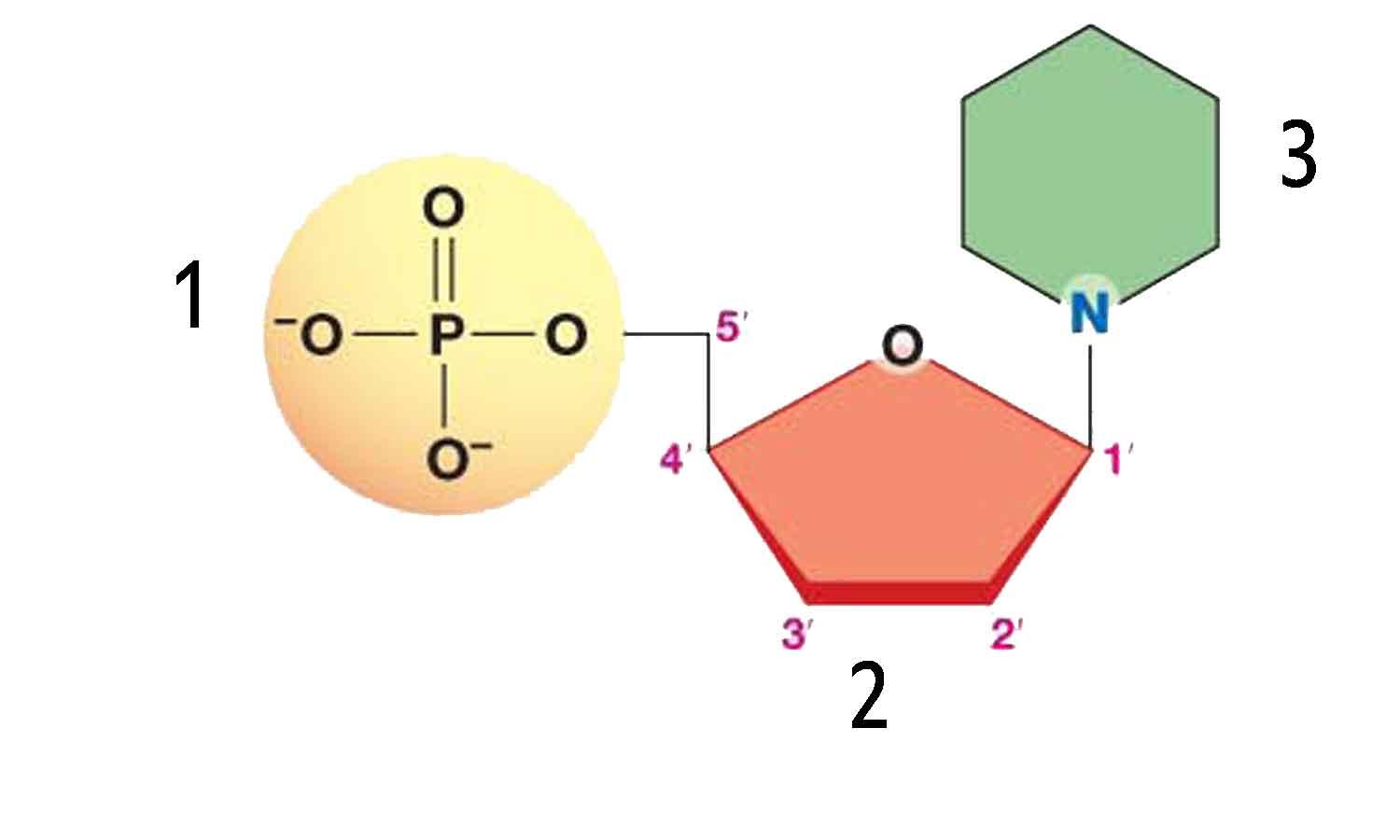
3) Nitrogen Base
2) Phosphate
3) Nitrogen Base
2) Ribose Sugar
3) Nitrogen Base
2) Deoxyribose Sugar
3) Nitrogen Base

When cells lose their ability to regulate the cell cycle, they can divide at an accelerated rate and form a mass of cells. This mass of cells is referred to as —
a tumor
an embryo
a gland
an organ
Which table shows two steps of DNA replication?


The karyotype, or chromosomal profile, for humans is shown. A karyotype can be used to investigate genetic disorders.
The chemical colchicine is used in the production of karyotypes. Colchicine prevents spindle fibers from forming during the cell cycle.
What is a result of preventing spindle fibers from forming?
The cell cycle skips G0 phase and repeats G1 phase.
Mitotic division is skipped, and the cell cycle proceeds to cytokinesis.
Mitotic division stops in metaphase and cannot proceed to anaphase.
The cell cycle skips S phase and proceeds to G2 phase.
Cells pass through a checkpoint before entering mitosis. Ideally, if DNA damage is 2 detected, the cells do not enter mitosis until the damage is repaired. Why is DNA damage repaired before cells enter mitosis?
So that another round of DNA synthesis does not have to take place
So that the chromosomes can align at the metaphase plate during mitosis
So that the cytoplasm can be divided equally between the two daughter cells
So that healthy daughter cells are produced, allowing the organism to continue growing
Scientists can bioengineer skin in a laboratory to treat severe burns and other types of skin injuries. This bioengineered tissue is grown from living cells. The cellular process that enables the cells to grow and develop into tissue is —
conjugation
meiosis
budding
mitosis

A segment of DNA is represented in the illustration.
How is information for a specific protein carried on the DNA molecule?
As a sequence of nucleotides
In the double-helix shape of the condensed chromosome
In the ratio of adenines to thymines
As a pattern of phosphates and sugars

The diagram shows cells in different phases of mitosis. A student is trying to find a cell in a particular phase of mitosis. The student is looking for evidence that spindle fibers are separating the chromosomes to ensure that each new nucleus has one copy of each chromosome.
Which cell is in the phase of mitosis that the student is searching for?
Cell 1
Cell 2
Cell 3
Cell 4
The sequence of nitrogenous bases in DNA varies widely. The sequence of the bases in DNA is most important for which of the following?
Providing the instructions for the traits of an organism
Preventing mutations from occurring during DNA replication
Allowing the DNA to have the shape necessary for replication
Helping form the sugar-phosphate backbone of DNA molecules

The model represents the change in the DNA content of a cell during the cell cycle.
Which part of the model represents the S phase?
I
II
III
IV

The diagram below represents the cell cycle.
When cells leave the cell cycle, they exit during G1 phase and then enter G0 phase, a resting period. Most normal cells can leave G0 phase and reenter the cell cycle at G1 phase before entering S phase. Cancer cells are different because they cannot enter G0 phase and are likely
to do which of the following?
Fail to complete S phase
Mutate during G1 phase
Repeat the cell cycle continuously
Die after completing mitosis
One strand in a molecule of DNA contains the sequence below.
ATTGCGTA
Which sequence is the complementary strand?
ATTGCGTA
UAACGCAU
TAACGCAT
GCCTATCG
Atherosclerosis is a disease that obstructs blood flow and, therefore, oxygen supply to target organs. A major component of atherosclerosis is the excessive reproduction of smooth muscle cells of the blood vessels. Certain drugs may have the potential to reverse or prevent the unregulated reproduction of the diseased blood-vessel cells. Which of these processes is the most likely target of these drugs?
Cell division
Erythroblast differentiation
DNA transcription
Cellular respiration

A photomicrograph of onion root tip cells during mitosis is shown below.
Which phase of mitosis is occurring in the cell indicated by the arrow?
Prophase
Metaphase
Anaphase
Telophase
Cells typically respond to DNA damage in three ways: by ceasing to grow and divide until the damage is repaired, by permanently ceasing to grow and divide, or by dying. In 2010 a group of scientists reported that a certain kind of immune reaction can cause DNA damage that leads to a fourth response. DNA damage can turn off genes involved in cell-signaling pathways. Turning off these genes can cause less-mature cells to divide too rapidly, often leading to the development of-
tumors
allergies
hemophilia
cardiovascular disease

Which part of the cell cycle controls the repair of damaged DNA which, if unsuccessful, could eventually result in the abnormal cell division that typifies some types of cancer?
G1
S
G2
M
Which of these must occur during S phase of the cell cycle so that two daughter cells can be produced during M phase?
The DNA must be replicated.
The chromosomes must be joined.
The cytoplasm must be separated.
The cell membrane must be expanded.

Checkpoints occur between the stages of the cell cycle. If a cell does not meet certain criteria at the end of a stage, it will not move to the next stage.
Which of these occurs just before the cell enters the G2 stage of the cell cycle?
The nuclear membrane disintegrates.
DNA replicates.
Centrioles form.
The nucleolus divides.

This model of the cell cycle includes two arrows that each represent a process in the cycle.
What do the two arrows represent?
Arrow 1 represents prophase, and Arrow 2 represents interphase.
Arrow 1 represents mitosis, and Arrow 2 represents meiosis.
Arrow 1 represents interphase, and Arrow 2 represents mitosis.
Arrow 1 represents meiosis, and Arrow 2 represents prophase.
The activities in the cell cycle occur during specific phases. In which phase of the cell cycle is DNA replicated?
Mitosis
G1 Phase
G2 Phase
S Phase
Telophase is a stage of a cellular process that begins after the chromosomes have moved to opposite poles of the cell. During which cellular process does telophase occur?
Translation
Interphase
Transcription
Mitosis

Part of the cell cycle is shown in this simplified model.
This part of the cell cycle is best described as the process that —
duplicates the DNA
completes cell division
maintains genetic homeostasis
synthesizes new molecules
People who have leukemia, a cancer that affects white blood cells, are often given Cytarabine. This drug inhibits the synthesis of DNA. Which phase of the cell cycle is most affected by Cytarabine?
G1 phase
S phase
G2 phase
M phase
DNA damage is detected during a G2 checkpoint before entering mitosis. The damage is repaired first and then they enter mitosis. Why is DNA damage repaired before cells enter mitosis?
So that the cytoplasm can be divided equally between the two daughter cells
So that healthy daughter cells are produced, allowing the organism to continue to grow
So that another round of DNA synthesis does not have to take place
So that the chromosomes can align at the metaphase plate during mitosis
Oncogenes are mutated forms of genes that can transform a cell into a tumor cell. How do oncogenes lead to tumor formation?
Somatic cell growth is inhibited
Antibody activity is unregulated
Cell division is unregulated
ATP production is inhibited


Which example describes diffusion?
Water moving across a semi-permeable membrane
Baking cookies and smelling them throughout the house
Ions moving through an ion channel
All of the above

Which describes a hypotonic environment?
Too much water in the cell will cause the cell to burst - the percentage of water is higher outside the cell than inside the cell
Too little water in the cell will cause the cell to shrink - the percentage of water is lower outside the cell than inside the cell
Concentrations of water are equal inside and outside the cell

Which describes a hypertonic environment?
Too much water in the cell will cause the cell to burst - the percentage of water is higher outside the cell than inside the cell
Too little water in the cell will cause the cell to shrink - the percentage of water is lower outside the cell than inside the cell
Concentrations of water are equal inside and outside the cell

Which describes an isotonic environment?
Too much water in the cell will cause the cell to burst - the percentage of water is higher outside the cell than inside the cell
Too little water in the cell will cause the cell to shrink - the percentage of water is lower outside the cell than inside the cell
Concentrations of water are equal inside and outside the cell

The movement of materials from an area of low concentration to an area of high concentration would require...
glucose
energy (ATP)
fish
chips

A student put some drops of Lugol’s iodine solution into the water in the beaker shown above. The water turned red. After a short time, the starch solution inside the dialysis tubing turned black. Which function of the cell membrane was the student demonstrating?
active transport of hydrogen ions
diffusion through a permeable membrane
facilitated diffusion of starch
diffusion through a semipermeable membrane

A student was observing Elodea submerged in a solution with a microscope. The student observed the cell cytoplasm pull away from the cell wall and clump together in the center of the cell.
Which statement best explains why this occurred?
The cell was submerged in a pure solution.
The cell was submerged in a hypotonic solution.
The cell was submerged in an isotonic solution.
The cell was submerged in a hypertonic solution.
If a cell’s cytoplasm contains 40% salt, which of the following best describes the concentration of H2O in the cytoplasm?
100%
60%
30%
10%

A student is analyzing samples of red blood cells using a microscope. Her observations are shown.
The student observes that the shape of Cell A appears normal, while Cell B appears swollen and Cell C is shrunken. The apparent shrinking of Cell C indicates the reaction of the cell to what?
an anaerobic environment outside the cell
higher solute concentration outside the cell than inside
more oxygen inside the cell than what can be utilized
lower solute concentration outside the cell than inside

After observing cells under the microscope, the student observes that the shape of Cell A appears normal, while Cell B appears swollen and Cell C is shrunken. The appearance of cell B indicates the reaction of the cell to what?
higher solute concentration outside the cell than inside
a solute concentration that is the same as that inside the cell
a cell that closed it's membrane to osmosis/diffusion
lower solute concentration outside the cell than inside

The picture above shows a cell model and the solutions associated with it. In this situation the cell model will...
gain water
lose water
increase in solute concentration
both gain and lose water

The diagram above shows three plant cells surrounded by water. Plant cell A exists in an environment where the cell remains the same because -
The net movement of water into and out of the cell is equal.
Water moves out of the cell at a greater rate than into the cell.
Water moves into the cell at a greater rate than out of the cell.
The salinity of the environment causes the plant cell to shrink.

The diagram illustrates the movement of molecules through a cell membrane.
What process is the cell using to move the molecules?
osmosis
endocytosis
active transport
facilitated diffusion

The diagram above shows three plant cells surrounded by water. Plant cell B exists in an environment where the cell loses water because -
The net movement of water into and out of the cell is equal.
Water moves out of the cell at a greater rate than into the cell.
Water moves into the cell at a greater rate than out of the cell.
The salinity of the environment causes the plant cell to shrink.

The diagram above shows three plant cells surrounded by water. Plant cell C exists in an environment where the cell gains water because -
The net movement of water into and out of the cell is equal.
Water moves out of the cell at a greater rate than into the cell.
Water moves into the cell at a greater rate than out of the cell.
The salinity of the environment causes the plant cell to shrink.

The diagram illustrates the use of energy by a nerve cell to expel a sodium ion from inside of the cell.
Which best explains why energy is necessary to complete this function?
The ion has more kinetic energy than surrounding molecules.
The ion is being transported against a concentration gradient.
The ion is a waste product that is digested by the cell membrane.
The ion is too large to pass through the cell membrane by diffusion.

In the diagram, the dots represent small molecules. The molecules are moving out of the cells, as indicated by the arrows. The number of dots inside and outside of the two cells represents the relative concentrations of the molecules inside and outside of the cells.
Which cell(s) must use ATP energy to move the molecules out of the cell?
Cell A
Cell B
Both cell A and B
Neither cell A nor B

In the diagram below, the dots represent small molecules. The molecules are moving out of the cells, as indicated by the arrows. The number of dots inside and outside of the two cells represents the relative concentrations of the molecules inside and outside of the cells.
Which cell(s) does not use energy/ATP to move the molecules out of the cell?
Cell A
Cell B
Both cell A and B
Neither cell A nor B
Which of these best explains why a saltwater aquarium would be a dangerous habitat for a freshwater fish?
Their cells would absorb too much oxygen.
Their cells would gain too much water.
The cells would lose too much water.
A saltwater aquarium is not a dangerous
habitat for a freshwater fish.

Cell transport occurs at the cell membrane. The diagram below shows the fluid mosaic model of a cell membrane. Which of the following correctly describes the fatty acids that make up the phospholipid tails of the membrane?
They are hydrophilic and therefore are dissolved in water.
They are hydrophobic and therefore repel water.
They are made of protein.
They are located on the external surface of the membrane due to their attraction to water.
Which of the following best describes the difference between diffusion and osmosis?
Diffusion is the movement of molecules from low to high concentration and osmosis is the movement of molecules from high to low concentration.
Diffusion requires energy but osmosis does not.
Diffusion is the movement of particles from high to low concentration and osmosis is specifically the movement of water molecules from a high to low concentration.
Diffusion and osmosis are the same thing.

Some students use vinegar to dissolve away the shells of three eggs and use these eggs as models of human red blood cells. The students observed the changes in the eggs when they were placed in different solutions.
Which statement best describes the role of the cell membrane in this model?
The cell membrane is an impermeable barrier that prevents water from entering the cell.
The cell membrane allows solutes to enter the cell, which causes the cell to shrink.
Cell membrane allows water to enter and leave the cell.
The cell membrane remove solutes from the environment.

A type of cellular transport is shown.
Which description best identifies this type of transport.
Active transport, because energy is being used to move molecules against the concentration gradient
Facilitated diffusion, because energy is being used to move molecules with the concentration gradient
Osmosis, because energy is not being used to move molecules with the concentration gradient
Endocytosis, because energy is not being used to move molecules against the concentration gradient

The diagram illustrates the activity of vesicles during a cellular process.
Which statement best explains process taking place?
endocytosis
exocytosis
facilitated diffusion
osmosis

Transmembrane proteins span the width of cell membranes. Four types of transmembrane proteins are shown in a section of cell membrane.
Although these proteins have different specific functions, they all-
stop chemical reactions within the cell
synthesize molecules that signal other cells
help the cell interact with its external environment
remove large waste particles from the cytoplasm of the cell
How is facilitated diffusion different from simple diffusion?
they both happen through the membrane
facilitated diffusion uses a protein channel in the membrane
facilitated diffusion can move molecules against the concentration gradient
simple diffusion uses channels

What is happening in the diagram?
Diffusion
Facilitated diffusion
Passive transport
Active transport
What is happening in the diagram?
Diffusion
Facilitated diffusion
Passive transport
Active transport

In this diagram, molecules are moving _________ the concentration gradient.
with
against

What is happening in this picture?
diffusion
osmosis
active transport

In this diagram, molecules are moving _______ the concentration gradient.
with
against
Water moves across a semipermeable membrane from an area of greater concentration to an area of lesser concentration.
diffusion
osmosis
active transport
When a molecule moves from an area of more molecules to an area of less molecules the molecule is...
moving against the concentration gradient
moving down/with the concentration gradient

The process shown is ________ which is a form of __________ transport.
exocytosis/active
exocytosis/passive
endocytosis/active
endocytosis/passive

The diagram shows _____________ which is a form of __________ transport.
endocytosis / passive
endocytosis / active
exocytosis / passive
exocytosis / active