Wayground logo

Free Printable Worksheets

Font size

S
M
L
XL
Worksheets

Q2 9 weeks test review 2020

Total questions: 40

Worksheet time: 28mins

Name
Class
Date
1.

Identify the structure that is indicated by the arrow in the image.

a)

cell wall

b)

central vacuole

c)

chloroplast

d)

nucleus

2.

Identify the structure that is labeled "C" in the image.

a)

central vacuole

b)

nucleus

c)

chloroplast

d)

mitochondria

e)

cell membrane

3.
What cell part is NOT found in all cells?
a)
Cell Wall
b)
Cell Membrane
c)
Cytoplasm
d)
Genetic Material
4.
Directs all cell activities through the DNA located there.
a)
Lysosomes
b)
Nucleus
c)
ribosomes
d)
Mitochondria
5.
Which of the following is the correct order of organization in living things from most basic (simple) to most complex?
a)
a.  Organism, cell, tissue, organ, organ system
b)
a.  Organ system, organ, tissue, cell, organism
c)
a.  Cell, tissue, organ, organ system, organism
d)
a.  Cell, organ, tissue, organ, organism, organ system
6.
Anything that can perform life processes by itself is a/an
a)
cell
b)
organ
c)
organism
d)
organ system
7.
Tissue that works together to perform a function
a)
organ
b)
cell
c)
organ system
d)
organism
8.
Matter can not be created nor destroyed: it can only be
a)
Destroyed a little bit
b)
Invisible
c)
Transformed, changed
d)
None of the above
9.
In a reaction A + B ----> C,  reactant A has 5g and product  C has 9g. How many grams does reactant B should have? 
a)
4g
b)
5g
c)
9g
d)
14g
10.
Bob puts 200 grams of ice into a pitcher with 900 grams of water. He gets distracted and comes back later to find that the ice has melted in the water. How many grams of water does Bob now have in the pitcher?
a)
200 g
b)
700 g
c)
1,100 g
11.

How many atoms of hydrogen are in a molecule of glucose (C6H12O6)?

a)

12

b)

6

c)

18

d)

4

12.
The powerhouse of the cell is the...
a)
Mitochondrion
b)
Golgi body
c)
Nucleus
d)
Ribosomes
13.
How many atoms of carbon (C) are in C6H12O6?
a)
3
b)
6
c)
12
d)
24
14.
Element or compound?
H2O
a)
element
b)
compound
15.
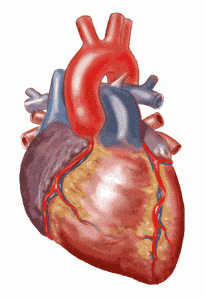
This is a example of ........
a)
cell
b)
organ system
c)
organ
d)
tissue
16.
Which organelle belongs in both plant and animal cells?
a)
Cytoplasm
b)
Chloroplast
c)
Large Central Vacuole
d)
Cell Wall
17.
Which organelle belongs in both plant and animal cells?
a)
Chloroplast
b)
Mitochondrion
c)
Large Central Vacuole
d)
Cell Wall
18.
Which organelle belongs in both plant and animal cells?
a)
Chloroplast
b)
Cell Wall
c)
Large Central Vacuole
d)
Cell Membrane
19.
Which organelle belongs in both plant and animal cells?
a)
Chloroplast
b)
Cell Wall
c)
Large Central Vacuole
d)

Nucleus

20.

What is an element?

a)

a material that is shiny and usually hard

b)

a substance made up of hydrogen and one other kind of atom

c)

a substance made of just one kind of molecule that cannot be broken down

d)

a substance made of just one kind of atom that cannot be broken down

21.

The nucleus of an atom contains which subatomic particles?

a)

protons and electrons

b)

protons and neutrons

c)

electrons and neutrons

d)

protons, electrons, and neutrons

22.
The atomic number is equal to _.
a)
the number of protons and electrons
b)
the number of neutrons only
c)
the total number of protons and neutrons
d)
the number of protons neutrons and electrons
23.
How many electrons does an atom of Krypton have?
a)
36
b)
83.80
c)
47.80
d)
119.80
24.
What is the location of the electron?
a)
the free floating negatively charged electron cloud
b)
the free floating positively charged electron cloud
c)
the very dense positively charged electron orbital
d)
the positively charged very dense nucleus
25.
Is this balanced?...
Al + O2 --> 2Al2O3
a)
Yes!
b)
NO!
26.
At the end of chemical reactions, what is the total mass of the reactants compared to the total mass of the products?
a)
the product is doubled
b)
the product is half the mass of the reactants
c)
the mass is the same
d)
the mass changes depending on the reaction
27.

What is a group of cells that are alike and work together?

a)

a cell team

b)

a tissue

c)

a cell family

28.

Which does only eukaryotic cells contain?

a)

nucleus

b)

DNA

c)

cell membrane

d)

ribosomes

29.

Prokaryotic cells do not have…….

a)

membrane bound organelles

b)

cell membrane

c)

DNA or RNA

d)

life

30.
Which is true of prokaryotic and eukaryotic cells?
a)
Prokaryotic cells are larger than eukaryotic cells.
b)
Eukaryotic cells do not have nuclei, and prokaryotic cells do have nuclei.
c)
Prokaryotic cells lack membrane-bound organelles, and eukaryotic cells contain membrane-bound organelles.
d)
Eukaryotic cells are simpler than prokaryotic cells.
31.
What is the charge of the neutron?
a)
Negative
b)
Positive
c)
electrical charge
d)
Neutral (no charge)
32.

Which sequence describes the levels of organization from MOST organized to LEAST organized?

a)

Organism, Organ, Tissue, Cell

b)

Cell, Tissue, Organ, Organ System, Organism

c)

Cell, Organ, Tissue, Organ System

d)

Organism, Organ System, Organ, Tissue, Cell

33.

The 5th level of organization in a multicellular organism

a)

organ

b)

tissue

c)

organism

d)

organ system

34.
Which statement about bacteria is true?
a)
All bacteria are prokaryotes
b)
All bacteria are eukaryotes
c)
All bacteria are autotrophs
d)
All bacteria are heterotrophs
35.
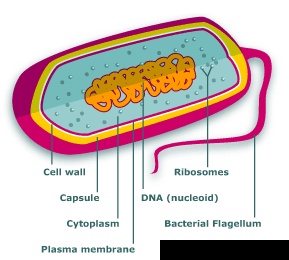
Which type of cell?
a)
Prokaryote
b)
Eukaryote
36.

Cell wall can be found in plants and animals

a)

True

b)

False

37.
If a reaction starts with a total 75g of reactants it should produce 
a)
a total of 40g of products
b)
a total of 75g of products
c)
a total of 180 g of products
d)
None of the above
38.

This chemical formula is called an

a)

atom

b)

element

c)

compound

d)

substance

39.

Which of the following answer choices would NOT be listed on the periodic table?

a)

Carbon (C)

b)

Silver (Ag)

c)

Salt (NaCl)

d)

Lithium (Li)

40.

Which of the following answer choices is NOT a compound?

a)

NaCl

b)

HMg

c)

Si

d)

PbSO