wayground logo

Free Printable Worksheets

NEW

Font size

S
M
L
XL
Worksheets

Semester 1 Final Exam

Total questions: 41

Worksheet time: 43mins

Name
Class
Date
1.
A series of steps used by scientists to solve a problem or answer a question. 
a)
scientific method
b)
recipe
c)
data collection
d)
metric system
2.
The summary at the end of an experiment that explains the results. 
a)
conclusion
b)
procedures
c)
materials
d)
responding variable
3.

This variable in an experiment is the one being deliberately changed by the scientist.

a)

control

b)

independent variable

c)

data

4.
A list of the steps anyone could follow to conduct an experiment. 
a)
obervations
b)
question/problem
c)
materials
d)
procedures
5.

A student is planning an experiment to find out how the height from which he drops a ball affects how high the ball bounces. The dependent variable is the _____.

a)

Diameter of the ball

b)

Force acting on the ball

c)

Height that the ball bounces

6.
When experimenting with the growth of a plant, a scientist uses three (of the same type of) plants, two different fertilizers, equal light, and equal water. What type of variable is the fertilizer?
a)
Dependent
b)
Independent
c)
Control
d)
Compound
7.

Which factor is the variable in this experiment?

a)

the type of bee

b)

the time of day

c)

the type of plant

d)

the color of the flowers

8.

Which of the following hypotheses could be tested by this experiment?

a)

Honeybees prefer to visit rose plants

b)

Honeybees prefer to visit red flowers.

c)

Honeybees prefer to visit flowers in the morning

d)

Honeybees prefer to visit Portland rose flowers between 9 and 10
9.
In a controlled experiment, how many independent variables can be worked with at a time? 
a)
one
b)
none
c)
two or more
d)
how ever many makes sense.
10.
Which of the following describes a solid?
a)
Matter that keeps its own size and shape
b)
Matter that does not have its own size and shape
c)
Matter that has its own volume but not size and shape 
11.
Which of the following describes liquids?
a)
Matter that keeps its own size and shape
b)
Matter that has its own volume, but not its own size and shape 
c)
Matter that does not have its own size and shape
12.
Which of the following describes gas?
a)
Matter that has its own volume, but not its own size and shape
b)
Matter that does not have its own size and shape
c)
Matter that keeps its own size and shape
13.
What is volume?
a)
Something about an object you can observe with you senses 
b)
To put two or more things together
c)
The amount of space matter takes up
14.
What is the formula for density?
a)
density = mass x volume
b)
density = mass / volume
c)
density = mass + volume
d)
density = mass - volume
15.
Matter is made of tiny particles called __________.
a)
Dust
b)
Calcium
c)
Atoms
d)
Water
16.
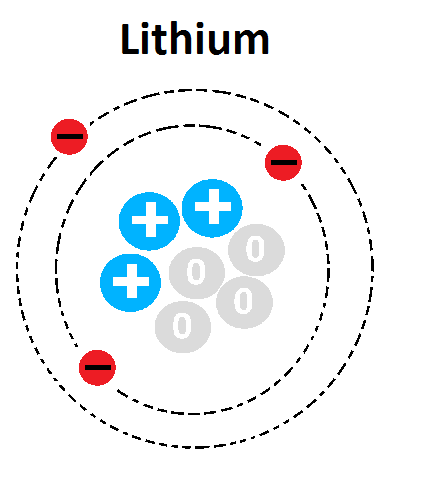
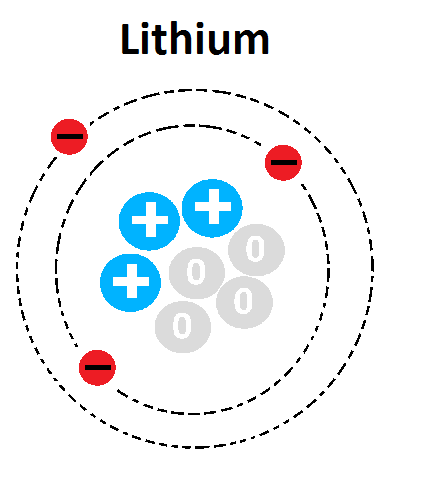
What is the atomic number of this atom?
a)
1
b)
3
c)
4
d)
7
17.

What is the atomic mass of this atom?

a)

1

b)

3

c)

4

d)

7

18.
The state of matter that has no definite size or shape is
a)
Solid
b)
Liquid
c)
Gas
19.
the central region of an atom where its neutrons and protons are is its 
a)
nucleus 
b)
electron cloud
c)
core 
d)
center 
20.
The positive particles of an atom are 
a)
electrons 
b)
positrons 
c)
neutrons 
d)
protons 
21.
Particles in an atom that are neutral and have no charge are 
a)
negatrons 
b)
electrons 
c)
neutrons 
d)
protons 
22.

Density is defined as

a)

the amount of matter

b)

the amount of mass in a given volume

c)

the amount of volume

d)

the shape of the matter

23.
Elements on the Periodic Table are considered.......
a)
Natural Resource
b)
Synthetic Material
c)
Neither Natural nor Synthetic
24.

What do we call an energy source that is used to replace fossil fuels.

a)

alternative

b)

renewable

c)

nonrenewable

d)

recyclable

25.
A resource that can be easily replaced.
a)
renewable
b)
alternative
c)
nonrenewable
26.
A resource not easily replaced.
a)
nonrenewable
b)
renewable
c)
alternative
27.

What is an environmentalist?

a)

a person who studies and cuts down trees

b)

a person who studies and protects the envoronment

c)

a person who who lives in and around tress

d)

a person who studies soil

28.
Which of Newton's Laws is also known as the Law of Inertia?
a)
Newton's 1st Law
b)
Newton's 2nd Law
c)
Newton's 3rd Law
d)
None of these
29.

Your friend kicks a soccer ball and it stops a few feet from you. What needs to happen to it

a)

Friction has to be applied to the ball

b)

Force has to be applied to the ball

c)

Speed has to be applied to the ball

d)

Inertia has to be applied to the ball

30.

If you are riding in the car and the driver turns left, why do you lean to the right?

a)

It takes you a moment to catch up with the new velocity of the car

b)

You have more inertia than the car, so it takes longer for you tu turn left

c)

You had been sitting at rest utnil the force of the turn sets you in motion

31.

Which of the following is the correct unit to use to measure force?

a)

Neutron

b)

Norton

c)

Nucleus

d)

Newton

32.
For every action, there is an equal and opposite reaction
a)
Speed
b)
Newtons 3rd law of motion
33.
Force= Mass x Acceleration
By increasing or decreasing the mass or acceleration of an object you change the force applied by that object.
a)
Newtons 1st law of motion
b)
Newtons 2nd law of motion
34.
What is the definition of CONDUCTION?
a)
When heat is transferred from objects like rays of light or electromagnetically.
b)
a  hot liquid or air that  expands, becomes less dense, and rises or becomes more dense, and sinks.
c)
When heat transfers from objects that are touching.
d)
When heat transfers through the heater or AC in your house.
35.
What is the definition of CONVECTION
a)
When heat transfers through waves.
b)
When heat transfers from objects that are touching.
c)
a  hot liquid or air that  expands, becomes less dense, and rises or becomes more dense, and sinks.
d)
Heat traveling from the sun
36.

What is the definition of Radiation?

a)

Heat transfer from a body at a higher temperature to a body at a lower temperature without actual movement of the particles.

b)

Heat transfer from a heat source at a distance like fire or the sun.

c)

Heat transfer from a hot body to a cold body directly without heating the medium in between.

37.
The Law of Conservation of Energy states:
a)
Energy can created or destroyed but not transformed 
b)
Energy cannot be created or destroyed, it can only transformed
c)
Energy can't be created, destroyed or transformed
38.

What is the Law of Conservation of mass?

a)

Mass is created in a chemical reaction

b)

Mass is created in a physical change

c)

Mass is never created or destroyed

39.
When measuring the volume of a rock, which method do you use?
a)
L x W x H
b)
Water Displacement
c)
Beaker measuring
40.
Ice melting
a)
Chemical Change
b)
Physical Change
41.
Wood burned in a fireplace
a)
Chemical Change
b)
Physical Change