
 Worksheets
Chesapeake Bay watershed!
Total questions: 23
Worksheet time: 25mins

What is a watershed?
Land that collects & channels water
Shape of the land
A natural stream of water
River & its tributaries
A body of water that is a mix of fresh and salt water is called -
a swamp
a bog
an estuary
a biopond
Which of the following statements about the about the Chesapeake Bay is NOT true?
The Chesapeake Bay is unusually shallow.
The Chesapeake Bay is unusually deep.
The Chesapeake Bay has a large area of land draining into a small amount of water.
The Chesapeake Bay is small compared to the size of its watershed.

The four major rivers of Virginia are...
The Susquehanna, Potomac, York and James
The Potomac, Rappahannock, York and James
The Potomac, Anacostia, York and James
The Potomac, Anacostia, Susquehanna and York

What body of water is #1?
Atlantic Ocean
Chesapeake Bay
Delaware Bay
Albemarle Sound

What body of water is #5
James River
Potomac River
Susquehanna River
Choptank River

What body of water is #8?
York River
Potomac River
Susquehanna River
Nanticoke River

What body of water is #10?
James River
Rappahannock River
Patuxent River
Choptank River

The Chesapeake Bay has what type of water in it?
fresh water
brackish water
salt water

What watershed in Virginia drains the South Western part of our state?
Gulf of Mexico
North Carolina Sound
Chesapeake Bay
To much fertilizer in an area can cause an excess of nutrients causing an algae bloom. This is bad news for the fish and it is called?
symbiosis
phototropism
eutrophication
mutualism
Which choice below is considered an ABIOTIC factor in the Chesapeake Bay?
blue crabs
tall grasses
different fish species
brackish water

What do the orange and yellow spheres represent in this model of an atomic nucleus?
Gluons and leptons.
Protons and neutrons.
Positrons and electrons.
Atoms and molecules.

What do the elements highlighted in red have in common?
The same number of protons.
The same number of electrons.
The same number of neutrons.
The same number of electron shells.

Which of the following is a true statement?
Periods form horizontal rows; groups form vertical columns.
Groups form horizontal rows; periods form vertical columns.
Categories form horizontal rows; gases form vertical columns.
Gases form horizontal rows; categories form vertical columns.
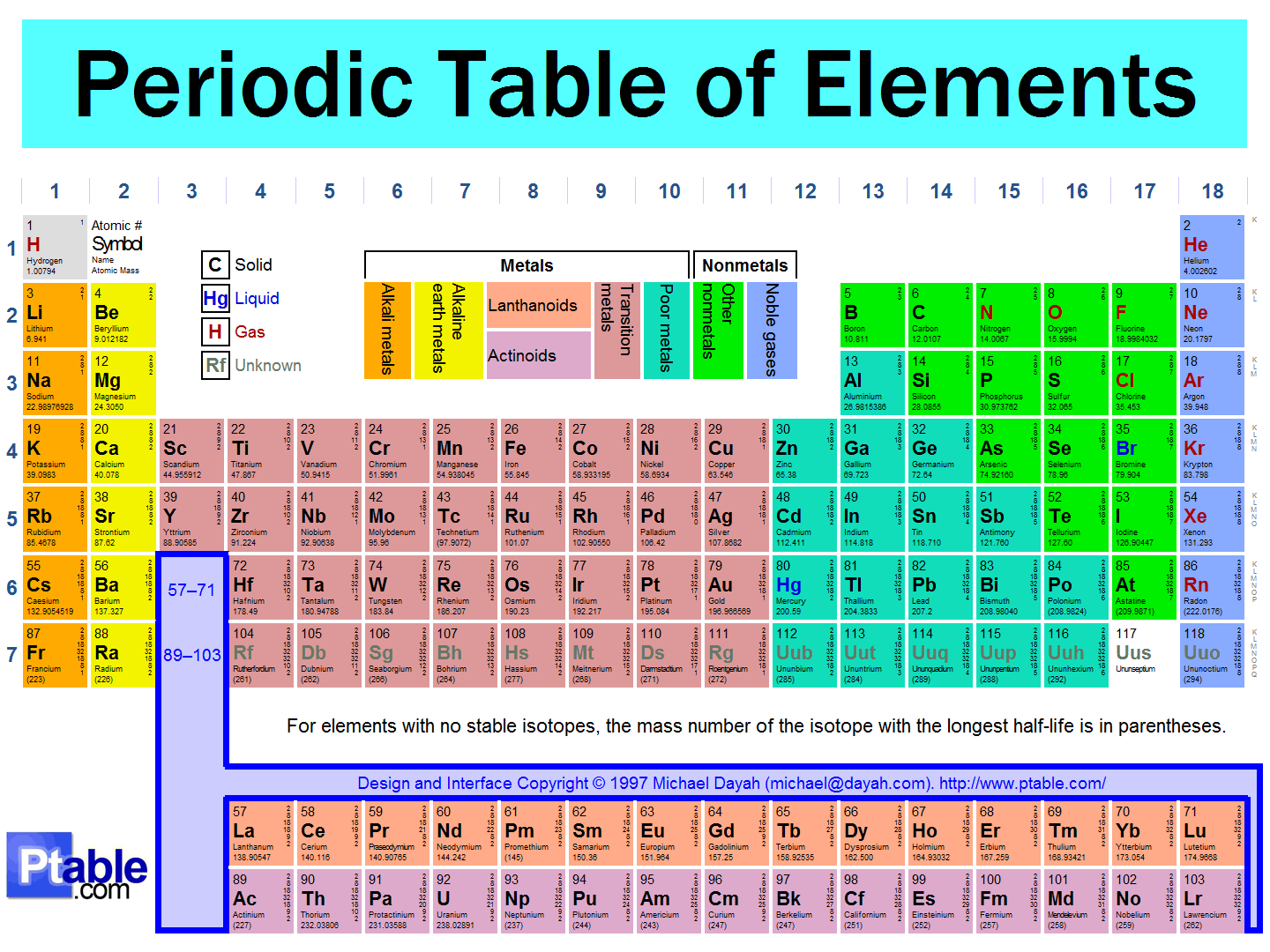
The horizontal rows on the periodic table are called
groups
families
periods
atomic numbers


A light bulb gives off ____ energy.
thermal
mechanical
kinetic
electrical
Earth has four SEASONS because?
of Earths rotation
of Earths tilt on its axis
of Earths revolution around the Sun
of Earths distance from the Sun

The height of a sound wave is called the?
wavelength
crest
trough
amplitude
A metal spoon in ice cream can become cold to touch because heat is transferred through?
convection
radiation
conduction

