wayground logo

Free Printable Worksheets

NEW

Font size

S
M
L
XL
Worksheets

Reflection

Total questions: 25

Worksheet time: 50mins
Name
Class
Date
1.
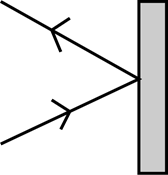
The illustration shows a light ray striking an object.
In the illustration, the light ray striking the object is-
a)
absorbed
b)
stopped
c)
reflected
d)
refracted
2.
The ray of light that strikes a reflecting surface is called ________.
a)
incident ray
b)
reflected ray
c)
normal ray
d)
none of the above
3.
The angle produced as a source of light bounces off a reflecting surface is called ______.
a)
angle of crookedness
b)
angle of reflection
c)
angle of incidence
d)
angle of bounce
4.

Your light-sensing organ is your

a)

ear

b)

finger

c)

brain

d)

eye

5.

In order to see a picture it must

a)

produce light

b)

reflect light

c)

absorb light

6.

Which of the following is NOT a use of a concave mirror?

a)

car lights

b)

torches

c)

security mirrors

d)

mirrors used by dentist

7.

Image behind the mirror is

a)

virtual

b)

real

c)

upside down

d)

upright

8.

image above the principal axis (PA) is

a)

virtual

b)

real

c)

upright

d)

upside down

9.

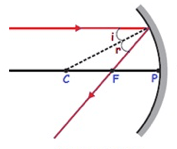
This ray diagram is for which mirror?

a)

concave

b)

convex

c)

plane

d)

window

10.

this type of mirror is used in supermarkets to see around bends

a)

concave

b)

convex

c)

plane

d)

window

11.

The image of an object, which is placed one foot in front of a plane mirror, will be ___.

a)

behind the mirror and reversed, left to right.

b)

behind the mirror.

c)

in front of the mirror and reversed, left to right.

d)

in front of the mirror.

12.
The velocity of light in vacuum is _______ m/s
a)
3x10⁸
b)
3x10¹²
c)
3x10⁶
d)
3x10¹⁰
13.
We can see objects because of_______
a)
reflection
b)
refraction
c)
transmission
d)
diffraction
14.
How does light behave as it enters these mediums?
a)
continue its path as straight line.
b)
bends toward the normal
c)
bends away from the normal
d)
reflects
15.
What is this image showing?
a)
Reflection
b)
Refraction
c)
The law of reflection
d)
Concave Mirror
16.

What do we call a material that light can travel through?

a)

air

b)

water

c)

medium

d)

pathway

17.
a)
Reflection
b)
Refraction
18.
What does the word "converging" mean?
a)
to separate
b)
to come together
c)
parallel 
d)
perpendicular
19.
A converging lens is also known as a ____ lens.
a)
convex
b)
concave
c)
double
d)
refracted
20.
This image is...
a)
Inverted and smaller
b)
inverted and bigger
c)
not inverted and smaller
d)
not inverted and bigger
21.
Which describes a convex lens?
a)
triangular in shape
b)
more transparent in the middle
c)
thicker on the edges than in the middle
d)
thicker in the middle than on the edges
22.
What type of lens do humans have in their eyes? 
a)
Concave Lens 
b)
Convex Lens 
23.
What type of image is formed when rays of light actually intersect?
a)
real
b)
virtual
c)
projected
d)
curved
24.
A _______ breaks white light into colors.
a)
prism
b)
visible spectrum
c)
shadow
d)
lens
25.
When some light can pass through and some light cannot, that object is:
a)
transparent
b)
translucent
c)
opaque
d)
a prism