
 Worksheets
Light reflection
Total questions: 20
Worksheet time: 12mins
which of the following is not a property of the image formed by a [lane mirror?
virtual and erect
Object size = image size
object distance = image distance
Real and inverted
Which of the following is a concave mirror?


which of the following ray diagrams is correct for the ray of light incident on a concave mirror as shown in the figure 10.6?
A
B
C
D
Convex mirror is also called as
converging mirror
diverging mirror
plane mirror
silver mirror
The relation between focal length and radius of curvature is
R = 2f
1/f = 2R
f = R/2
R = 2/f
The focal length of a plane mirror is ........
infinite
zero
1m
100m
When the object is in between the centre of curvature (C) and focus (F) of a concave mirror, then the position of the image is ...........
At focus
At the centre of curvature
at infinity
beyond the centre of curvature
When the object is at infinity, a point sized image is formed at ................ by the convex mirror
focus behind the mirror
focus in front of the mirror
radius of curvature
principal axis
The image formed by a concave mirror when the object is placed between the pole and the focus is ......
virtual, erect and magnified
virtual, erect and diminished
real, inverted and magnified
real, inverted and diminished
The angle of incidence of a ray of light passing through the centre of curvature of a concave mirror is ........... degree
105
180
90
0
What is the size of the image formed when an object is kept at the focus in front of concave mirror?
enlarged
diminished
highly enlarged
highly diminished
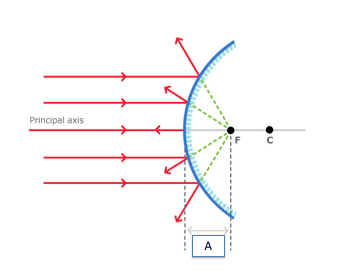
In the image, all the rays meet at F, What is F
focal length
focal point
center of curvature
reflection
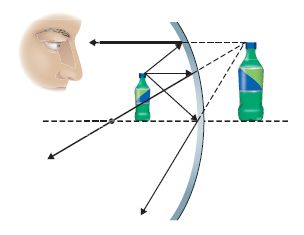

Through which point on principal axis shall reflected ray pass in the following diagram of incident ray ?
point F
point C
point P
none of the above


