
 Worksheets
Oscillation
Total questions: 29
Worksheet time: 18mins
What two conditions are required for simple harmonic motion to occur?
Acceleration is opposite to displacement
Acceleration is to the direction of displacement
Acceleration is inversely proportional to displacement
Acceleration is proportional to displacement

In a simple pendulum, which force brings the mass back to equilibrium?
Gravitational force
Elastic force
Tension
Friction
What is meant by forced oscillation?
When an object is vibrating at its natural frequency
When an object continues to vibrate after the disturbance is removed
When an object vibrates at a frequency which is different from its natural frequency
When an object receives a vibration from external sources
Which graph can be used to describe oscillation?
displacement-time graph
displacement-length graph
amplitude-time graph
time invariant graph
Which of the following best defines an oscillation?
Random movement
Back and forth movement about a fixed point
No movement
Which of the following motions are examples of oscillations? (Select all)
Vibration of a violin string
Heartbeat
Flapping of wings of a dragonfly
Bus journey from UG to DJ
A simple harmonic motion is defined as motion where
a∝x
a∝−x
v∝x
v∝−x
An oscillation has a function y(t)=2.0 sin (3.0t) cm
What is its angular frequency?
2.0 rad s−1
3.0 rad s−1
0.48 rad s−1
2.1 rad s−1
When a forced oscillation is damped, the amplitude
builds up quite slowly
constantly rises and falls
is always small
is reduced
The increase in amplitude of an oscillator caused by a driving frequency
resonance
resonator
generator
Lowest natural resonant frequency (LNRF)

Diagram below shows a graph of an oscillation system experiences damping.
Which of the following quantity does not change?
Size of oscillation
Period of oscillation
Energy of oscillation
Amplitude of oscillation

Diagram below shows an oscillating system.
Which graph shows the correct relationship between displacement and time for the oscillating system?


When is the pendulum at maximum velocity
At its lowest point
At its highest point
It moves at a constant velocity
It is at rest
Given an expression of x = 10 sin (0.25πt) where x in cm, t in second. Which of these answers are true?
the frequency is 0.125 Hz
the amplitude is 10 m
the angular frequency is 0.125 rad s-1
at t = 0, x = 10 cm
When is the pendulum at 0 velocity
At its lowest point
At its highest point
It moves at a constant velocity
It is at rest
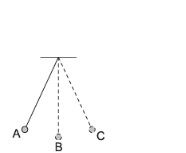
A pendulum oscillates as shown. At which of the following positions is the kinetic energy equal to the total energy?
A
B
C
Not enough information given.
Which of the following equation represent the displacement of SHM:
x= A tan ωt
x= A sin ωt
x= A sin ωt cos kx
x= A sin (ωt ± kx)


Which of the following is the expression for the above graph?
x = 2 sin (2πt)
x = 2 cos (2πt)
x = 2 sin (0.5πt)
x = 10 sin (2πt)

In x = A sin (ωt+ϕ) , what does ϕ represent?
Phase angle
Phase constant
When the body is in SHM motion, as the body reaches the equilibrium point, the potential energy = maximum while kinetic energy = 0.
False
True

When plotting a displacement - time graph, if ϕ = negative values, the graph need to be shifted to the left
False
True

The graph shows the variation of displacement x against time t of a body in simple harmonic motion. Which statement is true?
The period is 0.30 s.
The angular frequency is 0.40 s-1.
The frequency is 2.5 Hz.
The amplitude is 10.0 cm.
An oscillatory system is critically damped. Which statement is true?
The amplitude of oscillation decreases exponentially.
The displacement decreases to zero in a short time.
Energy dissipates from the system linearly with time.
The system takes a long time to come to rest.
which of the following graph is the graph of energy?



