

Wayground logo

Free Printable Worksheets

Font size

S
M
L
XL
Worksheets

HAP5.3 Action Potentials

Total questions: 30

Worksheet time: 15mins
Name
Class
Date
1.
When a neuron is depolarized, what are the first channels to open?
a)
Sodium
b)
Potassium
c)
Calcium
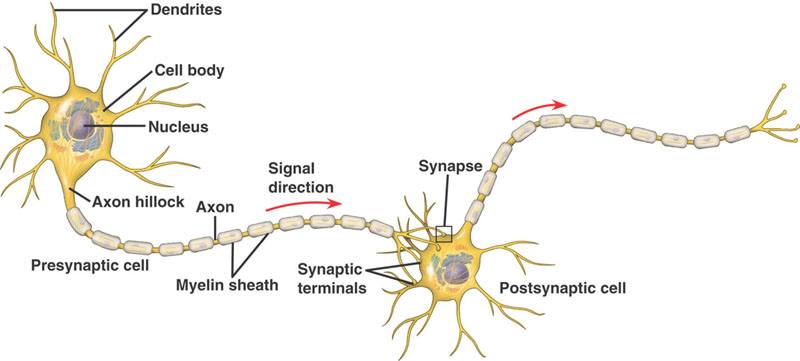
d)
ACTH
2.
When a neuron is resting, the inside of the axon has a ____________ charge.
a)
-55 mV
b)
-70 mV
c)
40 mV
d)
-75 mV
3.
When a neuron is not engaged in an impulse.
a)
Resting potential
b)
Action potential
c)
Neural potential
d)
Synaptic potential
4.
Which ions are involved in the electrical nerve impulse?
a)
Iodine and Sodium
b)
Potassium and Sodium
c)
Iron and Sodium
d)
Calcium and Iodine
5.
What number on the graph represents the Depolarization phase?
a)
1
b)
2
c)
3
d)
4
6.
What number on the graph represents the Hyperpolarization phase?
a)
1
b)
2
c)
3
d)
4
7.
The sodium-potassium pump....
a)
Sends (Na+) into the cell
b)
Sends (K+) into the cell
c)
Exchanges (K+) & (Na+) during depolarization
d)
Exchanges (K+) & (Na+) during hyperpolarization
8.
Why is -55 mV a significant number?
a)
This is the largest charge achieved during an action potential
b)
This is the threshold required to complete an action potential
c)
This is the resting charge of a neuron
d)
This is the charge when all the sodium is inside the cell
9.
Why is hyperpolarization important?
a)
It makes sure the neuron is healthy
b)
It prevents a second, unwanted signal from being sent
c)
It makes sure the neurons are in the correct space
d)
It makes sure the charge is back at -70 mV
10.
At what stages do Sodium/Potassium Channels open?
a)
Repolarization/ Repolarization
b)
Depolarization/ Hyperpolarization
c)
Hyperpolarization/ Repolarization
d)
Depolarization/ Repolarization
11.
Which is the correct order of events in depolarisation then repolarisation? 
a)
Sodium channels close, potassium channels open
b)
Sodium channels open, potassium channels open, 
c)
Sodium channels open, potassium channels close
d)
Potassium channels open, sodium channels open
12.
The sodium potassium pump restores the resting potential. By which process does this work? 
a)
Osmosis
b)
Diffusion
c)
Facilitated diffusion
d)
Active transport
13.
What is the insulating membrane that surrounds parts of the axon that helps to protect & propagate action potential?
a)
Axon
b)
Dendrites
c)
Node of Ranvier
d)
Myelin Sheath
14.
Describes the fact that a neuron fires at the same intensity despite the intensity of the stimulus.
a)
Threshold
b)
Repolarization
c)
All or None Principle
d)
Action Potential
15.

An electrical impulse within a single neuron is called a

a)

synapse

b)

membrane potential

c)

action potential

d)

cell body

16.

Depolarization occurs when

a)

sodium channels open

b)

potassium channels open

c)

sodium channels close

d)

potassium channels close

17.

Which of the following uses ACTIVE transport?

a)

sodium-potassium pump

b)

sodium channel

c)

potassium channel

d)

diffusion

18.
What number(s) on the graph represents the Resting Potential?
a)
1 and 2
b)
1 and 5
c)
2 and 3
d)
3 and 4
19.

Since all action potentials are of the same strength, how does your brain determine whether a stimulus is more or less intense?

a)

strength of action potentials

b)

frequency of action potentials

c)

length of depolarization period

d)

how long it take to repolarize the neuron

20.

When the Na/K pump is replacing the ions

a)

resting potential

b)

depolarization

c)

action potential

d)

repolarization

e)

refractory period

21.

Another action potential cannot be generated during which phase of the previous impulse?

a)

resting potential

b)

depolarization

c)

action potential

d)

repolarization

e)

refractory period

22.

At synapse axon terminal is expanded into

a)

End bulb or synaptic knob

b)

presynaptic neuron

c)

post synaptic neuron

d)

synaptic vesicle

23.

Gap between presynaptic and post synaptic neuron is called

a)

synaptic vesicle

b)

tight junctions

c)

synaptic cleft

d)

Synaptic knob

24.

Neurotransmitters are released from the

a)

Dendrites

b)

Post-synaptic neuron

c)

Presynaptic neuron

d)

Schwann Cells

25.
In order for a neuron to have an action potential, the neuron must receive more
a)
excitatory neurotransmitters
b)
inhibitory neurotransmitters
c)
agnostic neurotransmitters
d)
antagonistic neurotransmitters
26.
Excess neurotransmitters in the synapse that goes back into the presynaptic neuron.
a)
Resting potential
b)
Reuptake
c)
Retroactivity
d)
Repolarization
27.
What is the chemical used by a neuron to transmit an impulse across a synapse to another nerve cell?
a)
Neurotransmitters
b)
Synapse
c)
Threshold
d)
Impulse
28.
What generates a nerve impulse on the post-synaptic membrane? 
a)
Calcium binding with a receptor site
b)
Potassium leaking into the post-synaptic membrane 
c)
Neurotransmitter binding with receptor sites
d)
Neurotransmitter being removed from the synapse
29.

What chemical is activated by the action potential in the presynaptic neuron that causes the vesicles containing neurotranmitters to move toward the synaptic cleft?

a)

calcium

b)

potassium

c)

sodium

d)

phosphorus

30.

Which pattern shows how signals are transmitted from the presynaptic neuron to the post synaptic neuron

a)

electrical --> electrical

b)

electrical --> chemical

c)

chemical --> electrical --> chemical

d)

electrical --> chemical --> electrical
