

wayground logo

Free Printable Worksheets

Font size

S
M
L
XL
Worksheets

Honors Biology Midterm Exam-ish

Total questions: 50

Worksheet time: 50mins
Name
Class
Date
1.
Proteins are made of monomers called ___________
a)
Nucleotides
b)
Monosaccharides
c)
Amino Acids
d)
Glycerol and fatty acids
2.
DNA and RNA are examples of 
a)
Carbohydrates
b)
Lipids
c)
Proteins
d)
Nucleic Acids
3.
Monosaccharides are monomers of
a)
Carbohydrates
b)
Lipids
c)
Proteins
d)
Nucleic Acids
4.
Waxes, oils and fats are examples of
a)
Carbohydrates
b)
Lipids
c)
Proteins
d)
Nucleic Acids
5.
What type of macromolecule are enzymes?
a)
Protein
b)
Carbohydrate
c)
Lipid
d)
Nucleic Acid
6.
What is the function of an enzyme?
a)
enzymes break themselves into small pieces
b)
enzymes slow down chemical reactions
c)
enzymes speed up chemical reactions
d)
enzymes combine products to form reactants 
7.
Enzymes provide a site where reactants called substrates can be brought together in an enzyme-catalyzed reaction. The site is called the
a)
enzyme substrate complex.
b)
reaction site.
c)
active site.
d)
lock and key.
8.
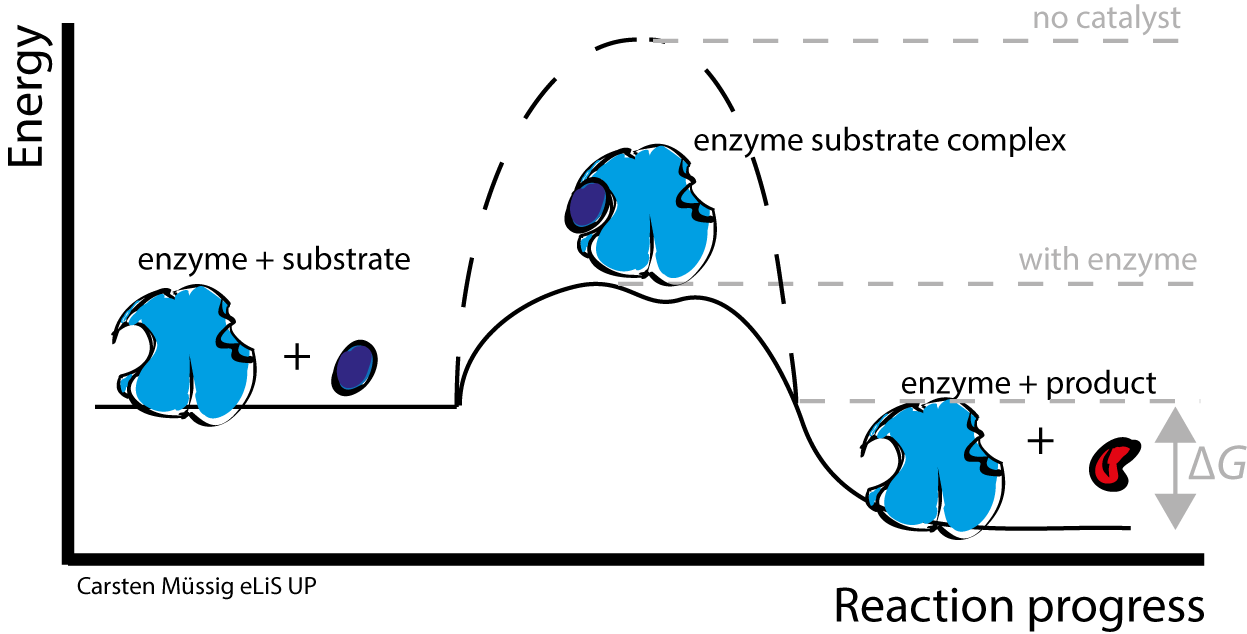
An enzyme speeds up a reaction by
a)
lowering the activation energy.
b)
raising the activation energy.
c)
releasing energy.
d)
absorbing energy.
9.

What happens when enzymes are heated to a high temperature?

a)

The enzymes die.

b)

The shape of the enzyme's active site changes

c)

The enzymes' amino acid sequence changes.

d)

The enzymes remain the same

10.
Enzymes will make a reaction go _______ and use ______ energy.
a)
faster, less
b)
faster, more
c)
slower, less
d)
slower, more
11.
Cells can produce over one thousand different enzymes at a time.  Enzymes are critical to the metabolism of these cells, but why are so many different enzymes needed?
a)
Cells are completely unable to control what enzymes
they produce
b)
The variety of enzymes prevents their actions from being inhibited. 
c)
The active site of an enzyme can only bind to a specific substrate.
d)
The products of a reaction are always converted into new enzymes.
12.

Which factors can change the shape of an enzyme and thus denatures (inactivates) a enzyme?

a)

Excessive heat and changes in pH

b)

Nothing can

c)

Exposure to light and sound

d)

Exposure to bacteria and Amoebas

13.
What effect do low temperatures have on enzymatic activity? 
a)
Low temperatures denature enzymes and slows reactions
b)
Low temperatures change the structure of substrates and slow reactions
c)
Low temperatures means molecules are moving slower and so reaction rate is low
d)
Enzymes work best at low temperatures
14.

These cells have no nucleus

a)

Prokaryotic

b)

Eukaryotic

c)

Both

15.

All cells have DNA

a)

True

b)

False

16.
Plants and animal cells are examples of ___ cells 
a)
prokaryotic cells 
b)
eukaryotic cells 
17.
Prokaryotic and eukaryotic cells have many differences, but they also share some common features.  Which of the following may be found in either type of cell?
a)
Golgi bodies
b)
ribosomes
c)
mitochondria
d)
nucleus
18.

A large fluid-filled vesicle located in the cytoplasm of a plant cell; stores water, enzymes, and waste; keeps toxic wastes away from the rest of the cell.

a)

Lysosome

b)

Vacuole

c)

Golgi apparatus

d)

Cell wall

19.

Only plant cells have a cell wall.

a)

True

b)

False -- all cells have a cell wall

c)

False -- animal cells also have cell walls

d)

False -- bacteria and fungi also have cell walls

20.

Which of the following is NOT found in all cells?

a)

Cell membrane

b)

Ribosomes

c)

Cytoplasm

d)

Mitochondria

21.

Select all of the eukaryotic organisms.

a)

Animals

b)

Plants

c)

Protists

d)

Bacteria

e)

Fungi

22.
What are the reactants of cellular respiration?
a)
glucose & carbon dioxide
b)
glucose & oxygen
c)
water & oxygen
d)
water & carbon dioxide
23.

Cellular Respiration occurs in what cell organelle?

a)

chloroplast

b)

cytoplasm

c)

mitochondria

d)

animal

24.

What are the 3 reactants of photosynthesis? The reactants are the things needed for photosynthesis to occur.

a)

oxygen, glucose, sunlight

b)

sunlight, oxygen, water

c)

water, oxygen, carbon dioxide

d)

carbon dioxide, sunlight, water

25.

What are the 2 products of photosynthesis? The products are the things made in the process of photosynthesis.

a)

water, sunlight

b)

glucose, carbon dioxide

c)

oxygen, glucose

d)

sunlight, oxygen

26.

Plant cells do not perform cellular respiration.

a)

True -- only animal cells perform cellular respiration

b)

False -- plant cells perform both photosynthesis and cellular respiration

27.

A difference between photosynthesis and chemosynthesis

a)

Photosynthesis doesn't use light and chemosynthesis does

b)

Photosynthesis makes sugar and chemosynthesis doesn't

c)

Photosynthesis uses light and chemosynthesis doesn't

d)

Photosynthesis doesn't make sugar and chemosynthesis does

28.

What is a similarity in chemosynthesis and photosynthesis

a)

they both produce carbon dioxide

b)

they both use light

c)

the both are used by plants

d)

they both produce sugar

29.
What is a disadvantage of fermentation as a process? 
a)
It produces too much ATP
b)
It only produces 2 ATP
c)
It occurs in the absence of oxygen
d)
It is only for quick bursts of energy
30.
Fermentation is cellular respiration without which molecule?
a)
CO2
b)
O2
c)
C6H12O6
31.
Most of the cell membrane is made of...
a)
Lipids
b)
Carbohydrates
c)
Proteins
d)
Nucleic acids
32.
What forms the channels and pumps in the phospholipid bilayer?
a)
carbohydrates
b)
proteins
c)
hydrophilic heads 
d)
lipids
33.
___________ allow cells to recognize each other and act like ID tags. 
a)
Carbohydrates 
b)
Proteins
c)
Phospholipids 
d)
Cholesterol
34.

This image is an example of a phospholipid. Which part of a phospholipid is HYDROPHOBIC?

a)

the phosphate "head"

b)

the lipid "tails"

35.
When both inside and outside of a cell have the same amount of water it is said that the cell has reached a state of
a)
Osmosis
b)
Diffusion
c)
Equilibrium
36.
Small, non-polar molecules like COand O2 and NO can pass through the cell membrane using what type of transport?
a)
Diffusion
b)
Osmosis
c)
Facilitated Diffusion
d)
Endocytosis
37.
Facilitated diffusion is the movement of materials into and out of the cell
a)
with the use of energy
b)
with the use of proteins but no energy
c)
by moving water
d)
by using ATP
38.
Which form of transport is being shown in the diagram.
a)
diffusion
b)
osmosis
c)
facilitated diffusion
d)
active transport
39.
Active transport requires _____ to move materials across the cell membrane.
a)
proteins
b)
sunlight
c)
oxygen
d)
energy
40.
In this image, the cell is using which type of molecular transport?
a)
Osmosis
b)
Diffusion 
c)
Endocytosis
d)
Exocytosis 
41.

An animal cell placed in a hypertonic solution will

a)

Stay the same

b)

Shrink- get smaller

c)

Swell- get bigger

42.
If you looked at red blood cells under a microscope and saw the blood cells exploded, what would you say happened?
a)
The cells were placed in a hypotonic solution.
b)
the solution was isotonic.
c)
The solution was hypertonic.
43.
 If a cell containing 5% salt is placed into a glass of water with 20% salt, the water is _______ compared to the cell.
a)
hypertonic
b)
hypotonic
c)
isotonic
44.
Replicate the following strand of DNA: 
AATCATGGA
a)
AATCATGGA
b)
TTAGTACCT
c)
UUAGUACCU
d)
GGATAUCUA
45.
If the percentage of DNA is made of 30% Thymine, what is the correct percentage of Guanine?
a)
30
b)
15
c)
20
d)
60
46.
How many amino acids are coded for by this sequence of nucleotides:
ATGGGAACTCCA
a)
4
b)
2
c)
6
d)
12
47.
Where does transcription take place?
a)
nucleus
b)
cytoplasm
c)
ribosome
48.

Transcribe this segment of DNA: TACGAA

a)

AUGCUU

b)

ATGCTT

c)

GCATCC

d)

GCAUCC

49.

What is the location in the cell for translation?

a)

nucleus

b)

mitochondria in cytoplasm

c)

ribosome in cytoplasm

d)

chloroplast in cytoplasm

50.

What process is occurring in this photo?

a)

Transcription

b)

DNA replication

c)

Translation

d)

DNA degredation
