
 Worksheets
Atomic Structure subatomic particles
Total questions: 25
Worksheet time: 33mins
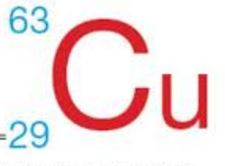
What is the mass number of Copper?
63
29
34
92

What were J. J. Thomson's three contributions to the atomic theory?
Discovered the electron
Discovered the nucleus -did the gold foil experiment
Used the cathode ray tube in his discovery
Created a model of the atom with electrons moving around the nucleus in fixed orbits
Created the "plum pudding" model of the atom

Rutherford’s experiment determined that the nucleus of an atom is tiny, dense and ______ charged.
neutrally
negatively
positively
variably
The cathode ray experiments led to which particle being discovered?
Nucleus
Proton
Neutron
Electron
The alpha particles in Rutherford’s experiments were used to -
Identify chemical properties
Bombard sheets of gold
Identify the melting point
Determine the molecular mass
In a famous experiment conducted by Ernest Rutherford, a few positively charged alpha particles were scattered by a thin gold foil. Which of the following is a conclusion that resulted from this experiment?
The nucleus is negatively charged.
The atom is a dense solid and is indivisible.
The mass is conserved when atoms react chemically.
The nucleus is very small and the atom is mostly empty space.
If we are talking about the isotope carbon-14, the mass number of this isotope is.....
12
13
14
6
What is the mass number and name of an element with 8 protons and 8 neutrons?
Carbon-14
Oxygen-16
Oxygen-24
Neon-8
Who discovered the charge of an electron?
Robert Millikan
JJ Thomson
James Chadwick
Eugen Goldstein

Bromine has how many Neutrons?
35
80
45
8

How many neutrons are in Tungsten
110
74
183
258


In standard nuclear notation, what does X represent?
The position of the element of the periodic table
The name of the element
The chemical symbol for the element
The date of discovery of the element
Strontium-90 is a radioactive isotope of strontium. How does the structure of this isotope differ from that of strontium-88.
Two more electrons
Two more protons
Two more neutrons
Two less protons
Which hypothesis led to the discovery of the proton?
When a neutral hydrogen atom loses and electron, a positively-charged particle should remain.
A proton should be 1840 times heavier than an electron.
Cathode rays should be attracted to a positively charged plate.
The nucleus of an atom should contain neutrons
As a consequence of the discovery of the nucleus by Rutherford, which model of the atom is thought to be true?
Protons, electrons, and neutrons are evenly distributed throughout the volume of the atom.
The nucleus is made of protons, neutrons and electrons.
Electrons are distributed around the nucleus and occupy almost all the volume of the atom.
The nucleus is made of electrons and protons.
What is the relative mass of an electron?
1/1840 the mass of a proton
1/1840 the mass of a neutron + proton
1/1840 the mass of a C-12 atom
1/1840 the mass of an alpha particle
All atoms are
positively charged, with the number of protons exceeding the number of electrons.
negatively charged, with the number of electrons exceeding the number of protons
neutral, with the number of protons equaling the number of electrons
neutral, with the number of protons, neutrons and electrons all being equal

Positively charged protons repel each other, so what holds protons and neutrons together in the nucleus?
Electrons
Nuclear forces
Attraction
Repulsion
What is the average mass of this element?

