
 Worksheets
MATTER AROUND US QUIZZ
Total questions: 60
Worksheet time: 39mins
Seema took a 100 ml beaker and filled half the beaker with water and marked the level of water. She dissolved some salt with the help of a glass rod and recorded water level again.
The water level increases appreciably
The water level decreases
The water level remains the same
There is little increase in water level.
Which of the following is not a characteristic of matter?
Matter is made up of extremely small particles
There is no space between particles of matter
The particles of matter are continuously moving
The particles of matter attract each other.
Which one of the following sets of phenomenon would increase on raising the temperature?
Diffusion, evaporation and compression of gases
Evaporation, compression of gases and solubility of solid in liquid
Evaporation, diffusion, expansion of gases and solubility of solid in liquid
Evaporation, solubility of gas in liquid, diffusion and compression of gases.
During summer, water kept in earthen pot becomes cool due to phenomenon of
Diffusion
Transpiration
Distillation
Evaporation
Which of the following is correct order of forces of attraction?
Water > Air > Sand
Air > Sugar > Oil
Air < Water < Sugar
Salt > Air > Juice
If we keep cold drink bottle in freezer, what will happen?
Water will change into ice
Cold drink bottle will break
CO2 gas will get solidified
Nothing happens.
Choose the correct statement out of the following
Conversion of solid into vapours without becoming liquid is called evaporation.
Conversion of vapours into solid without becoming liquid is called sublimation
Conversion of solid into liquid is called sublimation.
Conversion of liquid into vapours is called fusion.
Which of the following will produce severe burns ?
Cold water
Hot water
Boiling water
Steam
Which of the following conditions will increase the rate of evaporation?
Increase in temperature of water
Decrease in wind speed
Decrease in surface area of water
Adding sugar to water
Which of the following is incorrect?
Solids have fixed shape and fixed volume.
Liquids have fixed volume but not shape
Gases have neither fixed shape nor volume
The particles have least intermolecular space but maximum kinetic energy in liquids.
Which of the following is correct order of density ?
Air < Exhaust from chimneys < Honey < Water < Chalk < Cotton < Iron.
Air < Exhaust from Chimneys < Water < Honey < Cotton < Chalk < Iron.
Air < Exhaust from Chimneys < Honey < Water < Chalk < Iron < Cotton
Air < Exhaust from Chimneys < Water < Honey < Chalk < Cotton < Iron
Ice floats on water because
it has higher density than water
it has lower density than water due to more volume
it is solid
it is low melting solid
The physical state of a matter depends upon
temperature and pressure
temperature only
pressure only
nature of substance
The boiling point of water at higher altitude is
373 K
< 373 K
> 373 K
273 K
Latent heat of fusion is amount of
heat energy required to change 1 kg solid into liquid completely at its melting point.
heat energy required to convert 1 kg solid into liquid at room temperature
heat energy required to change 1 g of solid into liquid completely
heat energy required to change 1 kg of solid into liquid at any temperature.
Which of the following has minimum kinetic energy ?
Particles of ice below 0 °C
Particles of water at 0 °C
Particles of water at 100 °C
Particles of steam at 100 °C
Which of the following cannot be separated by sublimation?
Iodine and NaCl
Iodine and Ammonium chloride
Camphor and Sodium chloride
Naphthalene and Sand
liquid


What is mass?
anything that takes up space
the amount of matter an object has
the amount of space an object takes up
the measure of how warm something is


Water can change state. What happens to water during condensation?
It changes from liquid to a gas.
It changes from a gas to a liquid.
It changes from a liquid to a solid.
It changes from a solid to a liquid.
What is the study of matter and how matter changes?
Physical Science
Chemistry
Biology
Matterology
What term means "take up space"
Volume
Matter
Mass
Substance
What affect the rate of evaporation
Humidity
Wind
Heat
Temperature
Condensation occurs when water vapour....
loses heat
gains heat
Condensation involves a change of state from ___ to ___
Liquid to Solid
Liquid to Gaseous
Solid to Liquid
Gaseous to Liquid
Boiling occurs when water ...
loses heat
gains heat
What factors affect the rate of evaporation?
Temperature only
Temperature and Wind only
Temperature, Wind and Exposed Surface Area
None of the above
Ice melts at what temperature?
100o
10o
5o
0o
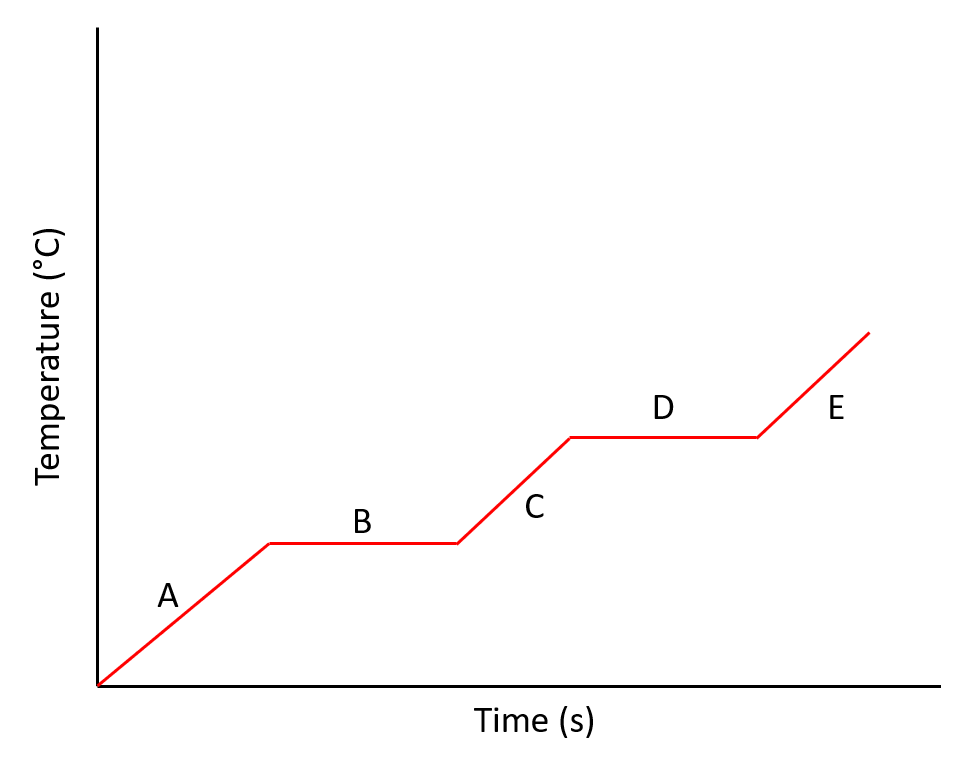
The diagram shows a heating curve for ice. Which line represents the ice melting?
A
B
C
D
E
Why are lines B and D flat?
The ice is melting
The ice is freezing
All of the thermal energy is used to break the bonds
They stopped the stopwatch
They stopped heating the ice.
The diagram shows a heating curve for ice. Which line represents the ice in a liquid state (water)?
A
B
C
D
E
Latent heat is
the heat absorbed or released at a boiling process during a change of phase
the heat absorbed or released at a constant temperature during a change of phase
the heat absorbed or released at a constant temperature during a change of phase of 1 kg object
the heat absorbed or released by an object to increase or decrease its temperature by 1 degree Celcius
The heat absorbed by melting a solid is known as
latent heat of fusion
latent heat of solid
latent heat of liquid
latent heat of vaporisation
Water molecules have the greatest kinetic energy in
Ice at 0 ⁰C
Water at 90 ⁰C
Water at 373 K
Steam at 150 ⁰C

It's the amount of heat required to change the state (gas,liquid, solid) of a unit of material
Latent Heat
Specific Heat
Temperature
Q

Q. The main processes in changing of phase include
Melting
Boiling
Condensation
All the above

The heat absorbed by melting a solid is known as
latent heat of solid
latent heat of fusion
latent heat of liquid
latent heat of vapourisation
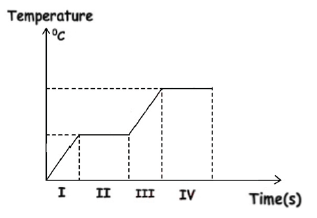
Consider the following temperature-time graph when a solid is heated. which part of the graph involves latent heat of vaporization?
Part I
Part II
Part III
Part IV

Superheating gas so that it becomes ionized is one of the methods to form this state of matter.
Solid
Liquid
Gas
Plasma
Where would you find a Bose-Einstein condensate?
Inside stars
At the North Pole
In a science lab
Bose-Einstein condensates exist only in theory

