
 Worksheets
Graduation in modern periodic table
Total questions: 25
Worksheet time: 25mins


The atoms on the right of the staircase are called
metalloids
non-metals
metals
noble gases
As you move down the group in the periodic table atomic size increases
This is because ____________.
The atoms have more mass.
The atoms have more protons.
The number of energy levels increases
The atoms have more nuetrons
As you move across the period of the periodic table from left to right atomic size decreases because, ______________.
the atoms have more mass.
the atoms have less mass
The attraction force of the positive protons increases
the atoms have less electrons.
Which one has the largest radius?
Lithium (Li, atomic #3)
Boron (B, atomic #5)
Flourien (F , atomic #9)
Nitrogen (N, atomic #7)
What is the measuring unit of atomic radius?
Picometer
Centimeter
Millimeter
Nanometer

Look at Group 1, Which of the following atoms has the largest atomic radius?
potassium (K)
rubidium (Rb)
Lithium (Li)
cesium (Cs)

Look at Period 4, Which of the following atoms is the SMALLEST following the predicted atomic radius trend??
Potassium (K)
Manganese (Mn)
Iron (Fe)
Copper (Cu)
Electronegativity is...
the ability of an atom to attract the electrons
the ability of an atom to lose electrons
the energy required to remove an electron from a specific atom
how easy it is to make friends.
Fluorine is more active than chlorine because ...........
fluorine has valency 1 but chlorine has 2
atomic number of fluorine is less than chlorine
atomic size of fluorine is less than chlorine
atomic size of fluorine is more than chlorine
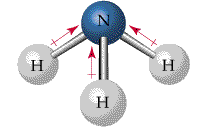
Use your knowledge and electronegativity sheet to predict what the following compound is classified as.
polar covalent
nonpolar covalent
ionic
metallic
Water molecule is polar because the difference in electronegativity is ................
Very low.
Very high
Relatively high

which is a metaloid
Ge
Mg
He
O

Is this a metal, metalloid, nonmetal or, nobel gas?
Metal
Metalloid
Nonmetal
Nobel gas

Metal oxides are basic because .....
they form alkaline solutions
they form acidic solutions
they are simple
they are dull

Magnesium reacts with oxygen to make
magnesium oxide / basic in nature
magnesium oxide / acidic in nature

When sodium reacts with water it produces ___________
hydrogen
carbon dioxide
Metal oxides which show both the properties of acids and base are called
Amphoteric oxides
Metamorphic
Basic oxides
Acidic oxides
The electronic configurations of three ele¬ments X, Y and Z are
X — 2, 8
Y — 2, 8, 7
Z — 2, 8, 2.
Which’of the following is correct?
X is a metal
Y is a metal
Z is a non-metal
Y is a non-metal and Z is a metal

What colour does a base turn red litmus paper?
Red
Blue
Violet
Green
Predict the product(s) of this reactio:
Mg + 2HCl →
MgHCl
MgCl2 + H2
MgCl2 + H
MgCl + H2

According to chemical activity series which metal is more reactive than calcium?
magnesium
potassium
silver
aluminum
Predict the product(s) of this reactio:
MgO + H2O →
MgHO
MgCl2 + H2
Mg(OH)2
MgO + H2
Predict the product(s) of this reactio:
CO2 + H2O →
COHO
H2CO3
H2CO2

