Wayground logo

Free Printable Worksheets

Font size

S
M
L
XL
Worksheets

Dilations Practice Quizizz

Total questions: 30

Worksheet time: 1hrs 2mins

Name
Class
Date
1.
A dilation is which of the following: 
a)
only an enlargement
b)
only a reduction
c)
Either an enlargement or a reduction
d)
Neither an enlargement or a reduction
2.

The point A (8, 12) was dilated to become point A' (2, 3). What was the scale factor?

a)

½

b)

¼

c)

4

d)

2

3.
Choose the correct scale factor:
a)
2
b)
3
c)
1/3
d)
1/2
4.

State the coordinate of the image of the given point B (4,9) under a dilation with center at the origin with the given scale factor of 2.

a)

B' (2 , 4.5)

b)

B' (-8 ,-18)

c)

B' (8 ,18)

d)

B' (9 ,4)

5.

A dilation produces a congruent figure

a)

True

b)

False

6.
When a dilation has a scale factor greater than one, the dilation is an enlargement.
a)
True
b)
False
7.
When the scale factor of a dilation is less than one, the dilation is a reduction.
a)
True
b)
False
8.
In a dilation what mathematical operation is used with the scale factor?
a)
addition 
b)
subtraction 
c)
multiplication 
d)
division 
9.
The __________ is the ratio of a length of the new figure to the corresponding length on the original figure.
a)
reduction
b)
enlargement
c)
scale factor
d)
center of dilation
10.

If your SF = 0.8, what type of dilation is it?

a)

Reduction

b)

Enlargement

11.

If your SF = 2.5, what type of dilation is it?

a)

Reduction

b)

Enlargement

12.

If your SF = 6/5, what type of dilation is it?

a)

Reduction

b)

Enlargement

13.
Dilate Point B by a scale factor of 3:
a)
(12,0)
b)
(12,12)
c)
(4,3)
d)
(0,12)
14.
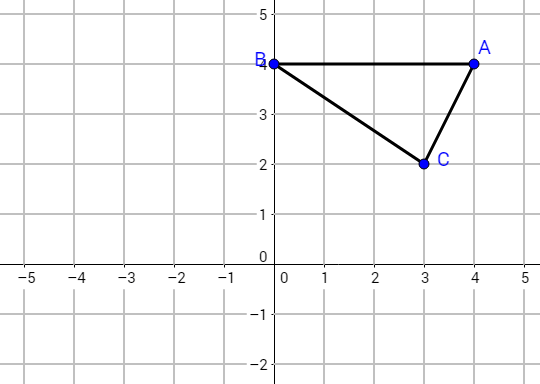
Triangle ABC will be dilated by a scale factor of 1/2.  What will be the coordinates of C'?
a)
(-1, -2.5)
b)
(12, 6)
c)
(3, -1.5)
d)
(0, 1.5)
15.
Rectangle ABCD is dilated so that A' is located at (3, 6).  What could be the dilation rule?
a)
(2x, 3y)
b)
(2/3 x, 2/3 y)
c)
(3/2 x, 3/2 y)
d)
(x + 2, y + 3)
16.
Rectangle ABCD is dilated so that the coordinates of C' are (2, -1).  What could be the dilation rule?
a)
(-2x, +1y)
b)
(1/2 x, 1/2 y)
c)
(2x, 2y)
d)
(x - 2, y - 1)
17.
Triangle ABC is dilated so that the coordinates of C' are (2, -1).  What was the scale factor of the dilation?
a)
3
b)
2
c)
1/2
d)
1/3
18.
Which algebraic expression could be the rule for a reduction?
a)
(x, y)→(2x, 2y)
b)
(x, y)→(5/2 x, 5/2 y)
c)
(x, y) →(0.5x, 0.5y)
d)
(x, y)→(5x, 5y)
19.
Dilation rules use ______________ to change the ___________ of a shape. 
a)
addition; location
b)
division; direction
c)
subtraction; orientation
d)
multiplication; size
20.
Tell whether the transformation is a dilation. Explain.
a)
No, scale factor isn't the same.
b)
Yes, scale factor is the same.
21.
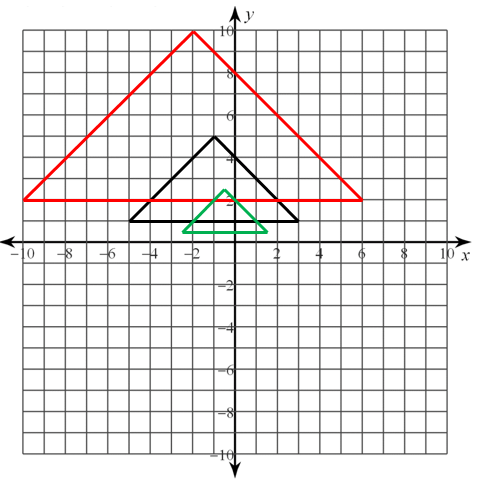
The red triangle has been dilated by a scale factor of 1/4, which triangle is it's new image? 
a)
green triangle 
b)
red triangle 
c)
black triangle
d)
none of these 
22.

A dilation does which of the following? Choose all that apply.

a)

Can make an enlargement.

b)

Can make a reduction.

c)

Always makes a similar figure.

d)

Always makes a congruent figure.

e)

Uses a scale factor.

23.

ABC ~ XYZ. What is the scale factor of the dilation of ABC to XYZ?

a)

23\frac{2}{3}

b)

32\frac{3}{2}

c)

2

d)

3

24.
Choose the correct scale factor:
a)
2.5
b)
1.5
c)
3.5
d)
4
25.

Point M (8, 12) was dilated to become Point M' (2, 3). What was the scale factor?

a)

½

b)

¼

c)

4

d)

2

26.

Which of the following rules could NOT be used to represent a dilation with a scale factor of 1/4?

a)

(x, y) →\rightarrow (14x, 14y)\left(\frac{1}{4}x,\ \frac{1}{4}y\right)

b)

(x, y) →\rightarrow (4x, 4y)

c)

(x, y) →\rightarrow (0.25x, 0.25y)

d)

(x, y) → (x4, y4)\rightarrow\ \left(\frac{x}{4},\ \frac{y}{4}\right)

27.

 ΔABC\Delta ABC was dilated to form  ΔA′B′C′.\Delta A'B'C'.  Which statement below is true about the angles of  ΔA′B′C′?\Delta A'B'C'?  

a)

The angles of  ΔA′B′C′\Delta A'B'C'  are 1/2 the angles of  ΔABC.\Delta ABC.  

b)

The angles of  ΔA′B′C′\Delta A'B'C'  are 1/4 the angles of  ΔABC.\Delta ABC.  

c)

The angles of  ΔA′B′C′\Delta A'B'C'  ≅\cong  to the angles of  ΔABC.\Delta ABC. 

d)

The angles of  ΔA′B′C′\Delta A'B'C'  are twice the size of the angles of  ΔABC.\Delta ABC.  

28.

 ΔABC\Delta ABC was dilated to form  ΔA′B′C′.\Delta A'B'C'.  Which statement below is true about the SIDES of  ΔA′B′C′?\Delta A'B'C'?  

a)

The sides of  ΔA′B′C′\Delta A'B'C'  are 1/2 the sides of  ΔABC.\Delta ABC.  

b)

The sides of  ΔA′B′C′\Delta A'B'C'  are 1/4 the sides of  ΔABC.\Delta ABC.  

c)

The sides of  ΔA′B′C′\Delta A'B'C'  ≅\cong  to the sides of  ΔABC.\Delta ABC. 

d)

The sides of  ΔA′B′C′\Delta A'B'C'  are twice the size of the sides of  ΔABC.\Delta ABC.  

29.

 Which of the following best explains why  are similar?

a)

Sides AB and A'B' are congruent.

b)

Corresponding sides are congruent.

c)

The measure of angles of  ΔABC\Delta ABC  are half the measure of corresponding angles on  ΔA′B′C′.\Delta A'B'C'.  

d)

Corresponding sides are proportional.

30.

 A figure is transformed based on the representation below.
 (x, y)→(2.6x, 2.6y)\left(x,\ y\right)\rightarrow\left(2.6x,\ 2.6y\right)  
Which statement best describes the resulting image?

a)

The figure was translated 2.6 units to the right and 2.6 units up.

b)

The sides of the image were reduced by a scale factor of 2.6.

c)

The sides of the image were enlarged by a scale factor of 2.6.

d)

The image is a reflection of the original.