wayground logo

Free Printable Worksheets

NEW

Font size

S
M
L
XL
Worksheets

CP First Semester Final Review

Total questions: 80

Worksheet time: 2hrs 35mins

Name
Class
Date
1.
What word describes when water is attracted to other substances?
a)
cohesion
b)
adhesion
c)
capillary action
d)
surface tension
2.
Attractions between water molecules are called
a)
Covalent bonds
b)
Ionic bonds
c)
Polar bonds
d)
Hydrogen bonds
3.

Attractions within one water molecule are called

a)

Nonpolar covalent bonds

b)

Ionic bonds

c)

Polar covalent bonds

d)

Hydrogen bonds

4.
Which of the following word pairs correctly completes the sentence below?
_______ are corrosive substances characterized as having a strong smell, a sour taste, and a _______.
a)
Acids; pH less than 7
b)
Acids; pH greater than 7
c)
Bases; pH greater than 7
d)
Bases; pH less than 7
5.
A solution with a pH of 7 is________
a)
increasing
b)
neutral
c)
decreasing
d)
apple juice
6.
What do carbohydrates provide for the body?
a)
Helps build and repair body tissue
b)
Helps hydrate your body
c)
Provides your body's main source of energy
d)
Helps vital processes 
7.
What is the monomer of proteins?
a)
amino acids
b)
polypeptides
c)
nucleotides
d)
monosaccharides
8.
Which is the monomer (building block) for lipids?
a)
fatty acids & glycerol
b)
nucleotide
c)
amino acids
d)
monosaccharide
9.
What is the function of nucleic acids?
a)
store genetic information
b)
store energy (long-term)
c)
store energy (short-term)
d)
build skin, hair, nails, muscles
10.
What type of macromolecule are enzymes?
a)
Protein
b)
Carbohydrate
c)
Lipid
d)
Nucleic Acid
11.
A monosaccharide is a:
a)
nucleic acid
b)
lipid
c)
carbohydrate
d)
protein
12.

All organic compounds contain

a)

C

b)

Fe

c)

Am

d)

Si

13.

what is dehydration synthesis

a)

the joining of two or more monomers, with a water molecule as a product

b)

when water is made in a laboratory

c)

splitting a water molecule into oxygen and hydrogen

d)

when a polymer is split into monomers by adding a water molecule to each one.

14.

what is an atom

a)

smallest part of the universe

b)

smallest part of a substance

c)

smallest part of anything

d)

smallest part of water

15.

protons

a)

negative charge, nucleus

b)

positive charge, shells

c)

positive charge , nucleus

d)

neutral charge, nucleus

16.

neutrons

a)

no charge, shells

b)

positive charge, nucleus

c)

neutral, no charge, nucleus

d)

negative charge, shells

17.

atomic number

a)

number of protons/stands for an element

b)

number of neutrons

c)

number of electrons

d)

number of protons and neutrons

18.

mass number

a)

number of protons

b)

number of electrons

c)

number of protons and electrons

d)

number of protons and neutrons

19.

2nd shell is stable with how many electrons?

a)

2

b)

8

c)

18

d)

32

20.

different number of electrons to protons

a)

isotope

b)

atom

c)

ion

d)

molecule

21.

bond created when electrons are shared equally between atoms

a)

hydrogen

b)

polar covalent

c)

ionic

d)

nonpolar covalent

22.

same number of protons, different number of neutrons

a)

atomic number

b)

mass number

c)

isotope

d)

ion

23.

how many bonds does an atom of nitrogen need to be stable

a)

1

b)

2

c)

3

d)

4

24.

This is the reason why some insects can walk on water

a)

surface tension

b)

liquid water is more dense than solid water

c)

water disassociates

d)

pH of water is 7

25.

How many total atoms are in one molecule of C6H12O6

a)

1

b)

6

c)

12

d)

24

26.
Ionically bonded compounds are made of atoms that 
a)
share electrons
b)
shoot their electrons out into space
c)
move their electrons to the nucleus of the atom
d)
give electrons to and accept electrons from each other
27.
What are the reactants of cellular respiration?
a)
glucose & carbon dioxide
b)
glucose & oxygen
c)
water & oxygen
d)
water & carbon dioxide
28.
The purpose of cellular respiration is to 
a)
make water
b)
make ATP
c)
make glucose
d)
make  oxygen
29.
In which way are photosynthesis and cellular respiration different?
a)
Cellular respiration stores ATP, while photosynthesis releases ATP.
b)
Cellular respiration produces oxygen, while photosynthesis uses oxygen.
c)
Photosynthesis releases energy, while cellular respiration stores energy.
d)
Photosynthesis uses carbon dioxide, while cellular respiration produces carbon dioxide.
30.
What is the correct equation for cellular respiration?
a)
6O2 + C6H12O6 -> 6CO2 + 6H2O + Energy
b)
6O2 + C6H12O6 + Energy -> 6CO2 + 6H2O
c)
6CO2 + 6H2O -> 6O2 + C6H12O6 + Energy
d)
6CO2 + 6H2O + Energy -> 6O2 + C6H12O6
31.
When a phosphate group is removed from an ATP molecule, 
a)
a substantial amount of energy is released
b)
an enzyme is formed
c)
energy is stored
d)
activation energy is increased
32.
The process of cellular respiration 
a)
is performed only by organisms that are incapable of photosynthesis
b)
is performed by autotrophs and heterotrophs
c)
occurs before plants are able to carry out photosynthesis
d)
occurs only in animals
33.
Cells produce ATP most efficiently in the presence of
a)
water
b)
carbon dioxide
c)
oxygen
d)
radiant energy
34.
What are the products of photosynthesis?
a)
water and carbon dioxide
b)
oxygen and glucose
c)
oxygen and carbon dioxide
d)
oxygen and water
35.
What molecule absorbs sunlight for photosynthesis?
a)
chloroplast
b)
thylakoid
c)
grana
d)
chlorophyll
36.
Use the diagram to answer the question. Between which parts of the molecule must the bonds be broken to form an ADP molecule?
a)
A and B
b)
A and C
c)
B and C
d)
C and D
37.
Plants need carbon dioxide from their environment to produce glucose during which stage of photosynthesis? 
a)
The light-dependent stage
b)
The light-independent stage (The Calvin Cycle)
c)
The electron transport chain
d)
ATP formation
38.
Most plants appear green because chlorophyll
a)
absorbs green light.
b)
absorbs violet light.
c)
does not absorb green light.
d)
does not absorb violet light.
39.
Where do the light-dependent reactions occur? 
a)
thylakoid membrane
b)
stroma
c)
mesophyll
d)
mitochondria
40.
Where does the Calvin Cycle occur?
a)
thylakoid
b)
stroma
c)
lumen
d)
mitochondria
41.
True or False.   The calvin cycle can happen at night.
a)
true
b)
false
42.
What is the name of the simple sugar that is produced in photosynthesis?
a)
Sucrose
b)
Dextrose
c)
Glucose
d)
Lactose
43.
Which term is the part of photosynthesis when light energy is captured and transferred to a molecule, such as ATP?
a)
light- independent reactions
b)
cellular respiration
c)
light- dependent reactions
d)
 photosynthesis
44.
What supplies the electron that is lost in PS II?
a)
oxygen
b)
water
c)
glucose
d)
rubisco
45.
After the electron leave PS II, where does it go next?
a)
Electron Transport Chain
b)
NADPH Reductase
c)
PS I
d)
Stroma
46.
What is the first stop in photosynthesis process?
a)
Photosystem I
b)
Photosystem II
c)
Electron Transport Chain
d)
stroma
47.

Plants and animal cells have...

a)

Mitochondria and chloroplasts

b)

Nucleus and chloroplast

c)

Cell wall and chloroplast

d)

Mitchochodria and cytoplasm

48.

Which organelle is the command center for eukaryotic (plant and animal) cells?

a)

Cell wall

b)

Nucleus

c)

Mitochondria

d)

Lysosome

49.

what is the function of a lysosome?

a)

To create energy for the cell

b)

To command the cell what to do

c)

To remove waste using digestive enzymes from the cell

d)

To protect the cell

50.

Which of the following are prokaryotic cells?

a)

Plant

b)

Animal

c)

Bacteria

d)

Plant and Animal

51.

What is the difference between mitochondria and chloroplast?

a)

Mitochondria produces energy and chloroplasts breaks down energy

b)

There is no difference. They are the same.

c)

Mitochondria breaks down energy from food and chloroplasts produce energy from sunlight.

d)

Mitochondria contains DNA and chloroplasts are green

52.

The outermost layer of a plant cell and animal cell is...

a)

Plant cell - cell membrane, animal cell - cell wall

b)

Plant cell - cell wall; animal cell - cell membrane

c)

Plant and animal cell - cell wall

d)

Plant and animal cell - cell membrane

53.

"Post office" of the cell that packages proteins and fats:

a)

ER

b)

Golgi Body

c)

Nucleus

d)

Cytoplasm

54.

Bubbles of membrane used for transporting material:

a)

Vesicle

b)

Golgi Body

c)

Mitochondria

d)

Chloroplast

55.

What does a plant cell have that an animal cell doesn't have?

a)

Cell Membrane and Cell Wall

b)

Cell Wall and Mitochondria

c)

Cell Wall and Nucleus

d)

Cell Wall and Chloroplast

56.

What is the jelly-like substance that keeps the organelles floating?

a)

Cell Membrane

b)

Nucleus

c)

ER

d)

Cytosol

57.

What are the "protein-makers" of a cell?

a)

Ribosomes

b)

Mitochondria

c)

ER

d)

Golgi Body

58.

This organelle controls what goes in and out of plant and animal cells.

a)

Cell Wall

b)

Cell Membrane

c)

Chloroplasts

d)

Cytoplasm

59.
Cell membranes are found in
a)
Only animal cells
b)
Only plant cells
c)
Some plant and animal cells
d)
All plant and animal cells
60.
Using this image, what organelle is D?
a)
Endoplasmic Reticulum
b)
Flagella
c)
Rough ER
d)
Smooth ER
61.
Using this image, what organelle is C?
a)
Cell Wall
b)
Mitochondria
c)
Large Cell Vacuole
d)
Chloroplast
62.
What is the difference between rough and smooth ER?
a)
There is no difference.
b)
Plants have rough ER, animals have smooth ER.
c)
What type of injuries the Doctors treat.
d)
Rough has ribosomes, smooth does not.
63.
A person with swollen gums rinses his mouth with warm salt water, and the swelling decreases. Which of the following has occurred?
a)
The swollen gums have absorbed the saltwater solution.
b)
The saltwater solution lowers the temperature of the water in the gums.
c)
The salt in the solution has moved against the concentration gradient.
d)
The water in the gums has moved out due to the high concentration of salt in the solution. 
64.
The cell membrane of the red blood cell will allow water, oxygen, and carbon dioxide to pass through. Because other substances are blocked from entering, this membrane is called
a)
perforated
b)
semi-permeable
c)
non-conducive
d)
permeable
65.
 Look at the diagram of a cross-section of a cell membrane below. The cell membrane controls movement of materials into and out of the cell. The following particles are moving from high concentration to low concentration and are using a carrier protein. How would you describe this type of movement across the membrane? 
a)
simple osmosis
b)
active transport
c)
simple diffusion
d)
facilitated diffusion
66.
Which activity can occur without the use of energy?
a)
contraction of muscle tissue
b)
protein synthesis in a cell
c)
active transport of minerals
d)
movement of water across a membrane
67.
The diffusion of water across a selectively permeable membrane is called 
a)
active transport
b)
facilitated diffusion
c)
osmosis
d)
phagocytosis
68.
During diffusion molecules tend to move 
a)
   up the concentration gradient
b)
 from an area of lower concentration to an area of higher concentration
c)
 in a direction that doesn’t depend on concentration
d)
 down the concentration gradient
69.
A series of steps used by scientists to solve a problem or answer a question. 
a)
scientific method
b)
recipe
c)
data collection
d)
metric system
70.
Which is NOT a step in the scientific method?
a)
Make observation
b)
Form a theory
c)
Collect data
d)
Form a hypothesis
71.
A testable explanation to a problem that has not yet been tested. 
a)
data
b)
theory
c)
hypothesis
d)
fact
72.
This variable in an experiment is the one being changed by the scientist. 
a)
dependent variable
b)
independent variable
c)
data
d)
control group
73.
An experiment is performed on plants to see how different liquids affect plant growth. Each plant in the experiment is given a different liquid; water, apple juice, or milk. Each plant has the same amount of soil, sunlight, and listens to the same music. In this investigation, the independent variable is ...
a)
The type of plant
b)
The amount of sunlight
c)
The type of music
d)
The type of liquid
74.
If I ride my bike to school instead of walking, then I will get to school faster. What is the dependent variable?
a)
True
b)
How fast you get to school
c)
Riding a bike or walking
d)
False
75.
You know 1000 mg = 1 g.  Convert 2.5 grams into milligrams.
a)
25 mg
b)
25,000 mg
c)
250 mg
d)
2500 mg
76.
What is the base unit for measuring mass?
a)
Meter
b)
Liter
c)
Gram
77.
Convert 27.5 cm to meters
a)
275 mm
b)
275 m
c)
.0275 m
d)
.0275 mm
78.

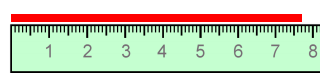
What is the length in centimeters (cm)?

a)

7.2 cm

b)

8.0 cm

c)

7.4 cm

d)

7.7 cm

79.
1000 grams = _____ kilograms
a)
0.0001
b)
1,000,000
c)
10
d)
1
80.
This part of the experiment serves as a basis of comparison; the one variable being tested has been omitted. 
a)
experimental group
b)
control group
c)
data
d)
variables