
 Worksheets
Plate Tectonics Review
Total questions: 62
Worksheet time: 59mins
Which of the following scientists developed the hypothesis of Continental Drift?
Wegener
Hess
Einstein
Churchill
The three animals, mesosaurus, lystrasaurus, and cynognathus represent what type of evidence that the continents actually moved?
zoological evidence
glacial evidence
evidence of climate change
fossil evidence
What is the force that causes continents to move?
conduction
convection
radiation
conveyor belts
The cycling of materials due to differences in density is called _______________.
convection
conduction
radiation
molting
Which of the following discoveries is evidence supporting the idea of continental drift?
the discovery of matching plant and animal fossils found on different continents
the discovery that most earthquakes are near plate boundaries
the discovery that rock age increases as distance from mid-ocean ridges increases
the discovery of sea-floor rock patterns to magnetic reverals

Look at this image. Which explanation best summarizes the hypothesis shown in the figure?
The present continents will gradually move to form a single landmass called Pangaea.
The continents were once a large landmass name Pangaea, which broke apart and gradually drifted to the present-day locations of the continents.
The continents were once a large landmass, but the north and south magnetic poles pulled the continents apart toward the poles
The continents were once a large landmass, but the ocean levels rose, and these oceans separate today's continents.
In the early 1900s, a hypothesis was introduced that proposed a single large landmass broke into smaller landmasses and formed the continents, which drifted in their present locations. Which is the name of this hypothesis?
continental drift
continental shift
plate movement
plate tectonics

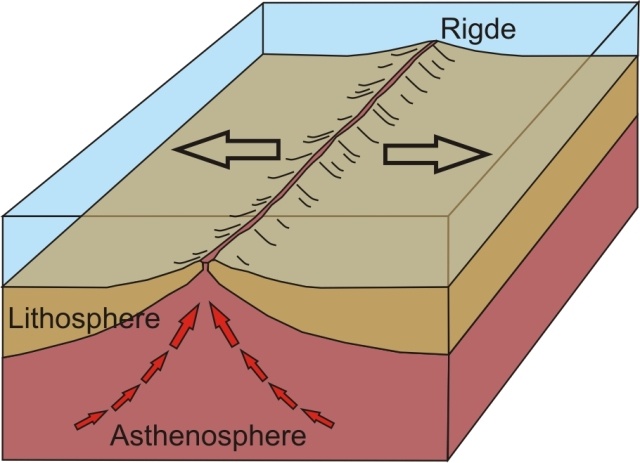
Look at this image, which shows changes at mid-ocean ridges. The highlighted section shows how one location of the sea floor moves over time. Which process is demonstrated in this image?
Continental drift
earthquakes
plate collisions
sea-floor spreading
There are long mountain belts that divide the sea floor and generate new sea floor as magma rises and erupts onto Earth's surface. What are these mountain belts known as?
magnetic poles
mid-ocean ridges
ocean trenches
subduction zones
___________ is the process by which one tectonic plate is pulled beneath another plate.
subduction
ridge push
mid-ocean ridge
convection
Two plates come together or collide at what boundary?
Convergent
Divergent
Transform
Two plates spread or move apart at what boundary?
Convergent
Divergent
Transform
Two plates slide past each other at what boundary?
Covergent
Divergent
Transform

New oceanic crust (sea floor) is created at this boundary.
Divergent Oceanic
Divergent Continental
Convergent Oceanic
Transform

The process where oceanic crust slides under another plate and is melted is called ___________.
seafloor spreading
subduction
continental drift
recycling


The movement of the tectonic plates is caused by
the rotation of the Earth.
convection currents in the Asthenosphere
the gravity of the iron-nickel core.
the Moho discontinuity.
In some areas of the world, like California and Japan, earthquakes are a common occurrence. How can this best be explained?
The strong ocean currents are undermining both areas causing earthquakes.
Both areas are located near the edge of the Pacific Ocean, the unstable sand causes earthquakes.
Both areas are subjected to strong ocean wind and waves that causes earthquakes.
Both areas are on the boundary of active plates, the motion of the plates causes earthquakes.
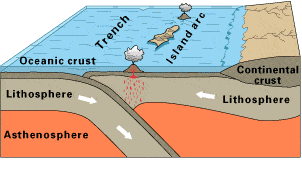
Observe this diagram of a plate boundary. One statement BEST describes what is happening. It is that
the oceanic crust is melting.
the denser ceanic crust is subducting under the less dense oceanic crust
volcanic islands are forming.
the tectonic plates are moving away from each other.
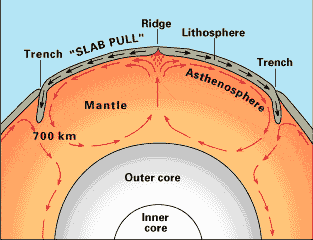
What is the source of energy that drives plate movement?
the subducton of the sea floor
the different densities of the oceanic and crustal plates
convection currents in the asthenosphere
the friction force between the plates that move past each other
Continental plates are ______ dense and ________ than ocean plates.
more; thinner
more; thicker
less; thinner
less; thicker

The area around the pacific plate where boundaries form is called...
death ring
fire zone
ring of fire
zone of fire

What geologic feature will occur at a hot spot ?
volcano
folded mountain
deep sea trench
crevasse
A prime example of an area over a hot spot is :
Japan
the Andes Mountains
the East African Rift
the Hawaiian Islands
What plate is the hot spot from the previous question located ?
Atlantic
Pacific
African
South American
As one moves away from a hot spot, the crust will get :
younger
older
the will be no change in age
What does heat do when convection currents are moving?
Sinks
Rises
Stays in place

Which picture shows material that is more dense?
The picture of the left
The picture on the right
Convection currents occur due to...
rotation of earth
differences in temperature and density
electrons moving
gravitational pull
Which of the following is one reason Earth's tectonic plates to move?
energy from the Sun
magnetic Pole Reversal
convection currents in the mantle
faults in Mountain Ranges

