
 Worksheets
Reproduction Unit Review
Total questions: 35
Worksheet time: 6hrs 50mins
Which statement correctly describes the term heredity?
Cells going through Mitosis in order to grow, repair, and replace dying cells
The passing of genetic information from one generation to the next generation
Mutations that occur in the somatic cells will be passed on to offspring
Sexual reproduction occurs due to Mitosis and passes all of the genes on to offspring

Look at the diagram of this amoeba reproducing. Which type of reproduction would this be an example of?
Sexual reproduction
Asexual reproduction
Meiosis
Gamete formation
In animals, which structure passes DNA from the father to the offspring?
Ovum
Egg
Pollen
Sperm
What mode of reproduction occurs when the offspring of an organism arises from a single parent organism and inherits identical genes to that of the parent organism?
Asexual Reproduction
Sexual Reproduction
Genetic Variation
Crossing over & Recombination

A diagram of a plant cell is shown. What process is occurring in the diagram?
Meiosis
Mitosis
Sexual Reproduction
Photosyntheis
Which statement best explains the reason for genetic variation in sexually reproducing organisms?
In sexual reproduction, offspring receive genes from the male parent
In sexual reproduction, offspring receive genes from the female parent
In sexual reproduction, offspring receive half of their genes from the male parent and half from the female parent, and each offspring have a different combination of genes
In sexual reproduction, the male offspring receive genes from the male parent and the female offspring receive genes from the female parent
What process results in organisms reproducing offspring that are genetically identical to the parent organism?
Sexual Reproduction
Asexual Reproduction
Meiosis
Fertilization
Why does sexual reproduction result in more genetic variety?
Genes from two parents are combined to create offspring.
Most organisms reproduce sexually than asexually which results in more genetic diversity.
Sexually reproducing organisms have more mutations which results in genetic diversity.
Offspring are genetically identical to the parents.
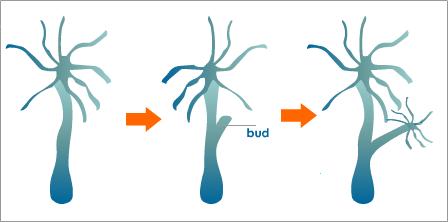
The diagram shows the reproduction in a hydra. How do hydra reproduce?
A single parent produces offspring that are genetically identical through sexual reproduction.
A single parent produces offspring that are genetically identical through asexual reproduction
A single parents produces gametes that are genetically identical through meiosis
A single parent produces gametes that develop into offspring when combined during fertilization
A population of komodo dragons have only females. These organisms are able to reproduce asexually. What is a disadvantage of asexual reproduction?
By combining 2 parent's traits to reproduce offspring, it can increases genetic variety.
These female komodo dragons are larger than those organisms that reproduce sexually.
Because all of these organisms are genetically identical, it makes them less likely to survive changes in the environment.
These organisms can reproduce a large amount in a very short time.
What is an advantage of sexual reproduction?
Smaller populations
Cannot adapt easily to changes
Adapts easily to new environments
Requires no energy to reproduce

A student looked at some skin cells underneath the microscope. Which of the following processes are occurring in the cells?
Fertilization
Meiosis
Mitosis
Crossing over & Recombination
Which of the following does not occur by mitosis?
Growth
Production of gametes
Repair
Asexual reproduction
Which of the following best describes meiosis?
It is carried out in all tissues that require cell replacement
It occurs only in cells in the reproductive structures of an organism
It happens in all of the tissues except for the brain and spinal cord
It is a type of cell division that occurs in 4 phases
A male shark has 40 chromosomes in the nucleus of each male gamete produced through meiosis. How many chromosomes would be present in the shark's somatic cells?
20
40
80
160
How many daughter cells are produced in mitosis?
4 new haploid cells
2 new haploid cells
4 new diploid cells
2 new diploid cells

What is the correct order of the stages in mitosis?
prophase, metaphase, anaphase, telophase
anaphase, metaphase, prophase, telophase
telophase, anaphase, metaphase, prophase
telophase, metaphase, anaphase, prophase

The diagram shows 2 cells that have copied all of their chromosomes and are being separated into 2 new cells. What is the term for this process?
Cytokinesis
Meiosis
Mitosis
Fertilization
A zygote will receive half of its chromosomes from the sperm and half from the egg. Which process ensures that the gametes contain half of the chromosomes of an organism?
Fertilization
Mitosis
Respiration
Meiosis

Sexual reproduction in animals depends upon the production of gametes through the process shown in the diagram. What process produces gametes in animals?
Meiosis
Mitosis
Mutations
Respiration

This diagram shows a pair of homologous chromosomes. In what type of cells would there be an absence of homologous chromosomes?
Bone cells
Skin cells
Gametes
Nerve cells

Why do kittens appear to be different from either of their parents?
The kittens gets half of its traits from both parents which creates variety
The kittens have mutations that cause them to appear different from their parents
The kittens have a disease that makes them look different from the parents
The kittens are not fully grown and will eventually look identical to the parents
What is one advantage of plants having the ability to reproduce both asexually and sexually?
The flowers can attract more insects
The plants can grow taller
The plants have the ability to adapt to the changing environment
The plants can produces more flavorful fruits
Potatoes can reproduce offspring by growing sprouts or tubers from the "eyes" of the potato. This is an example of what process?
Fertilization
Asexual reproduction
Sexual reproduction
Meiosis
Which of these occurs in asexual reproduction but not in sexual reproduction?
Genes carry genetic information from both parents to offspring
Reproduces offspring made of cells
The genetic information from two organisms combines
An offspring inherits a set of traits identical to the parent
When an egg and sperm fuse together to form a zygote, the offspring that is formed will have genetic traits that are passed on from both parents. This describes what type of reproduction?
Binary fission
Parthenogenesis
Sexual reproduction
Mitosis

Bears have certain characteristics that help them survive in order to reach reproductive age. Some of these characteristics may include: keen sense of smell, strong curved claws for climbing, and color vision to aid in finding foods. How are most of these characteristics acquired?
Genes that are inherited from both parents
Learning from older siblings
Eating quality foods rich in fiber and protein
Interactions with other bears
What process produces 4 genetically different gametes through the stages 2 PMAT, and it is the first process of sexual reproduction?
Meiosis
Mitosis
Sporulation
Asexual reproduction

Use the image to help answer the question. What process occurs between Interphase and Meiosis I that allows for more genetic variation?
DNA Replication
Mitosis
Cytokinesis
Crossing over
Which characteristics are advantages of sexual reproduction?
Genes in the offspring vary from the parent which allows these organisms to adapt to changes in the environment
Mutations could be beneficial for the organism
Selective breeding can allow to reproduce organisms with desired traits
All of the above

What is the function of the DNA inside the cell's nucleus?
The process of cellular respiration occurs to create energy for the cell
Regulates what enters and leaves the cell
Carries hereditary material
Stores food and water for the cell

Based on the diagram of a plant and animal cell division, which statement would accurately describe this process?
Plant and animal cells combine to produce offspring
Animal cells require oxygen to produce energy while plant cells do not require energy to produce food
Plant and animal cells both grow and divide to produce genetically identical diploid cells
Both cells grow and divide to produce chloroplast required for photosynthesis

