
NEW
Font size
 Worksheets
Balanced Chemical Equations
Total questions: 24
Worksheet time: 31mins
CuO+H2O → Cu(OH)2
Is the equation balanced or unbalanced?
balanced
unbalanced

Magnesium (Mg) can be burned in the air (O2) to produce solid magnesium oxide (MgO).
Check the correct chemical equation and check if it is balanced
2Mg + O2 → 2MgO
Mg + O → MgO
2Mg + CO2 → 2MgO + C
2Mg + O2 → Mg2O2
Pb(NO3)2 --> PbO + NO2 + O2
Synthesis
Decomposition
Single Displacement
Combustion

Sodium (Na) reacts with chlorine (Cl2) to produce sodium chloride (NaCl)
Check the correct chemical equation and check if it is balanced
NaCl → Cl + Na
Na + CO2 → NaCO2
2Na + Cl2 → 2NaCl
Na + Cl → NaCl
Write a complete balanced reaction for the following.
Calcium metal (Ca) reacts with oxygen gas (O2) to form solid calcium oxide (CaO)
2 Ca + O2 --> 2 CaO
2 Ca + 2 O --> 2 CaO
Ca + O2 --> 2 CaO
Ca + O2 --> CaO2
What could be the coefficients in this chemical equation?
__Mg + __Cl2 --> __MgCl2
1,2,1
1,1,1
2,1,1
1,1,2

Is this balanced?...
Al + O2 --> 2Al2O3
Yes!
No!

H2 + O2 --> H2O
What coefficient should be used to make the following equation balanced?
N2 + O2 --> ___NO
1
2
3
4


The small numbers in a chemical formula:
(the BLUE numbers)
Subscripts
Coefficients
Numbers
Molecules
KOH + H3PO4 --> K3PO4 + H2O
Synthesis
Decomposition
Single displacement
Double displacement

Is this equation balanced?
Yes, everything appears the same amount on each side.
No, there are too many hydrogens on the left side.
No, there are too many oxygen on the left side.
_AgNO3 + _H2S →_Ag2S+_HNO3
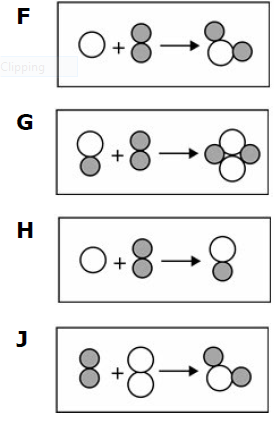
Which of the following models best demonstrates a balanced chemical equation?
F
G
H
J
PbCl2 + AgNO3 → Pb(NO3)2 + AgCl
Balance this equation, AlCl3 + NaOH → Al(OH)3 + NaCl
3,1,3,1
1,3,3,1
1,1,1,3
1,3,1,3
What type of reaction is displayed below?
Al + Fe2O3→ Fe + Al2O3
Single Replacement
Double Replacement
Synthesis
Combustion

