
 Worksheets
Electrostatics Test Review
Total questions: 25
Worksheet time: 16mins

When you charge a balloon by rubbing it on your hair this is an example of what method of charging?
Friction
Conduction
Grounding
Induction

What method of charging was used to get Ms. E's hair to stick up?
Friction
Conduction
Induction
Convection
What happens to the force between two charged objects when you double the distance between them?
Increases 2F
Decreases
21FIncreases 4F
Decreases 41F
The force between two charged objects is 10 N. If you triple the magnitude of both charges, what is the new force?
1.1 N
90 N
3.3 N
30N

Which image shows a neutral ball after a positively charged balloon is brought near the left side, but doesn't touch?
A
B
C
D
Coulomb's Law says that force is ______ related to charge and ______ related to the square of the distance between charges.
inversely, directly
directly, inversely
directly, directly
inversely, inversely

The equations for Electrostatic Force and Gravitational Force look similar but they have some big differences. Choose all the differences between each equation.
Electric force is weaker
Electric force is stronger
Electric force only attracts
Electric force attracts and repels

You need to draw a model that shows the difference between gravitational force and electric force. You will draw vectors to show the strength and direction of each force. List everything you would include in your model.
BIg arrows to show the strength of gravitational force.
BIg arrows to show the strength of electric force.
Arrows that show repelling and attracting for electric force
Arrows that show repelling and attracting for gravitational force

If the leaves of an electroscope spread apart, it indicates that _____.
the leaves of the electroscope are neutral
the leaves of the electroscope have received a charge
no charge is moving through the electroscope
there is static electricity in the electroscope

Which picture shows the charges on a neutral electroscope when a negatively charged rod is next to the top of the electroscope.
A
B
C
D
Two like charges
don't interact
repel
attract
add up to 2
Particles with opposite charges
attract
rebel
repel
attack

Why does the balloon stick to the neutral wall?
The positive charges are attracted to the balloon.
The negative charges are attracted to the balloon.
The positive charges move away from the balloon,
The negative charges move away from the balloon,
If the distance between two charges is increased by 6, what happens to the force?
Decreases
61FIncreases 6F
Decreases 361F
Increases 36F
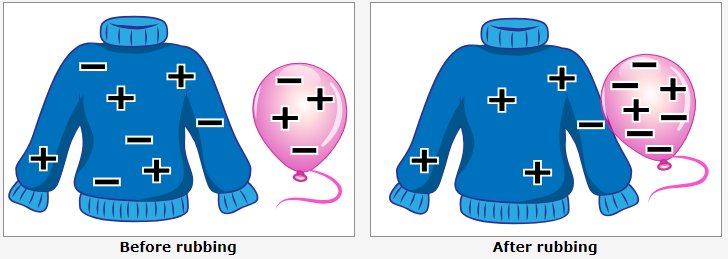
Before the balloons and sweaters are rubbed together, both objects are __________ charged. After they are rubbed together the sweater is __________ charged and the balloon is ___________ charged
negative/positive/negative
neutral/positive/negative
positive/negative/neutral
neutral/negative/positive

Describe what happens to the electric potential energy between two charges.
Increases
Decreases
Stays the same

Describe what happens to the electric potential energy between two charges.
Increases
Decreases
Stays the same
What happens to the electrostatic force when two charged objects are brought close together?
It increases
It decreases
You need to know the charge to answer
It remains the same
In conduction, one object starts charged and one is neutral. After they touch, what happens to the charges on the objects?
They both have the same charge
They have opposite charges
They are both neutral
In induction, one object starts charged and one is neutral. They are brought close to each other, what happens to the charges on the objects?
They both have the same charge, temporarily
They have opposite charges, temporarily
They are both neutral, temporarily

