
 Worksheets
IQWST LS3 Lessons 4 & 5
Total questions: 36
Worksheet time: 22mins
The inherited combination of alleles is known as the offspring's
heredity
phenotype
genotype
pedigree
A gene is
a section of a chromosome
made of DNA
contains instructions for building a protein
all of the above
One form of a gene is called_______________
a DNA
a phenotype
a trait
an allele
If a body cell in a butterfly contains 24 chromosomes, a butterfly egg would contain
3
6
12
24

Keith and Chris are brothers. Both of their parents have brown eyes. Keith also has brown eyes but Chris' eyes are grey. Which of the following explains why the brothers have different eye color?
Parents who both have brown eyes always have at least one offspring with grey eyes.
Offspring from the same parents always inherit the same traits.
Sometimes an offspring can show a variation of a trait that neither parent has.
Eye color is not an inherited trait.
A _____ is a combination of alleles (example: AA, Tt, pp)
phenotype
genotype
trait
gene
A _____ is a graphic organizer to show a family history of traits.
family tree
punnett square
pedigree
family graph
Mitosis produces what kind of cells?
body
gametes
none
all of them
Each parent contributes one half of the instructions for each trait to their offspring.
True
False

True or False? Two non tasting parents always have non tasting off spring.
True
False
If both parents CAN taste PTC, which of the following is true?
None of the children will be able to taste PTC
Their children will be a mixture of able and not able to taste.
Their children might all be able to taste, or there might be some non-tasters.
All of the children will be able to taste PTC
If both parents cannot taste PTC, which of the following is true?
None of the children will be able to taste PTC
There will be a mixture in the next generation.
It's possible for some of their children to taste PTC.
You can't predict - you have to wait to see what happens.

This pedigree of PTC tasters shows (more than 1 correct answer)
One trait is more likely to be passed down
Children can get traits from both parents
For some traits, children always have the same traits as the parents
Offspring can show a trait that neither parent shows.
When we crossed purebred purple plants, with purebred non-purple plants, what were the results?
The F1 and F2 generations were all purple.
The F1 generation was all purple but the F2 generation was all non-purple.
The F1 generation was all nonpurple but there was a mixture in the F2 generation.
The F1 generation was all purple, but there was a mixture in the F2 generation.
Why is it helpful to use plants to study genetics? (more than one answer may be correct)
They have shorter life spans than most animals so you can see more generations.
They reproduce asexually so they are easier to understand.
Some plants are male, and some are female, just like humans.
They reproduce sexually, so they show the same inheritance patterns.
What is DNA?
A molecule that carries the information/code for creating an organism.
A molecule found in the mitochondria of the cell.
A sticky substance that traps the pollen on the stigma of a plant.
A molecule that is holds the nucleus together.

In this pedigree, black represents sickle cell disease. Which patterns of inheritance does this pedigree illustrate? (more than one answer is possible)
Offspring can get instructions for a trait from either parent
For some traits, when parents have the same trait, the offspring always have the same trait as the parents.
For some traits, one variation is more likely to be passed down.
It is possible for offspring to have a trait that neither parent shows.
Compressed DNA is called a
Chromosome
Nucleus
Factor
RNA
Levels of organization in a cell
cell - chromosome - nucleus - DNA - gene
cell - nucleus - chromosome - DNA - gene
cell - nucleus - chromosome - gene - DNA
cell - nucleus - DNA - chromosome - gene
What is the process of creating two cells identical to the original cell to be used for cell regeneration, growth or asexual reproduction in single-celled organisms called
mitosis
meiosis
What is the process of creating 4 unique reproductive cells with half the number of chromosomes as non-reproductive cells to be used for reproduction called
mitosis
meiosis


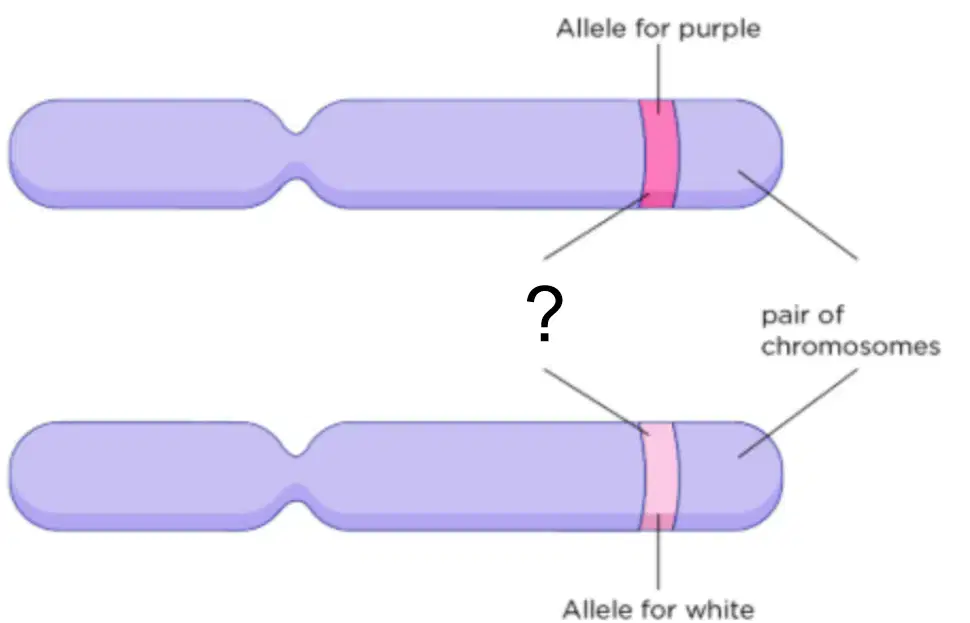
What is the missing label between these two chromosomes?
Locus
Alleles
Gene
DNA
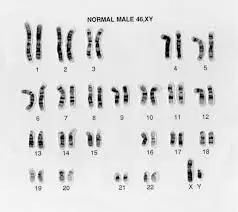
What is this?
Karyotype
Pedigree
Genotype
Chromosome
a=jagged petals
What shape petals will the Aa genotype produce?

