wayground logo

Free Printable Worksheets

Font size

S
M
L
XL
Worksheets

AQA Physics Paper 2- Waves

Total questions: 35

Worksheet time: 34mins

Name
Class
Date
1.

What is the frequency of a wave?

a)

# of oscillations produced in a certain amount of time

b)

The distance the wave oscillates from it's resting position

c)

The lowest point of a transverse wave

d)

Resting point of a wave - no wave movement

2.

What is the amplitude of a wave?

a)

Where there is no wave movement

b)

The distance the wave oscillates from it's resting position

c)

A disturbance that transfers energy from one place to another

d)

The distance between two corresponding parts of a wave

3.
The number of wavelengths that pass a point each second
a)
frequency
b)
wavelength
c)
pitch
d)
amplitude
4.

If the wavelength of a wave increased, what would happen to the frequency?

a)

decrease

b)

increase

c)

stay the same

5.

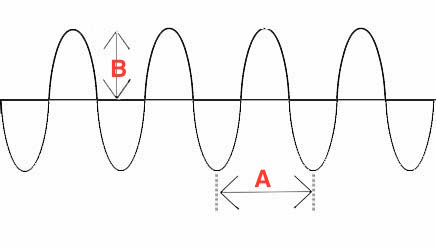
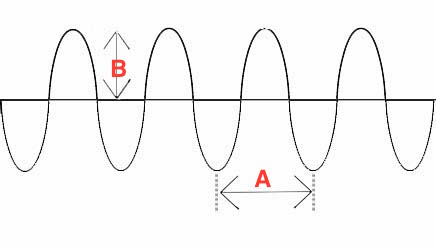
What property of this wave is represented by the letter "A"

a)

amplitude

b)

crest

c)

trough

d)

wavelength

6.
What property of the wave is represented by the letter "B"?
a)
amplitude
b)
crest
c)
trough
d)
wavelength
7.
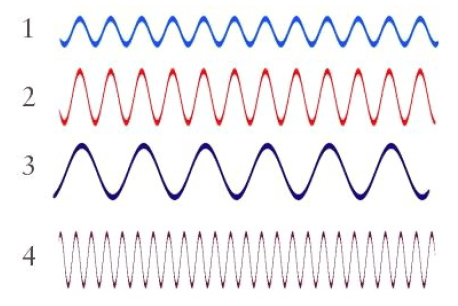
Which wave in the diagram has the greatest frequency?
a)
1
b)
2
c)
3
d)
4
8.

The units of frequency are...

a)

metres

b)

seconds

c)

Hertz

d)

degrees

9.

Light is an example of a transverse wave

a)

True

b)

False

10.

Sound is an example of a transverse wave

a)

True

b)

False

11.

Which of the following statements describes the period of a wave?

a)

Number of waves per second

b)

Distance from crest to crest

c)

Distance from resting position to top of the wave

d)

Time taken to produce one wave

12.

One use of radio waves is...

a)

Broadcasting and communications

b)

Heating

c)

Observing internal structure of objects

d)

Sterilising food and medical equipment
13.

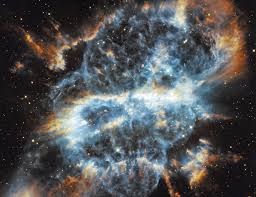
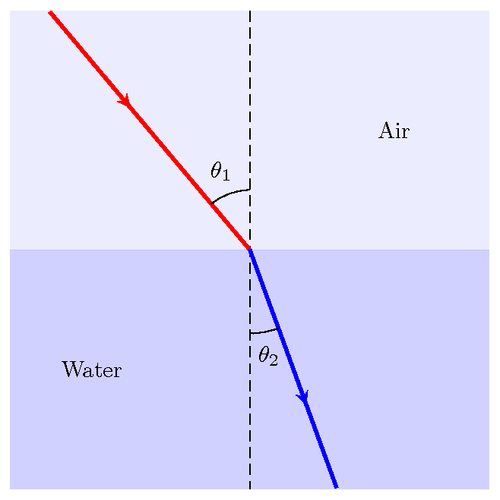
The following image demonstrates...

a)

Reflection

b)

Refraction

c)

Interference

d)

Diffraction

14.
Electromagnetic waves are:
a)
A.  Transverse waves.
b)
B.  Longitudinal waves.
c)
C.  Longitudinal and transverse waves
d)
D.  Sound waves
15.
Microwaves are used in
a)
A.  Satellite communications.
b)
B.  The transmission of television signals.
c)
C.  Electrical heaters
d)
D.  Medical Imaging.
16.
As objects get warmer they always emit
a)
A.   More infra red radiation
b)
B.   More visible radiation
c)
C.  Less infra red radiation
17.
From which two combinations of mediums will light bend the most?
a)
A.   water to air
b)
B.   air to glass
c)
C.   glass to water
d)
D.   water to glass
18.
Which of the following lists of electromagnetic waves are in order of increasing energy?
a)
A.   UV, IR, Radio waves, microwaves.
b)
B.   Radio, IR, Visible, gamma.
c)
C.   Gamma, X rays, UV, visible.
d)
D.   Radio, gamma, visible, microwaves.
19.
Radio waves are used in
a)
A.  Satellite communications.
b)
B.  The transmission of television signals.
c)
C.  Electrical heaters
d)
D.  Medical Imaging.
20.
Infra red waves are
a)
A.  Higher frequency than UV but lower than visible.
b)
B.  Lower frequency than UV and shorter wavelength than microwaves.
c)
C.  Longer wavelength than radio waves and higher frequency than microwaves.
d)
D.  Shorter wavelength than gamma rays and a lower frequency than gamma rays.
21.
Hot drinks cool down quicker in black cups than white ones because:
a)
A.  White is a good absorber and poor emitter of radiation
b)
B.  Black is a good absorber and emitter of radiation.
c)
C.  Black is a good absorber and poor emitter of radiation.
d)
D.  White is a good absorber and emitter of radiation.
22.
The electromagnetic waves with the highest energy have:
a)
A.   The longest wavelength
b)
B.   The largest amplitude
c)
C.  The highest frequency
d)
D.  The slowest speed
23.
X rays are used in
a)
A.  Satellite communications.
b)
B.  The transmission of television signals.
c)
C.  Electrical heaters
d)
D.  Medical Imaging.
24.

Which type of wave as oscillations that are parallel to the direction of energy transfer?

a)

Transverse

b)

Light

c)

Longitudinal

d)

S-Wave

25.

A material has a high optical density. What will this do to the speed of light when it enters?

a)

Speed it up

b)

Slow it down

c)

Stays the same

26.

Electromagnetic waves are made up of oscillating..

a)

particles.

b)

protons.

c)

electric and magnetic fields.

d)

electric fields.

27.
The loudness of the sound depends on
a)
wavelength
b)
amplitude
c)
frequency
28.
The pitch of the sound depends on
a)
frequency
b)
amplitude
c)
wavelength
29.
When an electron absorbs a photon of light, it also...
a)
gains positive charge
b)
gains negative charge
c)
increases energy level
d)
decreases energy level
30.

Which type of radio waves is reflected off the ionosphere?

a)

Long-wave

b)

Short-wave

31.

Which type of radio wave can diffract (bend) around curved surfaces such as hills?

a)

Long-wave

b)

Short-wave

32.

How are Electromagnetic waves different from Mechanical waves?

a)

EM waves have very short wavelengths

b)

EM waves transmit energy instead of matter

c)

EM waves can travel through the vacuum of space (without particles)

d)

EM waves can change direction by reflection

33.

Which is true about the speed of radio waves compared to light waves? They are...

a)

less energy & frequency, but still the SAME speed as the speed of light (300,000,000 m/s)

b)

less energy & frequency, so LESS than the speed of light (300,000,000 m/s)

c)

smaller wavelength, so LESS than the speed of light (300,000,000 m/s)

d)

more energy & frequency, so MORE than the speed of light (300,000,000 m/s)

34.

To calculate the frequency of an electromagnetic wave, you need to know the speed of the wave and its

a)

wavelength.

b)

intensity.

c)

refraction.

d)

amplitude.

35.

A radio wave has a frequency of 12.0 x 10⁶ Hz. Find its wavelength. (the speed of radtio waves in air is 3.0 x 10⁸ m/s).

(a)