wayground logo

Free Printable Worksheets

Font size

S
M
L
XL
Worksheets

Credit Recovery Algebraic Connections Fall 20

Total questions: 88

Worksheet time: 22hrs 0mins

Name
Class
Date
1.
6v(2v + 3) 
a)
12v+18
b)
15v2 + 8v
c)
12v2 + 18v
d)
12v2 + 18v2
2.
(2n + 2)(6n + 1)
a)
12n + 2
b)
12n2 + 2
c)
12n2 + 12n + 2
d)
12n2 + 14n + 2
3.
(x − 3)(6x − 2)
a)
6x2 − 20x + 6
b)
6x2 + 20x - 6
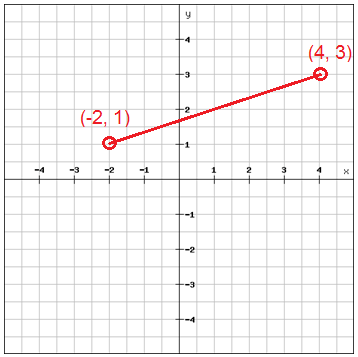
c)
6x2 +6
d)
6x + 6
4.

Simplify the expression.

(4n2 - 8n + 4) - (8n2 + 4n + 1)

a)

-4n2 - 12n + 3

b)

-12n2 - 12n + 5

c)

-4n2 - 4n + 3

d)

-12n2 - 4n + 3

5.
Simplify:
2x ( -2x -3)
a)
-4x - 3
b)
x2 - 3
c)
-4x2 - 6x
d)
-4x - 6
6.
Factor the polynomial. 
x2-4x-32
a)
(x-8)(x+4)
b)
(x-4)(x-32)
c)
(x+3)(x-4)
d)
x+2)(x+5)
7.
Factor completely
10x2 + 15x-5
a)
25(10x3+45x-15)
b)
5(2x3 + 3x2-x)
c)
x(10x3+15x-5)
d)
5(2x2+3x-1)
8.
Factor completely: 
3x2 + 18x +15
Hint: Factor GCF first.
a)
3(x2 + 6x + 5)
b)
(x + 5)(x + 1)
c)
3(x + 5)(x + 1)
d)
Prime
9.
(4x3-5x2+3x)+(-2x3-x2+6x)
a)
2x3-6x2-9x
b)
2x3+6x2+9x
c)
-2x3-6x2+9x
d)
2x3-6x2+9x
10.
(2x + 5y - z) + (-6x - 4y + 7z)
a)
-4x +6y + 6z
b)
4x + y + 6z
c)
-4x - y + 6z
d)
-4x + y + 6z
11.
(3x + 4y - 3z) - (2x - 6y + 7z)
a)
x + 10y - 10z
b)
-x +10y - 10z
c)
x -10y - 10z
d)
-x -10y - 10z
12.
How many terms are in the following polynomial?
3x3 - 2y + 8x -16
a)
1
b)
2
c)
4
d)
-16
13.
Simplify:
a)
9n3 + 4n
b)
7n+ 6
c)
-3n+ 2
d)
7n6 + 6
14.
(7 + 41) ÷ 2 – 15 =
a)
19
b)
9
c)
25
d)
3
15.
18 + (6 – 2) × 2 =
a)
26
b)
29
c)
44
d)
40
16.
15 + 7 × 2 – 11 + 35=
a)
38
b)
251
c)
53
d)
50
17.
What would be my first step? 3 + 4 x 6 - 4 =
a)
addition
b)
multiplication
c)
subtraction
d)
exponents
18.
10 + 45 ÷ 9 -(14 ÷ 2)  = 
a)
9
b)
8
c)
53
d)
18
19.

Find the graph of the standard form equation: 2x - y = 0

a)
b)
c)
d)
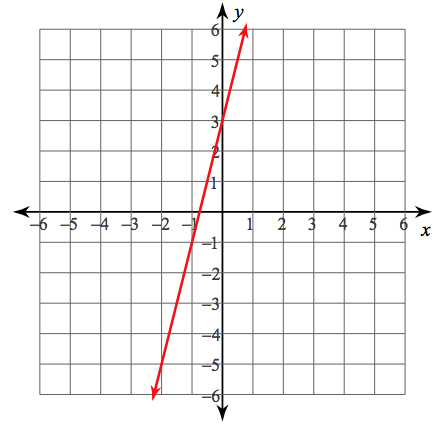
20.
Which equation represents the following graph?
a)
y = 3x + 2
b)
y = -2x + 3
c)
y = 2x + 3
d)
y = -3x + 2
21.
Graph. y = -4
a)
a
b)
b
c)
c
d)
d
22.
Put the equation in slope-intercept form: 
2x + 2y = 6
a)
y = - x + 3
b)
y = x + 3
c)
y = 2x +6
d)
y = - 2x + 6
23.

Write the equation in slope intercept form

x + y = -1

a)

y = x - 1

b)

y = 27, 239, 430

c)

y = -1x

d)

y = -x - 1

24.

Write the equation in slope intercept form.

5x + y = -5

a)

y = -5x - 5

b)

y = ⅕x - 5

c)

x = ⅕

d)

y = 27, 239, 430

25.
Change the following to slope-intercept form:
5x - 5y = 25
a)
y = x - 5
b)
y = 5x - 1
c)
y = -x + 5
d)
y = 5x + 1
26.
Give the equation for the graph
a)
y = 5x - 3
b)
y = 4x + 2
c)
y =-2x + 5
d)
y = - 2x + 4
27.
What is the equation of the line?
a)
y = -3/4x + 3
b)
y = 4/5x + 3
c)
y = -4/5x + 3
d)
y = -4/5x
28.
Which is the graph of y=-x+2?
a)
A
b)
B
c)
C
d)
D
29.

Based on the table, write the equation in slope intercept form.

a)

y= 5x+5

b)

y=1/5x+5

c)

y=15x+5

d)

y=10x+5

30.
Given the table, write the equation in the slope-intercept form.
a)
y = 1/3x + 6
b)
y = 3x + 6
c)
y = 2x + 6
d)
y = 1/2x + 6
31.
What is the solution to this system of equations?
a)
(4, -1)
b)
(-1, 4)
c)
(-4, 1)
d)
(-4, -1)
32.
Solve the system of equations.
x + 2y = -3
x - y = -12
a)
(-9, 3)
b)
(-7 ,5)
c)
(3, 15)
d)
(9, 6)
33.
Does the system have one, none or infinite solutions?
8x + 4y = 12
y = -2x + 3
a)
(0,3)
b)
(3,0)
c)
No solution(parallel lines)
d)
Infinitely many solutions
34.
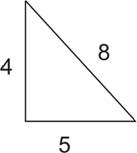
Area of triangle?
a)
17 units2
b)
20 units2
c)
10 units2
d)
16 units2
35.
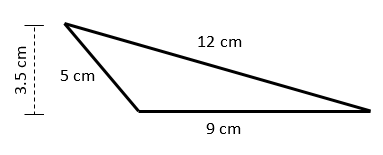
Find the area of the triangle pictured.  
a)
22.5 cm2
b)
45 cm2
c)
15.75 cm2
d)
31.5 cm2
36.
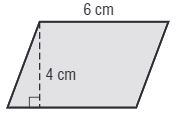
Find the area of the figure.
a)
10 cm2
b)
24 cm2
c)
12 cm2
d)
20 cm2
37.
What is the area of this figure?
a)
52 square centimeters
b)
36 centimeters
c)
57 square centimeters
d)
40 square centimeters
38.
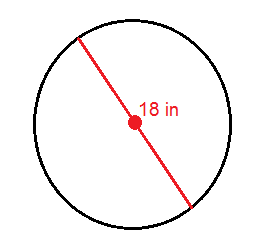
Find the area of the circle
a)
56.52
b)
254.34
c)
1017.36
d)
113.04
39.
Which of the following choices is closest to the area of a circle? (d = 9 cm)
a)
253.34 cm2
b)
63.59 cm2
c)
56.52 cm2
d)
28.26 cm2
40.

Find the midpoint of the line segment with endpoints (-2,0) & (9,-1).

a)

(1, 3)

b)

(3.5, -.5)

c)

(-.5, 3.5)

d)

(6, -.5)

41.
(4, -1) (2, -7)
a)
(0, 5)
b)
(-3, -4)
c)
(3, -4)
42.
(9.3, 9.4)  (8.3, -8.7)
a)
(8.88, 0.35)
b)
(-8, 0.35)
c)
(0, 2)
43.
Find the slope of the line that passes through the points (2, 4) and (6, 12)
a)
1/2
b)
-1/2
c)
2
d)
-2
44.
Find the slope of the line.
a)
1/4
b)
-1/4
c)
-4
d)
4
45.
What is the rate of change?
a)
1/2
b)
2
c)
7
d)
3
46.
What type of slope?
a)
negative
b)
steep
c)
undefined
d)
zero slope
47.

What is the slope of the line between (0,5) and (0,12)?

a)

0

b)

1

c)

-1

d)

undefined

48.

Two lines are perpendicular if and only if

a)

the slopes are the same

b)

the slopes are negatives of each other

c)

the product of the slope is -1

d)

One of the slopes is 0

49.
Find the distance.
a)
7.1
b)
7.8
c)
8.7
d)
8.9
50.
What is the distance between the two points?
a)
6.3
b)
6.5
c)
6.7
d)
16
51.
Find the distance between (-5, -8) and (-1, -16).
a)
8.9
b)
9.8
c)
10.3
d)
11
52.
Find the x and y intercepts
4x - 5y = 40
a)
x intercept is 10 
y intercept is 8
b)
x intercept is 10
y intercept is 20
c)
x intercept is 8
y intercept is 10
d)
x intercept is 10
y intercept is -8
53.
What is the x-intercept shown on the graph?
a)
(2, 0)
b)
(-2, 0)
c)
(0, 3)
d)
(3, 0)
54.
What is the x-intercept of the equation?
y = 3x - 12
a)
x = 3 or (3, 0)
b)
x = 4 or (4, 0)
c)
x = 1 or (1, 0)
d)
x = -12 or (-12, 0)
55.
What is the slope in the equation y=2x + 3?
a)
2
b)
3
c)
5
d)
Cannot be Determined 
56.

Write a linear equation in slope intercept form of a line with a slope of 12 and y intercept of 10

a)

y=12x-10

b)

y=10x+12

c)

y=12x+10

d)

x=10x-12

57.
Write the equation for the line in slope-intercept form.
a)
y= -1x+3
b)
y= 4x+3
c)
y=1/4x+3
d)
y= -4x+3
58.
Write the equation in point-slope form of the line that passes through the given point and has the given slope.
(4, -7); m = -1/4
a)
y + 7 = -1/4(x - 4)
b)
y - 4 = -1/4(x + 7)
c)
y + 7 = 4(x - 4)
d)
y - 7 = -1/4(x - 4)
59.
How long did it take this object to travel 10 m?
a)
0 s
b)
10 s
c)
15 s
d)
20 s
60.
What is happening at C?
a)
Stationary
b)
Accelerating
c)
Fast steady speed; moving away from the starting position
d)
Slower steady speed; moving away from the starting position
61.
What is happening in this graph from point A to B?
a)
The object is accelerating.
b)
The object is not moving.
c)
The object is decelerating.
d)
The object is moving at a constant speed.
62.
A student runs two times around a running path at a local park.  Each lap is 3 km.  The student completes the first lap in 20 minutes.  The student then sits on a bench and rest for 5 minutes before completing the second lap in 25 minutes.  Which graph bests represents the student's motion?
a)
F
b)
G
c)
H
d)
J
63.
The graph shows Ashley riding her bike to Maria's house. 
What was occurring from point B to point C?
a)
She was increasing her speed.
b)
She stopped for 4 minutes
c)
She was decreasing in speed
64.
Which graph shows the object standing still?
a)
A
b)
B
c)
C
d)
D
65.
What is this graph showing?
a)
Constant Speed
b)
Acceleration (speeding up)
c)
Deceleration (slowing down)
d)
No motion
66.
Find the length of the missing side. 
a)
48 in.
b)
52 in.
c)
16 in.
d)
24 in.
67.
Do the segment lengths 15, 12, and 9 form a right triangle?
a)
Yes
b)
No
c)
Maybe
d)
Pythagoras
68.

Does the set of numbers represent a right triangle?

20, 25, 15

a)

Yes

b)

No

69.
Find the length of the missing side. 
a)
25 cm
b)
42 cm
c)
52 cm
d)
48 cm
70.
The Pythagorean Theorem ONLY works on which triangle? 
a)
obtuse
b)
scalene
c)
isosceles
d)
right
71.
At Donald's Donuts the number of donut holes in a bag can vary. Help Donald find the mode.
12,10,10,10,13,12,11,13,10
a)
13
b)
12
c)
11
d)
10
72.
Find the mean of these numbers:
2, 57, 38, 42, 6
a)
29
b)
38
c)
50
d)
145
73.
Find the median of these numbers:
4,2,7,4,3
a)
2
b)
5
c)
7
d)
4
74.
To find the _________ you add up all the numbers and then divide by how many numbers you have.
a)
Mean
b)
Median
c)
Mode
d)
Range
75.
To find the ______ you put all numbers in order from least to greatest and then take the largest number minus the smallest number.
a)
Mean
b)
Median
c)
Mode
d)
Range
76.
Find the Mean of:
8, 14, 32, 6, 15
a)
15
b)
175
c)
75
d)
12
77.
What is the median of:
6, 12, 16, 11, 8, 4, 1, 11, 4
a)
11
b)
6
c)
8
d)
7
78.

Find the median of the box and whisker plot.

a)

58

b)

60

c)

62

d)

64

79.

Find the Quartile 1 of these numbers:

2, 3, 4, 5, 5, 5, 7,

a)

4

b)

6

c)

3

d)

5

80.

Find the Quartile 3 of these numbers:

2, 3, 4, 5, 5, 5, 7,

a)

4

b)

6

c)

3

d)

5

81.

Find the Quartile 1 of the following data set:

2, 3, 4, 5, 5, 5, 7,

a)

4

b)

6

c)

3

d)

5

82.

Find the lower quartile of the following set of scores.

12, 9, 4, 6, 5, 8, 9, 4, 10, 2

a)

10

b)

4

c)

9

d)

6

83.
Given the data: 136, 150, 119, 150, 125, 143.
Find the upper quartile (Q3)
a)
 125
b)
150
c)
139.5
d)
143
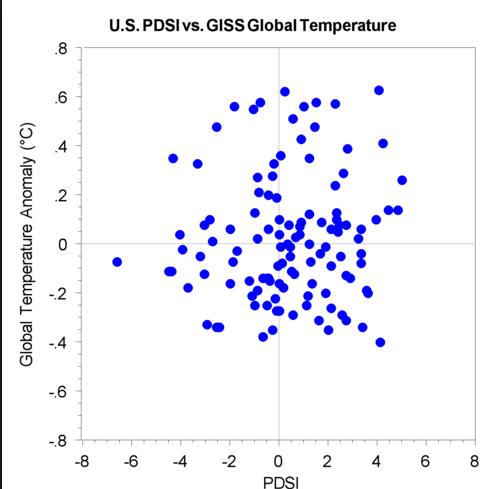
84.
What type of association does this graph have?
a)
positive 
b)
negative
c)
none
d)
all of the above
85.
What is the correlation?
a)
Negative correlation
b)
No correlation
c)
Positive correlation
d)
All of the above
86.
What type of correlation does this graph have?
a)
positive
b)
negative
c)
none
d)
all of the above
87.
What type of association does this scatter plot represent?
a)
positive linear association
b)
negative linear association
c)
no association
d)
nonlinear association
88.
About how many male math teachers were there in 2006?
a)
15
b)
30
c)
35
d)
45