
 Worksheets
Radioactivity
Total questions: 25
Worksheet time: 14mins
The three types of nuclear radiation in order of decreasing penetrating power are
alpha, beta, gamma
alpha, gamma, beta
beta, alpha, gamma
gamma, alpha, beta


An isotope of an element has the same number of _________, but a different number of _________.
Protons, electrons
Protons, neutrons
Electrons, neutrons
Neutrons, protons

Which type of radiation releases an electron?
Alpha radiation
Beta radiation
Gamma radiation
Theta radiation

What particle is released when an unstable isotope undergoes alpha radiation?
a helium nucleus
an electron
a photon of light
a neutron
An alpha particle is made up of
2 protons and 4 neutrons
1 proton and 1 neutron
2 protons and 2 neutrons
4 protons and 2 neutrons
When a substance undergoes beta decay
The atomic number increases by 1
The atomic number decreases by 2
The atomic number does not change

Which type of nuclear decay did Radon-198 go through?
alpha decay
beta decay
gamma decay

What will the values of x and y be?
x=194, y =83
x=194, y =84
x=194, y =85
I don't know. I should probably study this stuff more before the test.
A sample of Radium-228 decays from 100g to 12.5g. How many half lives did it experience?
1
2
3
4
How much of a 250g sample would be left after 5 half lives?
125g
62.5g
31.25g
7.81g
A scientist counts radioactivity as 120 counts per minute. The background count is 10 counts per minute. Which value should be recorded
12 counts per minute
110 counts per minute
130 counts per minute
1200 counts per minute
What stops beta radiation
Paper
Air
Glass
Aluminium 3mm or thicker
After 4 half-lives, 1g of a sample of Krypton-85 is left. What was the original mass of the sample?
16g
32g
0.0625g
4g
Which radiation carries no charge
alpha
beta
gamma
The term given to unstable radioactive atoms.
Parent
Daughter
Half Life
Igneous
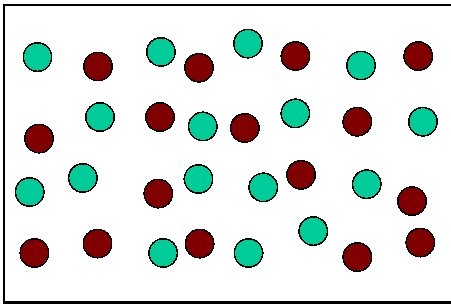
The diagram shows 32 atoms.
16 of the Red are parent isotopes
16 of the Green are daughter isotopes
How many half-lives have occurred?
0
1
2
3
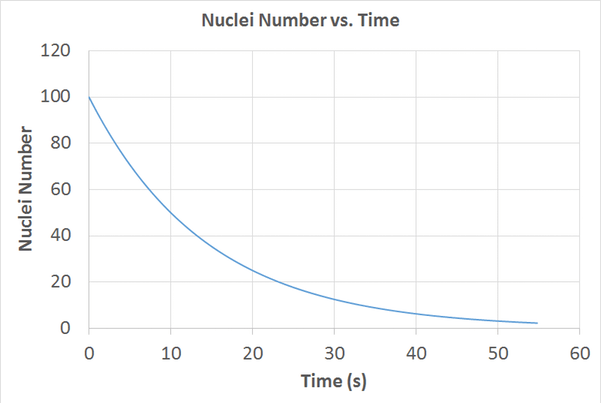
What is the Half life of this isotope?
5 seconds
10 seconds
15 seconds
20 seconds

The Half Life of Californium 252 is 5 years.
TRUE
FALSE
Name the instrument used to detect radioactivity?
Voltmeter
Ohmeter
Geiger counter
Seismograph

