wayground logo

Free Printable Worksheets

NEW

Font size

S
M
L
XL
Worksheets

History of the atom

Total questions: 20

Worksheet time: 1hrs 24mins

Name
Class
Date
1.

Which scientist discovered the electrons?

a)

Dalton

b)

Thomson

c)

Atristotle

d)

Bohr

2.

Bohr discovered that electrons are located in

a)

the nucleus

b)

inside protons

c)

electron cloud

d)

circular orbits around the nucleus

3.

What is a particle with one negative charge called?

a)

electron

b)

proton

c)

quark

d)

neutron

4.

What is a particle with one positive charge called?

a)

proton

b)

electron

c)

neutron

d)

quark

5.

What is the center of an atom called?

a)

nucleus

b)

electron cloud

c)

proton center

d)

photon center

6.
In Dalton's Atomic Theory, all elements consist of __________ that cannot be divided.
a)
Atoms
b)
Parts
c)
Molecules
d)
Hydrogen
7.

Who was the Greek philosopher who called the smallest particle of matter an "atom"?

a)

Democritus

b)

Aristotle

c)

J.J Thompson

d)

Einstein

8.

Which of the following is/are conclusions based on Rutherford’s gold foil experiment?

a)

Atom is mostly empty space

b)

The nucleus is positively charged

c)

The atom has a small dense nucleus

d)

All answers are correct

9.
Rutherford's gold foil experiment provided evidence that...
a)
negative and positive charges are spread evenly throughout the atom.
b)
alpha particles have a positive charge.
c)
gold is not a dense as previously thought.
d)
there is a dense positively charged nucleus at the center of an atom.
10.
J.J. Thomson provided evidence that an atom...
a)
is the smallest particle of matter
b)
contains negatively charged particles
c)
has an overall negative charge
d)
has an overall positive charge
11.

Which of the following is NOT a part of Dalton's atomic theory?

a)

All elements are composed of atoms.

b)

Atoms are always in motion.

c)

Atoms of the same element are always identical.

d)

Atoms that combine do so in simple, whole-number ratios.

e)

atoms cannot be created, destroyed, or divided

12.
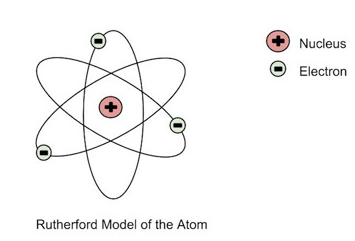
Which model is this?
a)
Thomson Model
b)
Cloud Model
c)
Bohr Model
d)
Rutherford Model
13.
The nucleus is made up of protons and what other particle?
a)
Electrons
b)
Nothing else
c)
Neutrons
d)
Atomic Number
14.
Which of these particles was discovered first?
a)
Protons
b)
Electrons
c)
Neutrons
d)
Quarks
15.
Which scientist saw the atom as a solid sphere?
a)
Dalton
b)
Thomson
c)
Rutherford
d)
Bohr
16.
Where are electrons of an atom found?
a)
Nucleus
b)
Electron Cloud
c)
Some are in the nucleus and some in the electron cloud.
d)
They are moving everywhere.
17.
Who stated that all atoms of the same element are excacty alike?
a)
Democritus
b)
Dalton
c)
Thomson
d)
Borh
18.

Democritus was known for

a)

discovering the electron

b)

discovering the proton

c)

creating the term atom, meaning indivisible

d)

discovering the nucleus

19.

Place the following atomic models in order, from earliest to latest:


A) Rutherford B) Thomson C) Dalton

a)

B, C, A

b)

C, A, B

c)

A, C, B

d)

C, B, A

20.
Ernest Rutherford discovered that the atom was mostly _________________ and has a _______________ charged nucleus.
a)
empty space, positively
b)
empty space, negatively
c)
full of protons, positively
d)
full of neutrons, negatively