
 Worksheets
Plant Transport Test-Grade 9
Total questions: 36
Worksheet time: 37mins
Sieve plates are present in the Sieve tubes of Phloem vessels in plants. What function do they serve in the transport of substances?
(a)
Which of the following does NOT affect rate of transpiration?
Water available in the soil
Temperature of the atmosphere around the plant
Amount of sunlight present
Amount of sucrose produced by the plant
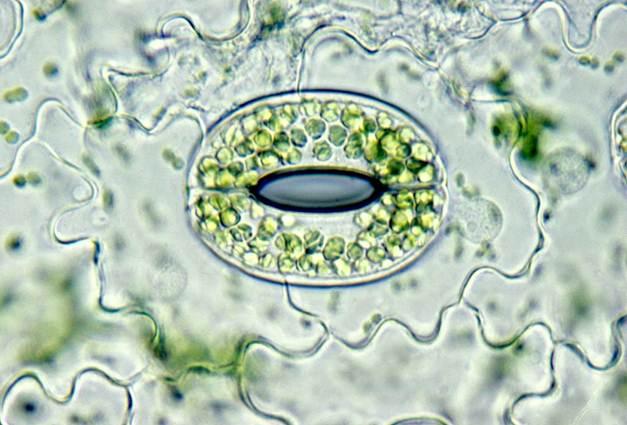
What do the guard cells do?
Control active transport
Control nutrients moving into the cell
Controls the rate of gases entering leaf
Controls the about of sunlight entering the leaves
Phloem sieve tubes are considered living due the presence of this specialized structure. Name the structure in the space provided.
(a)
High concentration of______ in the soil leads to the movement of _______ into the roots hairs of plants by the process of Osmosis.
Solutes, water
Water, solutes
Water, water
Water, ions
Where does sugar transport begin?
Phloem
Leaves
Root hairs
Vascular bundles

Students are instructed to place leafy celery stalks into color water in a beaker overnight. The following day, the students observed the color of the celery leaves changed from green to red. The students cut across the edge of the celery and observed the small tube openings along the edge are also red.
Using the appropriate terms, how do these work together to make the movement of the liquid possible?
(a)
After water enters the plant, water travels from the root hair cells, through the _______ to the xylem vessels.
phloem
cortex cells
mesophyll cells
root hair cells
An example of adhesion is...
Water molecules sticking to each other
Water molecules sticking to the walls of a straw
Magnets sticking to a metal wall
Gravity pulling water down
How do mineral ions enter a plant?
By osmosis with water molecules in root hair cells
By active transport only in root hair cells
Through the stomata in the epidermis of the root
Through the roots by diffusion
The plant transport system are made up of ____ types of tubes.
1
2
3
Many
How do Active transport and Diffusion differ from each other. State ONE difference.
(a)
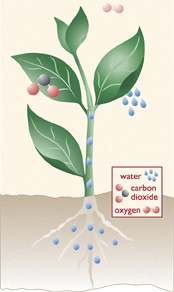
Water vapour exits a plant leaf by
The stomata
The epidermis
The root hair cells
The guard cells
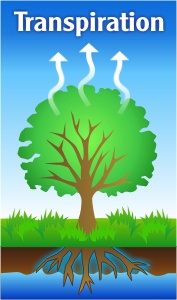
Transpiration is
The movement of water through a plant from the roots up the stem
The loss of water from the leaves of a plant by the process of evaporation
The flow of water into plant roots by osmosis from the soil
The loss of water from the leaves of a plant by the process of condensation
This is the definition for which word: "The movement of particles down a concentration gradient"
Osmosis
Diffusion
Active transport
Transpiration
What happens to the transpiration rate as light intensity increases?
It increases
It stays the same
It decreases
None of the above
Which of the following indicates the pathway of water through a plant?
Root hair cell --> xylem --> cortex --> stomata--> leaves
Cortex -- > stomata --> root hair cell --> xylem --> Mesophyll
Root hair cell --> cortex --> xylem --> leaves --> stomata
Leaves --> xylem --> roots -->cortex -->stomata
Transpiration is important as it ONLY
Pulls water up the stems and into leaves
Cools the plant through the evaporation process
Transports water to leaves for photosynthesis
All of the above
What is the effect of increasing humidity in transpiration?
It decreases transpiration rates
It increases transpiration rates
It doesn't impact the rate of transpiration
It levels the transpiration rate

Stomata are made of specialized cells called ______ which surround a tiny pore/opening
Stoma
Guard cells
Dermal cells
Epidermal cells

The transport vessels wrapped together in a sheath are known as
Vascular bundles
The Phloem tubes
Stomates
Transport system

Remember when you put the celery in the coloured water; What happened to the water by the next day if it was placed in front of a fan?
The water would take20 minutes to travel up the stalk
The water would stop moving up the stalk
The water would take a shorter time to travel up the stalk
The water would take a long time to travel up the stalk

When we added red food coloring to the water, what did that prove?
That capillarity is not at work
That the process of root pressure was at work
That transpiration pull is at work
None of the above
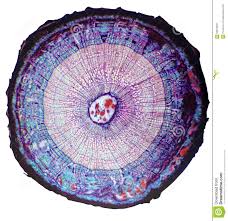
Recall what substance is used to thicken and strengthen xylem walls in woody plants.
Protein
Cellulose
Lignin
Glucose

What is the name of cell on the right of this image?
A xylem cell
A root cell
A phloem cell
A root hair cell

Identify the type of vascular bundles in the diagram above.
Monocot root
Dicot root
Dicot stem
Monocot stem
Why do large multicellular organisms need transport systems while simple unicellular organisms do not?
Large organisms have a much smaller surface area to volume ratio compared to smaller ones.
Unicellular organisms have a much larger surface area to volume ratio than multicellular organisms.
Unicellular organisms have a much smaller surface area to volume ratio than multicellular organisms.
Large organisms have a much larger surface area to volume ratio compared to smaller ones
Roots hair cells contain numerous (a) which are essential in providing energy needed for active transport.
Root pressure is a phenomenon seen in the roots of all plants. Would water be able to move to the xylem if there was an absence of pressure?
Yes, because the process of Osmosis would still occur
No, the water would flow back to the root hair cells
Yes, due to transpiration the water would move to the xylem
None of the above are true

This image shows how materials move into various sized cells in a given amount of time. Why does one square cell have more pink coloring than the others?
The surface area was too larger to get through
The volume of the other cells was too large for the dye to get through
There was not enough surface area for the dye to get through
The volume was too low for the dye to stay in the square

Microvilli, like root hairs on plants, are tiny projections that extend off the cell to increase the Surface Area. What purpose might that serve?
Decreased absorption
Better communication among cells
Increased absorption
Decreased diffusion
Mineral salts in plants are MAINLY transported in the
Cambium
Phloem vessels
Companion cells
Xylem vessels

The question mark represents what structure in the image above?
(a)

The question mark represents what structure in the image above?
(a)

The figure above shows the transport vessels in a flowering plant.
Identify the vessels P and Q in the figure.
(a)

Describe TWO (2) ways in which vessel P is suited for its function.
(a)

