
 Worksheets
Quiz: Macromolecules
Total questions: 15
Worksheet time: 30mins
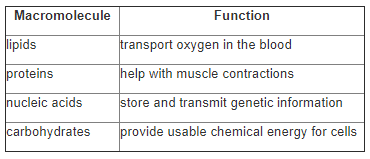
A biology student creates a table that shows the function of the four major macromolecules. For which macromolecule does the student list an incorrect function?
The lipid because they are responsible for long-term energy storage.
The proteins, because they are responsible for helping with chemical reactions within the organelles of the plant.
The carbohydrates because they are responsible for the structure of the cell membrane.
The nucleic acids because they are responsible for transmitting genetic information for the production of proteins within the cell.
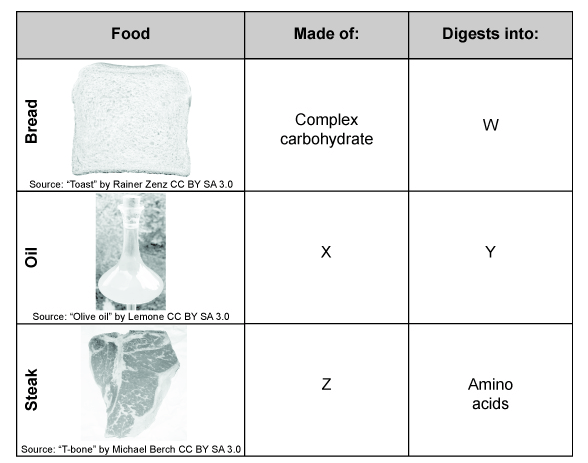
The table below shows three foods, the large molecules they are made of, and the smaller molecules into which they digest. Some information is missing from the table, represented by the letters W, W, Y, and Z. Use the table to answer any questions that follow.
Based on the table, the molecules in the bread are broken down into smaller molecules at W called...
simple sugars.
fatty acids.
polysaccharides.
lipids.
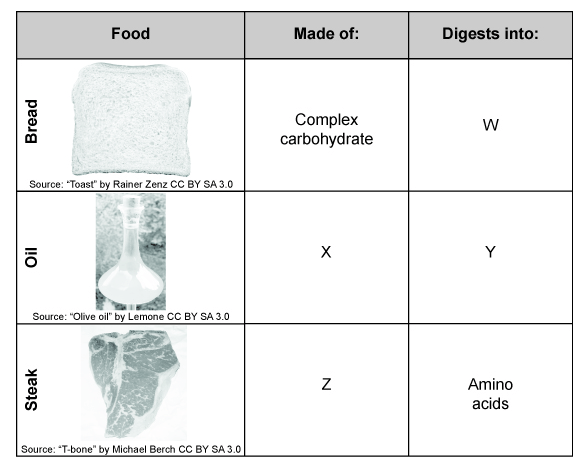
The table below shows three foods, the large molecules they are made of, and the smaller molecules into which they digest. Some information is missing from the table, represented by the letters W, W, Y, and Z. Use the table to answer any questions that follow.
Which of the following is true in the table?
X represents proteins, and Y represents polysaccharides, into which proteins break down.
X represents starches, and Y represents simple sugars, into which starches break down
X represents fats, and Y represents fatty acids, into which fats break down.
X represents proteins, and Y represents starches, into which proteins break down.
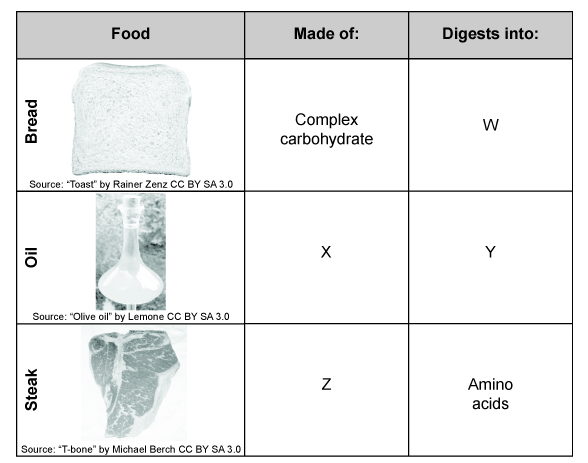
The table below shows three foods, the large molecules they are made of, and the smaller molecules into which they digest. Some information is missing from the table, represented by the letters W, W, Y, and Z. Use the table to answer any questions that follow.
In the table, which letter should be replaced with "Protein"?
W
X
Y
Z
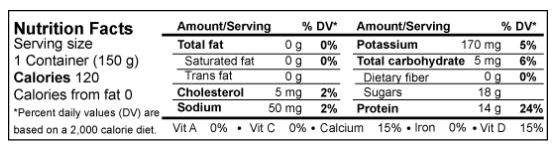
The picture shows the nutritional label for Greek yogurt, a milk-based food product that is high in protein. When a person eats the yogurt, the 14 grams of protein will be...
combined into monosaccharides.
combined into monosaccharides.
broken down into amino acids.
broken down into nucleic acids.
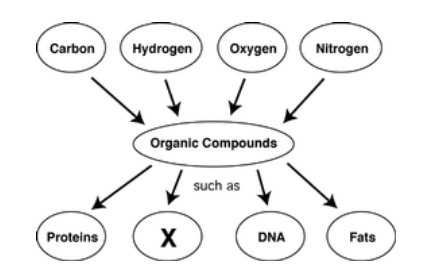
The diagram represents the synthesis of nutrients to form organic compounds. Which of the following substances is most likely represented by the letter X?
carbon dioxide
carbohydrates
ozone
water
Select all of the foods that contain large amounts of carbohydrates.
beans
pasta
potatoes
steak
sugar
Glucose is a simple component of a complex carbohydrate. In this situation, glucose is
a monosaccharide, and the complex carbohydrate could be a polysaccharide.
a polysaccharide, and the complex carbohydrate could be a protein molecule.
an amino acid, and the complex carbohydrate is a fat molecule.
a fatty acid, and the complex carbohydrate is a protein molecule.
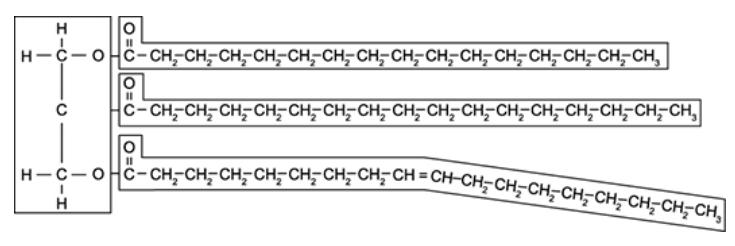
Look at the structure of a substance shown below. What type of macromolecule is depicted?
carbohydrates
lipids
proteins
nucleic acids
What element do the four major groups of organic compounds all have in common?
Nitrogen
Water
Carbon dioxide
Carbon
What are the monomers that make up a DNA polymer?
fatty acids
amino acids
monosaccharides
nucleotides
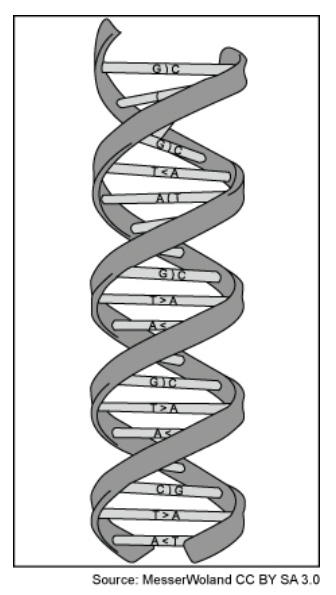
The picture is a major macromolecule known as DNA. What best describes the function of this macromolecule?
It is broken down to provide usable chemical energy.
It stores and transmits genetic information.
It transports oxygen in the blood.
It helps plants retain water.
Both lipids and carbohydrates can be used by the cell as...
replacements for salts.
building blocks for RNA.
sources of energy.
catalysts for metabolic reactions.
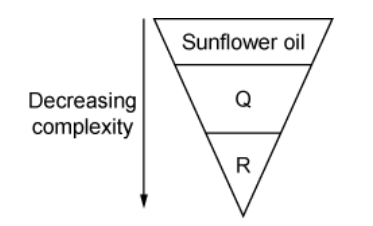
The diagram shows the components of sunflower oil. What are Q and R in this model?
Q represents a fat; R represents fatty acids.
Q represents a protein; R represents amino acids.
Q represents a protein; R represents carbohydrates.
Q represents a carbohydrate; R represents simple sugars.
All enzymes are examples of which type of organic molecule?
carbohydrates
lipids
proteins
nucleic acids

