
 Worksheets
Polynomial Practice
Total questions: 10
Worksheet time: 15mins
7x2 + 4x - 3
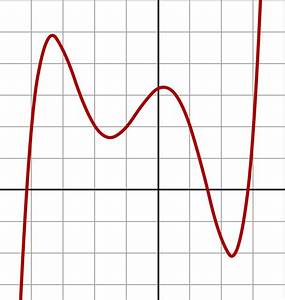
Is the leading coefficient Positive or Negative AND is the degree even or odd?
Negative odd
Positive odd
Negative even
Positive even
What is the y-intercept for the polynomial given by:
y = 3x2 + 9x5 − 4 + 10x8 + 2x9 ?
(0,2)
(0,-4)
(0,9)
(0,3)
What is the leading coefficient for the polynomial given by:
y = 3x2 + 9x5 − 4 + 10x8 + 2x9 ?
2
10
9
3
The degree of the polynomial given by
y = 3x2 + 9x5 − 4 + 10x8 + 2x9 is:
8
9
5
24

Which one of the following could be the polynomial seen in the image?
y = (x + 3)(x + 1)(x − 2)
y = -(x + 3)(x + 1)(x − 2)
y = -(x − 3)(x + 1)(x + 2)
y = (x + 3)(x + 1)(x + 2)
Divide. (2x3 + 7x2 - 6x - 8) ÷ (x+ 4)
Use an area model.
2x2 - x - 2
2x3 - x2 - 2x
2x2 + 15x + 54 + 208/x+4
2x3 + 15x2 + 54x + 208
Given that (a+4) is a factor, factor the polynomial completely.
a3−2a2−15a+36(a−3)(a+3)
(a−3)2
(a+4)(a−3)(a+3)
(a+4)(a−3)2
Given the polynomial in factored form, select all the x-intercepts. Check all that apply.
f(x)=−43x(x+5)2(x−6)(x−1)
(1,0)
(3/4,0)
(6,0)
(0,0)
(-5,0)
Given the polynomial function g(x)=65(x)(x−1)2(x+4) , select the correct end behavior.
As x→−∞, g(x)→∞
As x→∞, g(x)→∞
As x→−∞, g(x)→−∞
As x→∞, g(x)→∞
As x→−∞, g(x)→−∞
As x→∞, g(x)→−∞
As x→−∞, g(x)→∞
As x→∞, g(x)→−∞

