
Font size
 Worksheets
10.2 Wave Theory and Calculations
Total questions: 27
Worksheet time: 2hrs 15mins
What does a wave carry from place to place?
energy
matter
people
A wave that can travel through matter and empty space is a:
electromagnetic wave
longitudinal wavy
transverse wave
Waves that require a material to travel though are called
electromagnetic waves
mechanical waves
ocean waves
transverse waves
I do not know and do not wish to answer.
True or false: Mechanical waves can be transverse or longitudinal?
True
False
The EM spectrum travels as what type of wave?
Transverse
Longitudinal
Sound
S-Waves
Sound is an example of what type of wave?
Transverse
Longitudinal

What kind of wave is this?
electromagnetic
longitudinal
transverse

#1 refers to the
wavelength
amplitude
crest
trough
#2 refers to the
wavelength
amplitude
crest
trough
#3 refers to the
wavelength
amplitude
crest
trough
#4 refers to the
wavelength
amplitude
crest
trough

What is the amplitude of this wave?
3 cm
-3 cm
6 cm
4 cm

What is the wavelength of this wave?
3 cm
10 cm
4 cm
8 cm

This picture is an example of which type of wave?
transverse wave
longitudinal wave
ocean wave
What are properties of electromagnetic waves?
carry energy
can move through space
can move through matter
include x-rays
Which are properties of a mechanical wave?
can be longitudinal or transverse
can move through space
must have matter to move
carries energy
Longitudinal waves have:
crests and troughs
crests and compressions
compressions and rarefactions
troughs and rarefactions
Longitudinal waves move:
at a right angle compared to the direction the wave is traveling
in a circle compared to the direction the wave is traveling
matter
in the same direction as the wave is traveling
The number of waves that pass somewhere in a second is:
amplitude
frequency
wavelength

Which wave has a greater frequency?
A
B
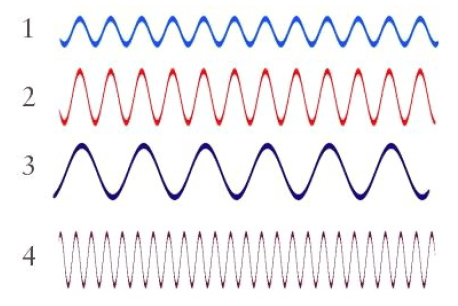


Which shows the EM spectrum in order from longest to shortest wavelength?
Gamma, X-Ray, UV, Visible, IR, Microwaves, Radio
Radio, Microwaves, IR, Visible, UV, X-Ray, Gamma
Visible, UV, X-Ray, Gamma, Radio, Microwaves, IR
Visible, Radio, Microwaves, IR, UV, X-Ray, Gamma
What is the speed of light?
3.0x1081 ms
3.0x10⁸ m/s
6.626x10⁻³⁴ Js
6.626x10⁻³⁴ J/s
What is the correct formula for the velocity of a wave (c) ?
Note:f is the frequency of the wave
λ is the wavelength of the wave
c = fλ
c = λf
c = fλ
c = f2λ2
A wave has frequency of 5 Hz and a speed of 25 m/s. What is the wavelength of the wave?
25 m
125 m
5 m
25 m/s

