wayground logo

Free Printable Worksheets

Font size

S
M
L
XL
Worksheets

Evidence for Evolution

Total questions: 17

Worksheet time: 13mins

Name
Class
Date
1.

The theory of evolution proposes...

a)

All living things share one common ancestor

b)

Humans used to be monkeys

c)

More similar species have a more recent common ancestor

d)

Aliens created dolphins and whales

2.
The most recent ancestral form or species from which two different species evolved is known as ________________________.
a)
a common ancestor.
b)
an embryonic stage.
c)
development.
d)
evolution.
3.
Common ancestry relates to evolution because
a)
evolution only happens when there are common ancestors.
b)
Common ancestors make evolution happen more quickly.
c)
evolution can never take place with common ancestors.
d)
the more two organisms have in common, the more recent is their common ancestor during their evolution.
4.
Relative dating of rock layers tells us that the deeper we dig, 
a)
the younger the rocks get.
b)
the simpler the rocks get.
c)
the harder the rocks get.
d)
the older the rocks get.
5.
The diagram shows fossils in different rock layers. Which of these statements about the age of these fossils is most likely correct?
a)
Fossil A and C are the same age
b)
Fossil B is older than fossil C
c)
Fossils A is older than fossil B
d)
Fossil D is older than fossil C
6.

Scientists find the remains of an animal that has been extinct for a long time. What type of evidence is this?

a)

DNA analysis

b)

Comparative anatomy

c)

Fossil record

d)

Analogous anatomy

7.
What does the theory of continental drift state?
a)
The continents were once joined in a super-continent and have moved over time
b)
Continents are stationary and do not move
c)
The Earth is broken into lithospheric plates that move due to convection currents
d)
none of the above
8.

Which evidence proves that continental drift separated the continents?

a)

The shape of the continents

b)

Similar fossils found on separate continents

c)

All of the above

9.
What is represented by the picture? 
a)
Sea-floor spreading
b)
Pangea
c)
How the continents are arranged today
d)
Volcanoes
10.

_____________________are features present in modern organisms which are no longer in use.

a)

DNA

b)

Vestigial structures

c)

Fossils

d)

Homologous structures

11.

Which of the following is a vestigial structure humans have? (that has no use)

a)

Elbows

b)

Tailbone

c)

Forearm bones

d)

Hair

12.
Two organisms that are closely related would have
a)
very similar DNA sequence
b)
exactly the same DNA sequences
c)
no proteins in common
d)
completely different DNA sequence
13.
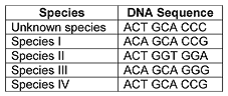
According to this data, the unknown bacterial species is most closely related to: 
a)
Species I
b)
Species II
c)
Species III
d)
Species IV
14.
_____________  is the study of embryos to see how their similarities and differences indicate an evolutionary relationship.
a)
Paleontology
b)
Common ancestry
c)
Homologous structure
d)
Embryology
15.
In stage one (top row) of these embryos, most of the embryos________
a)
look very similar.
b)
have very different features.
c)
show different stages of development.
d)
have only a tail if they are non-human.
16.
In the the third embryonic stage (bottom row), mammal embryos _____
a)
have more characteristics in common with each other than with reptiles or birds.
b)
are still hard to tell from reptiles and birds.
c)
have the same features as fish, reptiles, and birds.
d)
do not have tails.
17.
The more similar the stages of embryonic development, the more likely that organisms share ____________
a)
a common ancestor.
b)
embryos.
c)
eggs.
d)
embryology.