
 Worksheets
Economics - Unit 1 (2026)
Total questions: 35
Worksheet time: 22mins

Economics is the study of ______________
Money
How to get rich
Consequences and Punishments
Choices

The second-best choice that we give up when a decision is made is called the _____.
opportunity cost
producer
profit
scarcity

A combination of vision, skill, ingenuity, and willingness to take risks that is needed to create and run a business. Someone who does this is called a(n) ____.
Entrepreneur
Laborer
Economist
Environmentalist

Which of these is NOT one of the three factors of production?
labor
land
capital
stocks

a graph that shows how much an economy or business can produce between two goods
how much money something costs
a visual explanation of land, labor, and capital
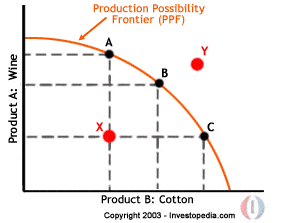


A ____ is the first time a company sells shares of itself to the public to raise capital/money.
IPO (Initial Public Offering)
Bear Market
Bond
Dividend

A ____ market is when the prices of stocks are generally rising.
bear
bull
mermaid
IPO

When you own ____ in a company, you are a shareholder who owns a part of the company.
401k
demand
bonds
stock
Another name for money is _____ and it is needed to build or expand a company. When you make profit off your stock it is also called your _____ gains.
capital
bonds
dividends
brokerage

_____ is the quantity or amount of a product that is available ; _______ is how much of a product or service is desired or wanted.
demand / supply
supply / demand
A financial professional who buys and sells stocks for a client.
IPOer
Which of these is NOT a stock exchange?
NYSE
NASDAQ
S&P 500
Which of these is NOT a stock index (average of stocks)?
NASDAQ
S&P 500
Dow

How many stocks are listed on the Dow?
500
Investors will tell you to mitigate risk by ______ your portfolio.
A stock market strategy that involves borrowing stock, immediately selling it, rebuying it when it drops in price, returning the borrowed stock, and pocketing the difference is called ___.
If you own certain types of stock, you can earn ______ quarterly on profits.
TRUE OR FALSE: Uncertainty and risk are the same thing.

Risk-averse means that you _____.
love taking risks

TRUE OF FALSE: In order to buy and sell stock, you have to hire or work with a stockbroker.
TRUE

The act of putting money away or into something that will earn your future profits is called a(n) _____.
Investing in a stock index will on average get you yearly investment gains of _____.
1-2%
4-5%
10-11%
25-30%

Individuals, businesses, & governments examine the costs and expected benefits of their choices using decision making grids, data analyses, and ratios using a _____.

TRUE OR FALSE: Economic models are theoretical in nature.
TRUE
FALSE

Economists rely on statistics/data and look for _______. They use economic models (simplified representations of complex economic forces) to help explain their findings.
patterns
growth
negative space
coffee

____ examines specific, individual elements in an economy. The elements include: prices, costs, profits, competition, and the behavior of consumers and producers.

____ examines the economic “big picture.” In other words, it is the study of the economy as a whole.
Policy
Studying how a sandwich sub in Union City, PA determines the price of a sub or how a pizza place determines the cost of a large pizza would fall under the study of _____.
microeconomics
macroeconomics
biology
foodology

In Adam Smith's "The Wealth of Nations," he argued that prices in an economy would set themselves based on supply and demand. This idea is called the "__________."
![Humanities Week Quiz [Upper Sec]](https://cf.quizizz.com/image/image-loader.svg)
