wayground logo

Free Printable Worksheets

NEW

Font size

S
M
L
XL
Worksheets

化石Fossils

Total questions: 35

Worksheet time: 31mins
Name
Class
Date
1.

If a scientist found a fish fossil in the desert, what can they infer?

a)

An animal ate the fish.

b)

The water covered the area long ago.

c)

Today's fish looks the same

d)

The fish is endangered.

2.

What statement is true about fossils?

a)

All living organisms leave behind fossils.

b)

Fossils show that camels never change.

c)

Some living things have not really changed in millions of years.

d)

Plant fossils have never changed.

3.

What replaces the wood of a once-living thing to form petrified wood?

a)

amber

b)

cast

c)

mold

d)

minerals

4.

Turtles look much like they did millions of years ago. What can we infer about turtle fossils?

a)

They did not change over time.

b)

The turtle survived the ice age.

c)

Turtles went extinct.

d)

Turtles were never endangered.

5.

What can we infer about animals with dull teeth?

a)

They ate other animals.

b)

They ate only plants.

c)

They ate nothing.

d)

They only ate fish.

6.
Correctly sequence the layers of rocks oldest to youngest 
a)
A,B,C,D
b)
D,C,B,A
7.
Correctly sequence the layers of rocks oldest to youngest 
a)
C,E,D,A,B
b)
C,E,D,A,B
c)
C,E, D,B,A
8.
Correctly sequence the layers of rocks oldest to youngest 
a)
A,D, C, B, E
b)
E, B,C D, A
c)
B,E,C, D, A
9.

Which is NOT a reason scientists study fossils?

a)

They tell us how long a species existed on Earth.

b)

To learn how organisms are related to each other.

c)

How organisms communicated with each other.

d)

Fossils tell scientists the types of environments that organisms lived in.

10.

Which is NOT a way an organism could become a fossil?

a)

It can be frozen in ice.

b)

It can be quickly buried in sediment after death.

c)

It can be trapped in the resin of a tree.

d)

It can be left out in the sun to decompose.

11.

An organism should be buried quickly after it dies if it has a chance of becoming a fossil

a)

True

b)

False

12.

Which is NOT a step in the process an organism goes through to become a fossil?

a)

Layers of sediment build up on the buried body.

b)

A organism dies and is buried quickly.

c)

Minerals fill the spaces of the decaying bone.

d)

An organism becomes extinct.

13.
Where can the oldest layer be found?
a)
The top layer
b)
The middle layer
c)
They are all the same age
d)
The bottom layer
14.
Which layer formed first?
a)
Rock Layer W
b)
Rock Layer X
c)
Rock Layer Y
d)
Rock Layer Z
15.
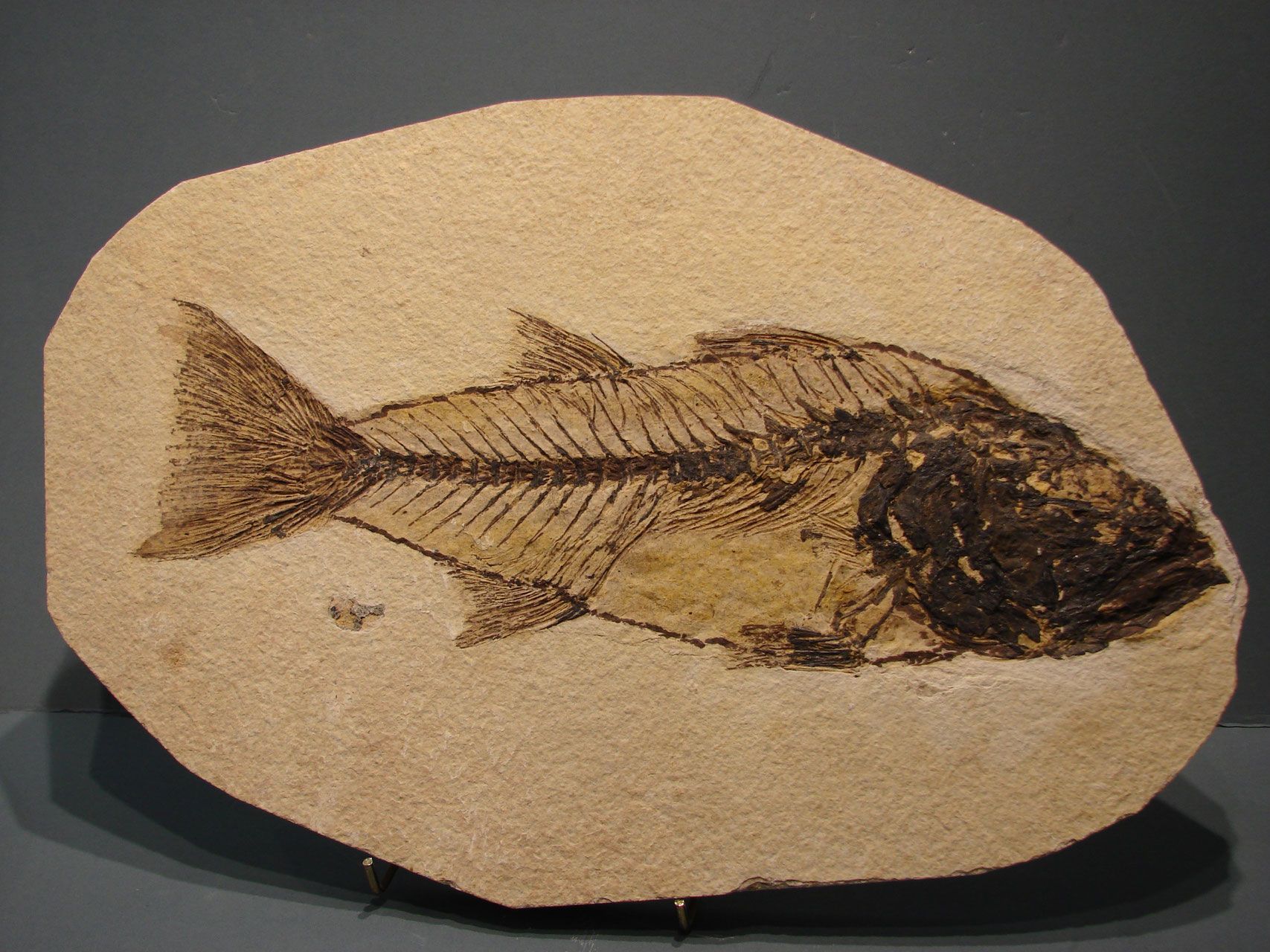
If scientists found this fossil, what could they infer?
a)
what fish are like today
b)
that this fish lacked oxygen
c)
what kind of animal ate this fish
d)
that water once covered the area
16.
What is the correct order of the rock layers from oldest to youngest?
a)
F, E, C, B, A, D
b)
A, B, C, D, E, F
c)
F, E, D, C, B, A
d)
D, F, E, C, B, A
17.
Which area would a shark tooth most likely be found? 
a)
Area A
b)
Area B
c)
Area C
d)
Area D
18.
Look at the fossil above. Where would be the BEST place to find it?
a)
desert
b)
jungle
c)
near the ocean
d)
piedmont
19.
Which animal part would most likely form a fossil?
a)
Muscle 
b)
Fur
c)
Lung
d)
Bone 
20.

Which statement is true?

a)

Layer C is the oldest

b)

Layer B is older than Layer A

c)

Layer B is older than Layer C

d)

Layer A is the youngest

21.

Which type of rock can contain fossils?

a)

Metamorphic

b)

Stereosonic

c)

Sedimentary

d)

Igneous

22.

What conclusions could you make about the environment where this fossil formed?

a)

It was under water.

b)

It might have been a grassland.

c)

It was snowy and cold.

d)

It was a desert.

23.

What is a good rule to follow when determining the age of rock layers?

a)

The oldest is always on the top.

b)

The rock layers get older as you dig deeper.

c)

The layers position does not necessarily tell you about the age.

d)

The youngest is always on the bottom.

24.
Which fossil layer is the youngest
a)
A. Layer A
b)
B. Layer B
c)
C. Layer C
d)
D. Layer D
25.
Look at the diagram, what layer did animal E first show up in?         
a)
Layers #4
b)
Layers #5
c)
Layers #6
d)
Layers #7
26.
Which rock layer contains the newest fossils?
a)
F
b)
E
c)
B
d)
C
27.
Which layer formed first?
a)
Rock Layer W
b)
Rock Layer X
c)
Rock Layer Y
d)
Rock Layer Z
28.
What is the correct order of the rock layers from oldest to youngest?
a)
B, C, D, E, A
b)
A, B, C, D, E
c)
E, D, C, B, A
d)
B, C, D, A, E
29.
What is the correct order of the rock layers from oldest to youngest?
a)
F, E, C, B, A, D
b)
A, B, C, D, E, F
c)
F, E, D, C, B, A
d)
D, F, E, C, B, A
30.
What information can a fossilized plant give scientists?
a)
what color the plants were long ago
b)
what kind of animals existed long ago
c)
what dinosaurs looked like long ago
d)
what environments were like long ago
31.
A family was hiking on a mountain and found several fossils, including a shark tooth and a clam shell.  How has the area changed?
a)
It used to warmer.
b)
It used to be colder.
c)
It used to be an ocean.
d)
It used to be a desert.
32.
Finding warm-weather plant fossils in the layers of a cold northern island suggests that
a)
the fossils are used to  cold
b)
the climate used to be warmer
c)
the area used to be located further south
d)
the people used to eat the plants
33.
What does this fossil of a leaf most likely show?
a)
The plant was eaten by an animal.
b)
The plant lived a long time ago.
c)
The plant died on a rock.
d)
The plant lived on rocky places.
34.
What does this fossil have in common with a living leaf?
a)
It has the same shape.
b)
It has tissue of a real leaf.
c)
It stores energy.
d)
It was dug from the earth.
35.

The illustration shows a fossil of a dinosaur skull. Which of the following best describes why this fossil is not made of bone but rock?

a)

The dinosaur ate many plants that contained minerals.

b)

The dinosaur died when a rock fell on it and crushed it.

c)

The dinosaur skull changed from bone to rock in the ground.

d)

The dinosaur died in the ocean and sank to the bottom.