NEW
Font size
 Worksheets
Evolutionary History and Relationships
Total questions: 15
Worksheet time: 28mins

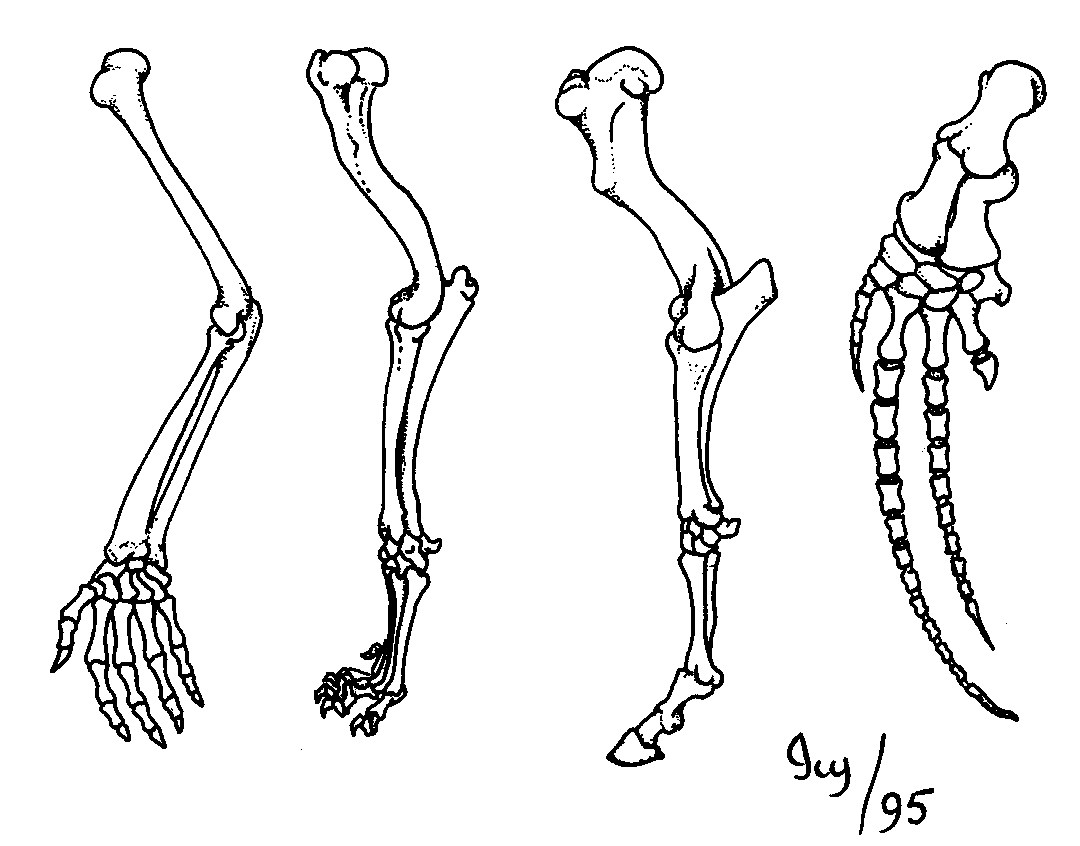
The bones of the forelimbs (wing or arm) of three animals are shown in the illustration. What is the most reasonable conclusion that can be drawn from a comparison of these structures?
Birds and bats are closely related to each other while humans are unrelated to both
The common ancestor of birds and bats must have had wings and flown.
Humans live in habitats very different from the habitats of both birds and bats.
Humans and bats share a closer evolutionary history with each other than with birds.

The diagram provided here is a phylogenetic tree. It shows how groups of organisms are related through a shared evolutionary history. Which of the following provides the best evidence that can be used to create this diagram?
The habitats in which the animals live
Competition between organisms for resources
Similarities and differences in body structures
Observations of interactions in the wild
Whales, which live in the water, have hips. These structures are important for carrying the weight of animals that walk on land. Finding this body part in animals that don’t walk on land is best explained how?
Whales have evolved this structure because it might be useful in the future.
Whales are able to interbreed with other animals that have hips.
Whales have a diet that includes other animals that have this structure.
Whales share a common ancestor with animals that walk on land.

The diagram provided here is a phylogenetic tree. It shows how groups of organisms are related through a shared evolutionary history. The nodes on the diagram show the shared characteristics that link the related groups of animals. Two of the nodes are labeled with the correct characteristics. Which of the nodes should be labeled “body hair”?
Node A
Node B
Node C
Node D

The table shows characteristics of the structures of several related groups of plants. All of these plant types are related in their evolutionary history to a common ancestor that had what characteristic?
A transport system made of xylem and phloem
Seeds that were covered
Leaves with branching veins
Leaves with parallel veins
The diagram provided here is a phylogenetic tree. It shows how groups of organisms are related through a shared evolutionary history. Which of the following provides the best evidence that can be used to create this diagram?
The habitats in which the animals live
Competition between organisms for resources
Similarities and differences in body structures
Observations of interactions in the wild
In a cladogram, when does a group of organisms branch off?
when a new trait evolves
when an ancestor becomes extinct
when it is discovered
then it becomes large enough

What structure separates Perches from Salamanders?
Jaws
Lungs
Claws/Nails
Fur
A homology is something that is similar in all of the following EXCEPT –
Structure
Size
Position
Evolutionary origin
The sequence of heritable changes that occurred among species since the origin of life on Earth
Diversity
Fossil record
Evolutionary history
Anatomy
Similar body parts
ancestor
fossil record
paleontologist
anatomical homologies
When organisms are descended from a single ancestor
cladogram
common ancestry
evolutionary origin
anatomical homologies
Scientist who studies prehistoric life
geologist
biologist
paleontologist
cardiologist

Consider the evolutionary tree. Which is the best description of the two organisms highlighted in pink?
They are separated by two nodes.
They share a recent common ancestor.
They belong to the same species.
They are ancestors of each other.